
Commercial refrigeration and coolrooms in East Gippsland
Coolrooms, freezer rooms and commercial refrigeration for food businesses, farms and cold stores, installed, serviced and repaired from Bairnsdale.
What ABL does in commercial refrigeration
ABL installs, services and repairs refrigeration for food businesses, farms and cold stores across East Gippsland, from Bairnsdale.
Coolrooms and freezer rooms
New and retrofitted modular rooms, chilled, frozen or both, with shelving, strip curtains, lighting and alarms.
Refrigeration repairs
Coolrooms, freezer rooms, display fridges and kitchen refrigeration that have stopped or are running warm.
Planned maintenance
Servicing on a schedule for the equipment your business relies on.
Temperature monitoring
Temperature records and alarms for rooms and cabinets.
Equipment supply
Commercial refrigeration equipment chosen for what it has to do and where it stands.
Ice machines for venues
Sales and repairs of ice machines for hospitality venues.
Coolroom hire
Cold storage for a set time, such as an event or a busy season.
Farm and dairy
Milk vat cooling, bulk milk storage, produce cold rooms and on-farm meat chillers.
Hospitality venues
Refrigeration across cafes, restaurants, hotels and bars, station by station.
Installation, servicing and repairs
From restaurant installations to component-level repairs, our team delivers reliable refrigeration solutions
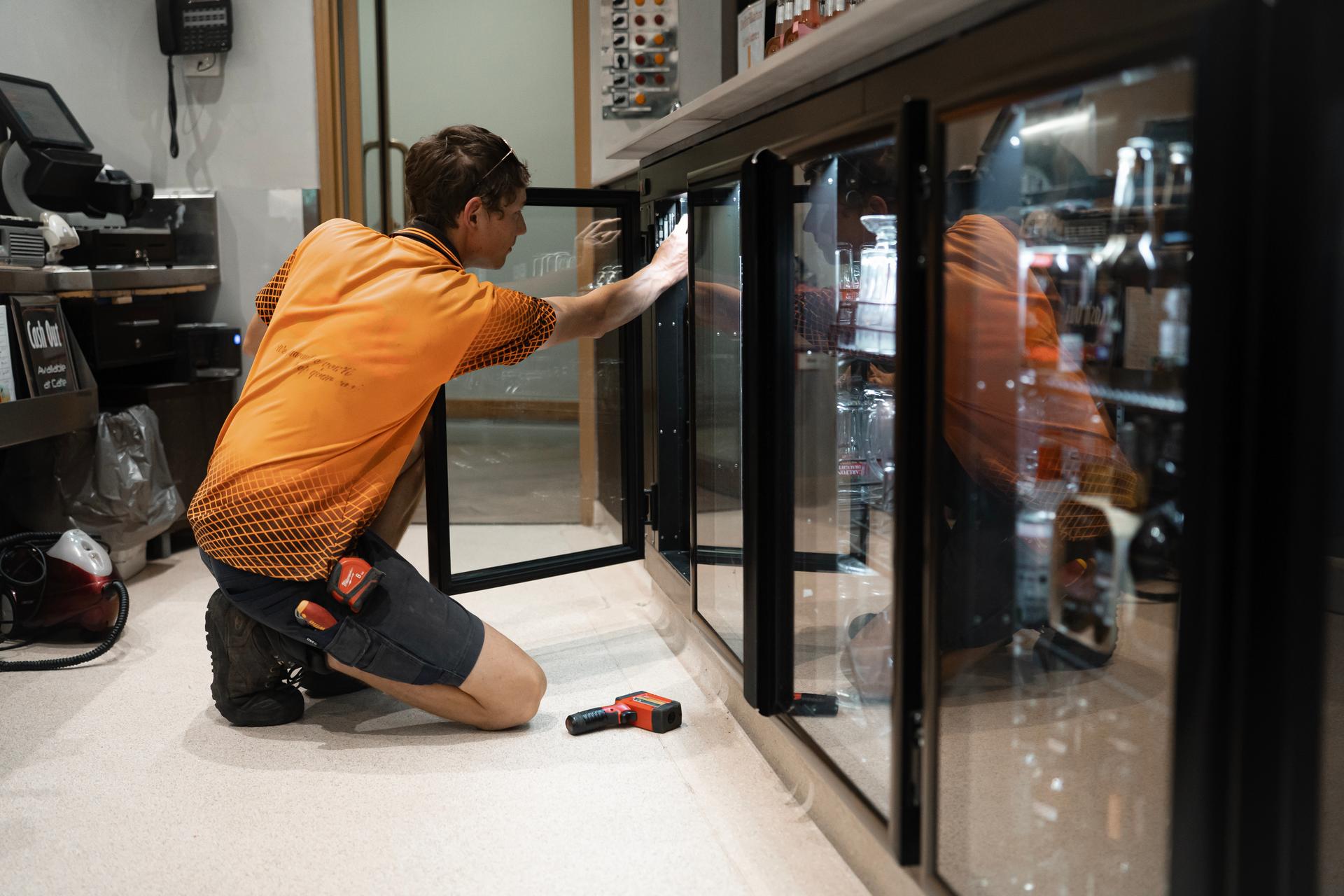
Commercial Refrigeration Installation
Restaurant & hospitality equipment setup
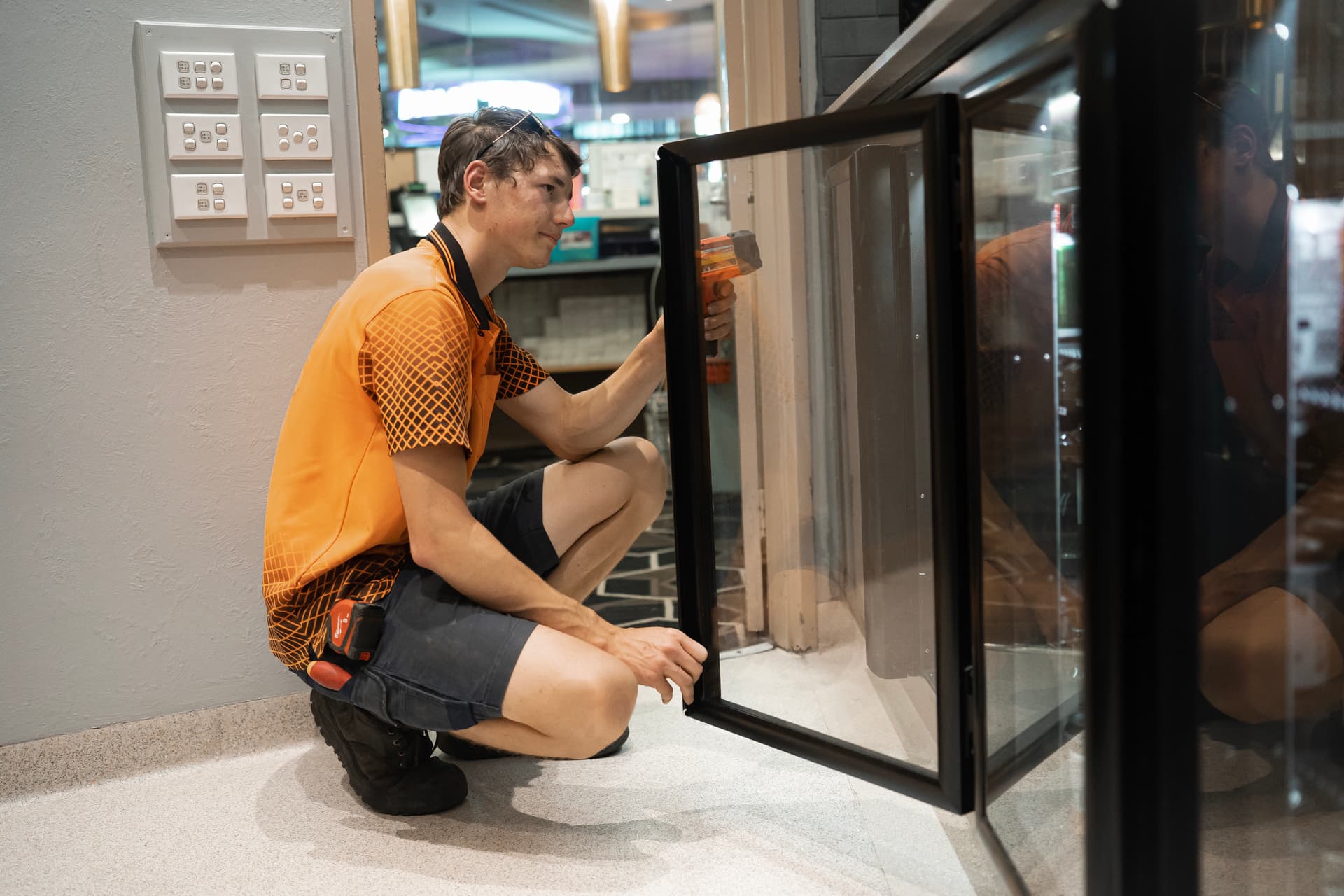
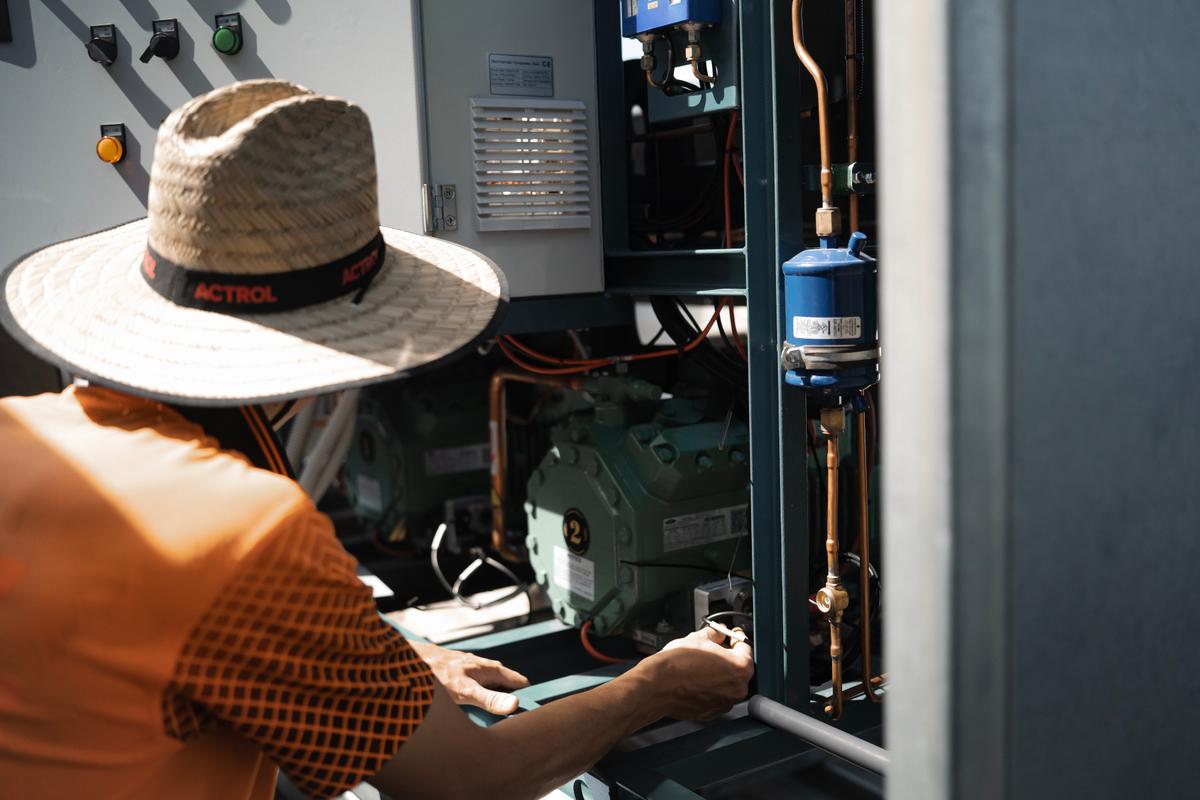
On-Site Service & Repairs
Fast response for commercial clients
Who we work for
Agriculture and farms
Cold storage for produce, dairy and on-farm meat.
Hospitality
Restaurant kitchens, hotels, cafes and bars.
Retail and food stores
Supermarkets, butchers and specialty food stores.
Fishing boats
Ice machines for commercial fishing vessels.
Saltwater flake and freshwater flake or cubed ice machines for commercial vessels are covered on the marine ice machines page.
Warning signs worth a call
These are the usual causes, not a diagnosis. Which one you have is for the technician to find on site.
It is too warm, or the temperature swings
The usual causes are a door left open or a damaged seal, stock blocking the air, a blocked condenser, a coil that has iced over, a failed fan or a faulty sensor, or a refrigerant leak. Note the display reading, the food temperature and the time.
Heavy frost or ice
Usually air leaking in around a door, or a defrost heater, timer or thermostat that has failed or is wrongly set. Note where the frost is and how long it has been building.
It runs all the time
Often a blocked condenser or poor ventilation around the refrigeration unit, and otherwise much the same list as for equipment that runs warm. Note whether the temperature is still holding.
The power bill has climbed
Dirty condenser coils, worn door seals, a refrigerant leak or a failing compressor all make equipment work harder. Planned servicing is the time to find these. Book an efficiency assessment.
For what to do with the stock, and when to turn equipment off, see the refrigeration repairs page.
Coolrooms and freezer rooms
Modular panel rooms
From about 5 cubic metres to more than 100, which can be moved or made bigger later.
Chilled, frozen or both
Coolrooms, freezer rooms, and rooms with a chilled side and a frozen side.
Fitout
Shelving, strip curtains, lighting, and temperature monitoring with alarms.
We handle complete cold room installations including structural assessment, refrigeration design, panel assembly and electrical work. Every system is built to Australian Standards with food-safe materials and reliable components designed for East Gippsland's climate.
Each room is planned around what you store, the site, the power and the drainage. The quote sets out what it includes, from the room and its refrigeration to any fitout.
Farm refrigeration
Produce storage
Controlled atmosphere storage for fruits, vegetables, and cut flowers with humidity control.
Dairy operations
Milk vat cooling, cheese making facilities and bulk milk storage.
Meat processing
Hanging chillers, blast freezers and processing room refrigeration for on-farm butchering.
Farm refrigeration is planned around harvest peaks, milking times and tanker collections, and much of it stands outdoors or in a shed. Our farm storage solutions are rugged, reliable, and designed to handle East Gippsland's environmental challenges from coastal salt to alpine cold.
Your refrigeration and your food safety duties
Refrigeration holds the temperature. Keeping food safe is the food business's duty, under its own procedures.
What the food standards ask
Under Standard 3.2.2, potentially hazardous chilled food is kept at 5°C or colder, unless the business can show another temperature is safe, and frozen food stays frozen. A business that handles potentially hazardous food needs a thermometer accurate to plus or minus 1°C.
Standard 3.2.2A, Food Safety Management Tools, applies to food service, catering and retail businesses that handle unpackaged, potentially hazardous food that is ready to eat. It covers a food safety supervisor and food handler training. A category one business, a caterer or food service business that makes that food ready to eat and serves it, also keeps records that it has managed the food safety risks, such as storage temperatures, unless it can show an authorised officer in another way. Both standards bind the food business.
How equipment and records help
We set and service equipment to hold the temperature your goods need. We install digital temperature monitoring systems with data logging capabilities to maintain compliance records. Alarm systems can alert you via SMS or email if temperatures drift outside safe ranges. Our systems include documented calibration. We provide regular calibration certificates, installation certificates and commissioning documentation for your compliance records.
Every service visit is documented with detailed reports including temperatures recorded, work performed, and parts replaced. We can provide scheduled maintenance contracts to ensure consistent documentation.
In Victoria a cafe, restaurant or shop registers with its local council, and a butcher, seafood business or dairy is licensed by Safe Food Victoria.
Commercial refrigeration questions
Answers to the questions businesses ask before they call
The size comes from your own numbers: what you store, how much of it at your busiest, how it arrives and how often it turns over. Bigger is not safer, because an oversized room costs more to build and to run. We assess your actual needs including peak storage times, delivery schedules, and future growth plans to recommend the right capacity.
As a general guide, as at November 2026, a small walk-in chiller of about 5 cubic metres costs around $8,000 to $12,000, and larger custom rooms from $15,000 to $50,000 or more. Your quote is the price. It depends on the size, the temperature, the refrigeration, the site work and the fitout, and the quote is free. We provide detailed quotes with transparent pricing and financing options available.
A coolroom holds chilled stock, usually designed for 0 to 4°C. A freezer room holds frozen stock and is usually designed for minus 18°C to minus 20°C, which is common practice rather than a figure from the food standards. The federal government's energy guide for refrigeration recommends thicker panels for a freezer room, at least R6 against R4.5 for a coolroom, and a freezer room needs an insulated floor.
It depends on the equipment, how hard it works, where it stands and what a failure would cost you. We agree a schedule for your equipment and its duty.
Under the food standards, potentially hazardous chilled food is kept at 5°C or colder, unless the business can show another temperature is safe, and frozen food stays frozen. The standards give no freezer temperature as a number. Produce varies: broccoli keeps best at 0°C, while beans are best at 7 to 10°C, so tell us everything that will share the room. We install accurate digital temperature monitoring and can set up alarm systems to alert you if temperatures drift outside safe ranges.
Yes, we regularly retrofit coolrooms and freezers into existing buildings. We assess structural suitability, floor loading capacity, electrical supply adequacy, and drainage options. Modular coolroom panels can be assembled inside most buildings with standard ceiling heights. We handle all electrical work and drainage installation to ensure your new refrigeration integrates seamlessly with your existing facility. Any fixed wiring is electrical installation work, which in Victoria requires a licensed electrician.
Absolutely. Commercial refrigeration failure can mean thousands of dollars in spoiled stock. We offer 24/7 emergency service for commercial clients across East Gippsland. Our technicians carry common spare parts and can often repair systems on the first visit. For restaurants, cafes, and food businesses, we prioritize emergency calls to minimize downtime and prevent product loss. Call 0427 967 405 anytime for urgent commercial refrigeration repairs. Tell us what has failed, the temperature it shows, when it started, and the brand and model.
No. These are two separate rules. The HFC phase-down limits imports of bulk HFC gas, and equipment already in Australia is not affected. R22 is an older gas, an HCFC, with its own phase-out: equipment that runs on R22 can still be serviced with it, but from 1 January 2030 R22 imports are banned entirely, and spare parts may get harder to find. We can also service and maintain systems using older refrigerants while recommending upgrade paths. Work that involves handling a scheduled refrigerant, such as an HFC or R22, or a part of the equipment that could release one, needs a refrigerant handling licence. All our technicians are ARCtick certified refrigerant handlers. The official fact sheets and the licence check are linked below these questions.
Official guidance on refrigerants: the Australian Refrigeration Council's fact sheets on R22 gas and equipment and on HFC gas and equipment, both July 2026. To check a technician's refrigerant handling licence, use Look for the tick.
Talk to ABL about your refrigeration
Get a quote for a new room or new equipment, or call the emergency line for a breakdown.