
Split system leaking water inside: what to do and what to record
Why a split system leaks water inside, what to do first, what you can safely check, and a leak report to fill in for the technician.
Last updated
A split system that leaks water inside usually has a drain that is blocked, bent or disconnected, dirty filters, or a dirty coil that has iced up and is melting. Once the unit is off, record where the water shows, when it started, and what the unit and the weather were doing. A technician needs those to find which cause it is.
How to use this guide
Step 2: Fill in the leak report
Where, when, how much and what changed. Fill in what you can.
Go to the record
Where is the water showing?
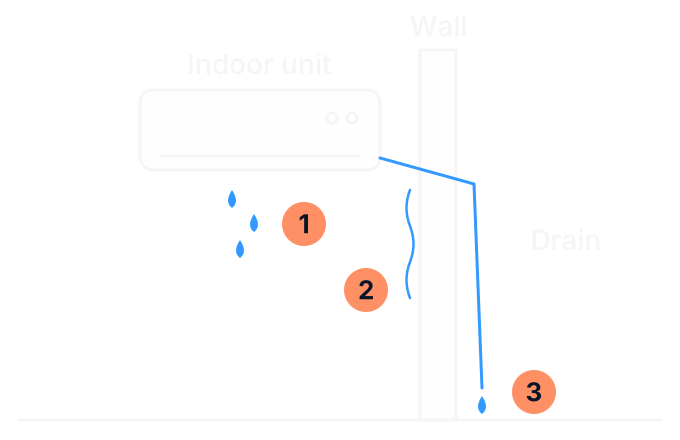
Look in three places. You do not need to touch the unit or move anything to do it.
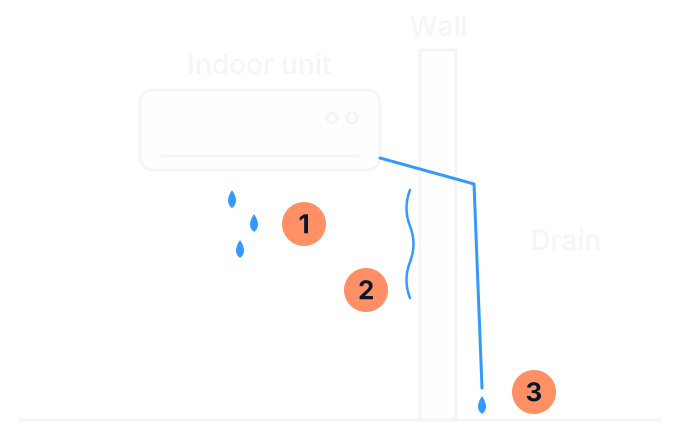
- Under the indoor unit: drips from the front, the ends or the back edge.
- The wall below and beside it: a wet streak or a damp patch, along the way the pipes run to the outside.
- The end of the drain outside: whether water is coming out of it while the unit runs.
| What you see | What to write down |
|---|---|
| Drips from the indoor unit | Which part of the unit they fall from, how fast, and whether they stop when the unit is off. |
| A wet wall or a damp patch | Where it is in relation to the unit, how big it is, and whether it follows a line down or across the wall. |
| Water, or no water, at the drain outside | Whether the drain was dripping while the unit ran. If you cannot find where it ends, write that down. |
| Water you cannot place | Where it pools, and where the nearest part of the system is. A photo helps. |
Why is my split system leaking water inside?
Moisture in the air condenses on the cold coil inside the indoor unit, the way it does on a cold drink, and normally runs out through a drain pipe to the outside. So water dripping from the end of the drain outside is normal in cooling. Water inside means some of it is not getting out that way, even if the drain outside still drips. The usual causes:
| Possible cause | Who deals with it |
|---|---|
| A drain that is blocked, kinked or bent | A technician. |
| A drain line that has come apart | A technician. |
| Dirty air filters | You, the way your manual shows. |
| A dirty coil, which can ice up and overflow as it melts | A technician. The coil is inside the unit. |
| A drain pump that has stopped, on a system that has one | A technician. |
| The way the unit or its drain was installed | The installer or a technician. |
| A refrigerant leak | A licensed technician. |
The water does not tell you which of these it is. Where it shows, and whether the drain outside was dripping, narrows it down for the person who comes.
What can I check, and what should I leave alone?
| Check | What to do |
|---|---|
| The end of the drain outside | See whether water is coming out of the drain outside. Write down what you saw while the unit was running. |
| The air filters | A dirty filter can make condensation form and drip from the air outlet. With the unit off, clean the filters the way your manual shows. How often depends on use: as often as every two weeks in a busy season, and a couple of times a year at the least. Check the manual for your model. |
Leave the rest. Do not open the unit, push anything into the drain or spray a cleaning product inside it. Shop-bought cleaning sprays can harm the parts inside an air conditioner and, in the worst case, cause leaks. Chemical drain cleaners can damage the drain pipe.
What else should I write down about the leak?
Record the conditions and the history. You are not working out the cause, so write down what happened even if it seems unrelated:
- the weather: humid, raining, or hot and dry
- the mode the unit was in, and how long it had been running
- whether this is the first time, or it has happened before
- any recent work: a service, a clean, a new installation, building work, or anything moved near either unit
- when the filters were last cleaned
What if the water is at a ducted ceiling outlet?
Treat water at a ceiling outlet, or a stain on the ceiling near one, the same way: turn the system off and arrange an assessment. Do not go into the roof space to look. Write down:
- which room and which outlet
- whether it drips or only stains, and how big the mark is
- whether it has rained, and whether the system was running when the water appeared
- whether any other outlet or ceiling shows the same
Take a photo of the mark with something beside it for scale, so a second photo shows whether it has grown.
Leak report for your technician
What will a technician usually do?
We work back from where the water shows. A visit usually covers:
- the drain path from the unit to the outside. A blocked drain can be cleared by suction, which is gentle on the pipe
- the filters, the coil and the drainage, cleaned where they need it
- how the unit and its drain sit, since the installation is one of the causes
- the refrigerant charge, where the signs point to it. If it is low, the code of practice has the system tested for leaks, and any leak repaired, before refrigerant is added
What a visit costs depends on what is wrong: the distance travelled, the parts and the time on site all add to it.
How urgent is a water leak from a split system?
| What you see | What to do |
|---|---|
| Water near a power point, a light fitting or anything electrical | Turn the unit off now and call. Water pooling in a unit can damage its electrics. |
| Water dripping or running inside | Stop using the unit until it has been assessed. The water can damage floors, walls and furnishings, and water that leaks and pools is a safety risk. |
| A stain or a damp patch, with the unit now off | Book an assessment, and photograph the mark so you can tell whether it grows. |
| Water dripping from the end of the drain outside, and none inside | Nothing. That is where the water is meant to go in cooling. |
Why a leak needs an assessment
A leak tells you that water is not getting out the way it should. It does not tell you why. The refrigerant handling code of practice (opens in a new tab) (2025 edition) advises owners that a unit that is not working properly should be seen by a competent service technician as soon as the problem appears. If you also see ice on the indoor unit, see the guide to ice on an air conditioner indoor unit.
We repair and service air conditioners for homes and businesses in Bairnsdale and East Gippsland. Our air conditioning repairs page explains how to book.
Sources (7)
Checked on 17 November 2026
- Daikin: troubleshooting for split and multi-split air conditioners (opens in a new tab)
- CHOICE: how to fix and maintain your own air conditioner (opens in a new tab)
- CHOICE: how to clean your air conditioner (opens in a new tab)
- Hitachi Cooling and Heating Australia: how to avoid smells in your air conditioner (opens in a new tab)
- Mitsubishi Electric Australia: how to clean your air conditioner filter (opens in a new tab)
- Australia and New Zealand refrigerant handling code of practice, part 2, 2025 edition (opens in a new tab)
- ABL Refrigeration: air conditioning services (opens in a new tab) ABL's own page.
Related pages
- Ice on an air conditioner indoor unit: what to record before you call
For ice on the indoor unit, which can drip as it melts.
- A musty smell when the air conditioner starts: what to note before you call
For a damp or musty smell from the same unit.
- Air conditioner burning smell or tripping breaker: what to do
What to do if the power trips or you smell burning.
Want a technician to look at it?
Call ABL or send an enquiry. Have your notes ready: the brand, the model and what the unit is doing.
Filled in the record? Copy or print it first: it is not sent with a call or an enquiry.