
Does a split system need regassing? What a leak repair involves
Why a sealed split system should not run low, what a low charge means, the order of a proper leak repair, and the questions to ask before you agree to it.
Last updated
No. A split system moves the same refrigerant round a sealed loop, and the refrigerant is not used up as the system runs, so a system that was installed correctly should not need regassing. If it is low, refrigerant has leaked out, or the system has been short of it since it was installed. The fix is to find the leak, repair it, test that the system holds, and only then charge it with the right amount.
How to use this guide
Why should a split system not need regassing?
Refrigerant is the fluid that carries heat. In cooling it takes heat out of the room at the indoor unit, gives it off outside at the outdoor unit, and comes back to do it again. In heating the process runs the other way. The refrigerant is not used up and does not go stale on the way round, so a sealed system keeps the charge it was given.
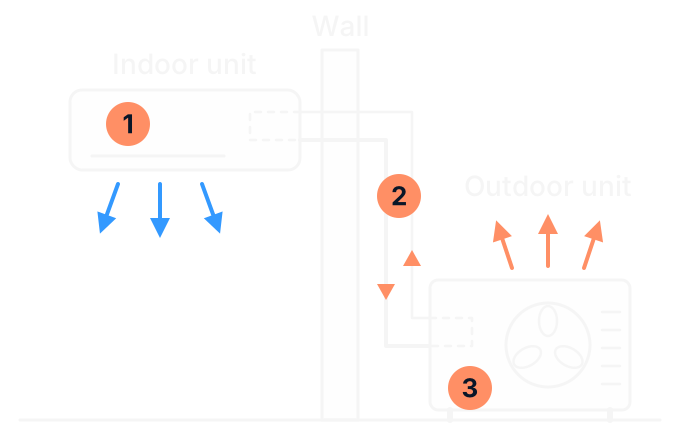
- The indoor unit. Its coil takes heat out of the room.
- The pair of pipes that joins the two units. Each pipe is joined to each unit at a connection.
- The outdoor unit. Its compressor drives the refrigerant round the loop, and its coil gives the heat off outside.
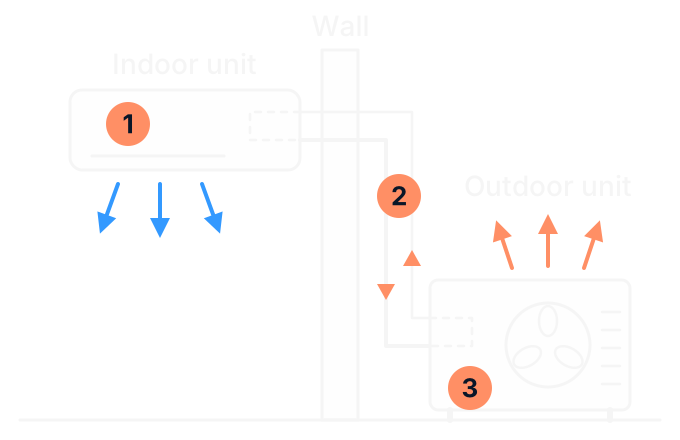
So why do some systems run low?
- A leak at a joint. The usual place is a connection between a pipe and a unit that was not made or tightened properly when the system went in.
- A leak in a part. A pipe, a coil or another part that holds refrigerant can be damaged or fail over the years.
- A short charge from the start. Where the pipes between the units are long, the installer adds refrigerant at installation. A system that missed out has been short of refrigerant from the day it went in.
Either way, the cause is something to find and fix.
Is it low refrigerant, or something else?
A system short of refrigerant usually shows it by cooling or heating less well than it did, and sometimes by ice on the indoor unit. Each of those has other usual causes, and some of them you can deal with yourself. A symptom tells you something is wrong. It does not tell you the refrigerant is low: only a technician's test shows that.
| What you notice | Other usual causes | Where to start |
|---|---|---|
| It does not cool or heat as well as it did | A dirty filter, the mode or temperature set on the remote, furniture or other things blocking the air, doors and windows open, or a failing part. | The guide to an air conditioner not cooling or heating has the checks you can make. |
| Ice on the indoor unit | Dirty filters, a dirty fan or a dirty coil. | Turn it off and see the guide to ice on the indoor unit. |
| It runs longer and the power bill has gone up | Dirty filters, longer hours, or a system that does not suit the room. A system short of refrigerant also works harder for the same result. | The guide to filter cleaning and a professional service covers the filters. |
| Frost on the outdoor unit in heating | Normal on a reverse cycle system in heating when it is cold and damp outside. The unit stops now and then to melt it off. | See the guide to frost on the outdoor unit in winter. |
| A sound like water flowing inside the unit | Usually the refrigerant moving round the system, which is normal. | Nothing, unless it comes with poor cooling or heating. |
What does a proper refrigerant repair involve?
When we suspect a system is short of refrigerant, we work in this order. The first two steps and the last are ordinary practice. The steps in between follow the refrigerant handling code of practice (opens in a new tab) (2025 edition), which licensed technicians are required by law to follow.
- We rule out the simple causes first: the filters, the settings and anything blocking the air.
- We look at how the system is running, to see whether it is likely to be short of refrigerant.
- We recover the refrigerant left in the system into a cylinder, so none of it is released, and test the whole system for leaks. The code requires a leak test whenever a leak or a low charge is known or suspected, and the first leak found may not be the only one.
- We repair every leak we find, then test again to show that the repair holds.
- We pump the air and moisture out of the system before any new refrigerant goes in.
- We charge the system with the right amount of the refrigerant it was designed for, and record what went in.
- We check that it cools and heats as it should.
Is it legal to top up a split system?
Not before the leaks are dealt with. The Australian Refrigeration Council (opens in a new tab) says topping up a system before it has been fully tested and all identified leaks repaired is illegal, whoever does it, and the code of practice says a technician cannot do other work on leaking equipment without repairing the leak. That is as at November 2026.
So a regas is not a maintenance item.
Who is allowed to do the work?
The council says all servicing and repairs of a home air conditioner must be done by a technician with a full refrigeration and air conditioning licence (opens in a new tab). The restricted split system licence (opens in a new tab) covers installing and decommissioning single-head split systems under 18 kW, and not service or repair work that involves the refrigerant. You can check a technician's licence at Look for the tick (opens in a new tab).
The refrigerant matters too. As at November 2026, the Australian Refrigeration Council says a system must not be charged (opens in a new tab) with a refrigerant that has a higher global warming potential than the one it was designed to use. Systems designed for R22 are exempt. The label on the unit says which refrigerant that is.
What affects the cost of a leak repair?
A leak repair is priced on what the technician finds, so ask for the price after the diagnosis. These change it:
- The time it takes to find the leak. The whole system is checked, and a small leak can take longer to find than a large one.
- Where the leak is. Redoing a joint at a connection is a smaller job than replacing a coil or another part.
- The kind and amount of refrigerant. A long pipe run holds more. For an older system, the Australian Refrigeration Council (opens in a new tab) says the price of R22 may rise depending on demand and availability.
- Access. An outdoor unit on a roof, or pipes inside a wall or ceiling, take longer to reach.
If the leak is in a part that costs a lot to replace, or the system is near the end of its life, that is the point to weigh the repair against a new system: see the guide to repair or replace.
What should make you ask more questions about a quote?
These are the signs that a quote is not dealing with the cause:
- a price for refrigerant alone, with no leak test and no repair
- a system that has had refrigerant before and is low again, which usually means the leak was not found or not repaired
- refrigerant described as going stale, or as something that needs topping up every so often
- no clear answer about which refrigerant will go in, or, unless your system runs on R22, a different one from the one on the label with no reason given in writing
- no refrigerant trading authorisation number on the quote: the code of practice says authorisation holders must put their permit number on quotes and invoices
Ask for the answers in writing. The sheet below puts the questions in order, and works for a quote from us or from anyone else.
Refrigerant quote question sheet
What about older R22 systems and car air conditioning?
An older system that runs on R22 can still be serviced with it, but the Australian Refrigeration Council (opens in a new tab) says imports of R22 end entirely on 1 January 2030, after which servicing relies on recycled or reclaimed gas. That is as at November 2026. So a leak on an R22 system is a good time to weigh a repair against a new system, with the guide to repair or replace.
Car air conditioning is a separate trade, with its own licence and its own code of practice, and this guide is about the systems in homes and businesses. The rule on leaks (opens in a new tab) is the same: a leak is repaired before the system is refilled.
How urgent is it?
Book a visit rather than living with it. The code of practice advises owners to have a unit that is not working properly seen by a technician as soon as the problem appears, so that any leak stays small. If there is ice on the indoor unit, turn the system off until it has been seen.
Check the label for the refrigerant your system uses. The manual for one R32 system (opens in a new tab) says that if a refrigerant leak is suspected, all naked flames are to be removed or put out and a service technician consulted. Follow what your own manual says.
Who to call
ABL repairs and services air conditioners for homes and businesses in Bairnsdale and East Gippsland. If you think your system is low on refrigerant, our air conditioning repairs page explains how to book a repair visit. Have your question sheet with you when you call.
Sources (16)
Checked on 20 November 2026
- Australia and New Zealand refrigerant handling code of practice, part 2, 2025 edition (opens in a new tab)
- Australian Refrigeration Council: fact sheet 13, who can do what with split system air conditioners (July 2026) (opens in a new tab)
- Australian Refrigeration Council: fact sheet 26, R22 gas and equipment (July 2026) (opens in a new tab)
- Australian Refrigeration Council: prohibited charging (opens in a new tab)
- Australian Refrigeration Council: licence types (opens in a new tab)
- Australian Refrigeration Council, Look for the tick: home air conditioners (opens in a new tab)
- Australian Refrigeration Council, Look for the tick: car air conditioners (opens in a new tab)
- Look for the tick: about the tick (opens in a new tab)
- Daikin Australia: does an air conditioner ever need re-gassing? (opens in a new tab)
- Daikin Australia: how does an air conditioner work? (opens in a new tab)
- Daikin: air conditioner troubleshooting (opens in a new tab)
- Fujitsu General: does an air conditioner ever need to be recharged with gas? (opens in a new tab)
- Mitsubishi Electric Singapore: frequently asked questions 18, 24 and 34 (opens in a new tab)
- Panasonic: operating instructions, CS-RE9JKR and CS-RE12JKR (F566894) (opens in a new tab)
- Fujitsu: operation manual for an R32 system, ASTH18KNTA and ASTH22KNTA (part 9368092009-01) (opens in a new tab)
- ABL Refrigeration: air conditioning services (opens in a new tab) ABL's own page.
Related pages
- Air conditioning repairs in Bairnsdale and East Gippsland
How to book a repair visit and what to have ready.
- Air conditioner not cooling or heating: what to check before you call
The checks to make before you suspect the refrigerant.
- Repair or replace an air conditioner: how to compare the two quotes
When a leak repair is worth it, and when a new system is.
Think your system is low on refrigerant?
Call ABL or send an enquiry. Tell us what the system is doing, and anything you have been told about its refrigerant.
Filled in the record? Copy or print it first: it is not sent with a call or an enquiry.