
Air conditioner not cooling or heating: what to check before you call
Why an air conditioner runs but does not cool or heat, what to check from the outside, how urgent it is, and a service-call record to fill in.
Last updated
If your air conditioner is running but the room is not getting cooler or warmer, check five things from the outside: the mode and set temperature, the fan speed and louvres, anything blocking the indoor unit, open windows and doors, and any exhaust fan that is running.
How to use this guide
Step 2: Write it down
Note what you find, with the brand and model. Fill in what you can and leave the rest blank.
Go to the record
What to check when an air conditioner is not cooling or heating
None of these checks involves opening the unit beyond what your manual shows for the filters, touching wiring or resetting anything. They are the things we ask about first when you call.
| Look at | Check, then write down |
|---|---|
| Mode on the controller | Check it is set to the mode you want, such as cool or heat. Write down the mode it was in when you noticed the problem. |
| Set temperature | Check the temperature is set where you expect. Write down the set temperature, and the room temperature if you have a thermometer. |
| Fan speed and louvre direction | Look at what the fan speed is set to and where the louvres are pointing. Write down both, and whether the airflow feels strong, normal or weak. |
| Under and beside the indoor unit | Check that furniture, curtains or other objects are not blocking it. Write down anything you moved, and whether it helped. |
| Windows and doors | Check they are closed in the room you are cooling or heating. Write down which ones were open. |
| Ventilation and exhaust fans | Check whether one is running in or near the room. Write down which fans were on. |
| Filters | Clean them the way your manual shows. How often depends on use: as often as every two weeks in a busy season, and a couple of times a year at the least. Write down when the filters were last cleaned. |
| The remote controller | Check that its display is clear and that the unit answers it. A faint display or erratic operation can mean the batteries need replacing. Write down whether new batteries changed anything. |
| The outdoor unit | From a step back, look at whether the fan turns while the system runs, and whether there is ice, frost or water on or under the unit. Write down what you saw, and the weather at the time. |
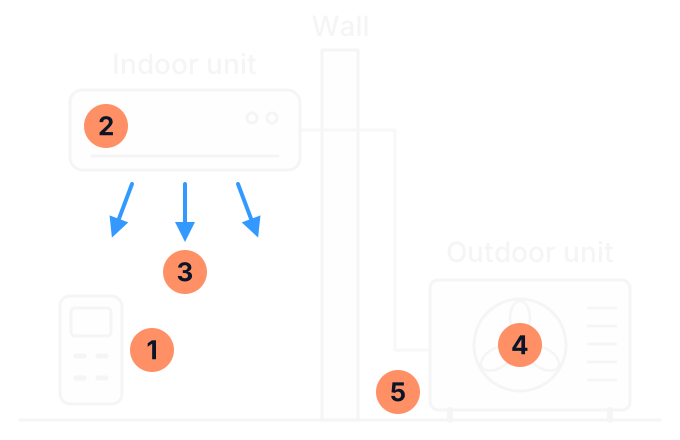
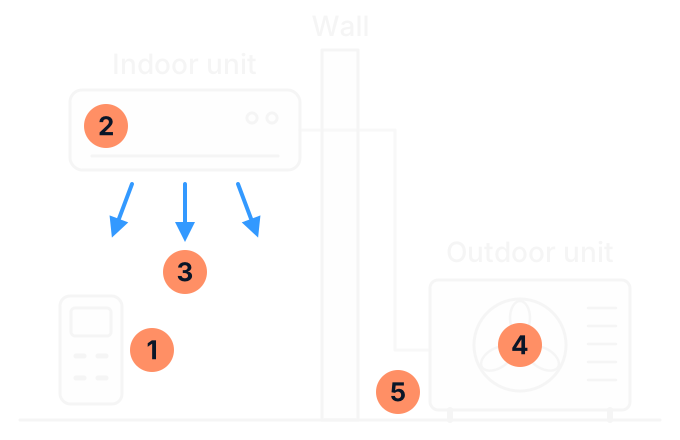
- Controller: the mode, the set temperature and the fan setting.
- Indoor unit: any lights or codes, and any water dripping.
- Air at the louvre: how strong it is, how it feels, and anything blocking it.
- Outdoor fan: whether it turns while the system runs.
- Around the outdoor unit: ice, frost, water, or anything stacked against it.
Why is my air conditioner running but not cooling?
Some causes are yours to fix from the outside, and some need a technician:
| Possible cause | Who deals with it |
|---|---|
| The wrong mode or set temperature | You, at the controller. |
| Dirty air filters | You, the way your manual shows. |
| Blocked air at the indoor or outdoor unit | You, for furniture, curtains, plants or things stacked against a unit. |
| Heat getting in: open windows and doors, sun on north or west windows, little insulation | You, for doors, windows and shading. |
| A day hotter or colder than the system was designed for, or a unit too small for the room | A site assessment. |
| Low refrigerant | A licensed technician, who tests for leaks before any refrigerant is added. |
| A worn or failed part, such as the compressor or the fan controls | A technician. |
The checks above cover the first four. If they are all in order and the room still does not cool, what is left needs someone on site.
How urgent is an air conditioner that is not cooling?
| What you notice | What to do |
|---|---|
| A burning smell, a breaker or safety switch that trips, or water leaking inside | Stop using it now and call. The warning at the top of this page applies. |
| Ice on the indoor unit, or a harsh new noise | Turn it off and call. See the guides to ice on an air conditioner indoor unit and air conditioner rattling and vibration noise. |
| Running but not cooling, with no other sign | Book a visit. The refrigerant handling code of practice (opens in a new tab) advises owners to have a unit that is not working properly seen as soon as the problem appears, so that any refrigerant leak stays small. A unit that is not working properly also costs more to run. |
| Falling behind on the hottest days only | Fill in the record on a hot day and a mild one, and ask for an assessment of the system and the room. |
If someone in the home is at risk in the heat or the cold, say so when you call.
Why is my reverse-cycle air conditioner not heating the room?
Some pauses in heating are normal, so record how long they last and what the air feels like between them. You do not need to work out why it is happening. Write down:
- the weather and the outside temperature, such as a frosty morning
- how long the unit runs between pauses, and how long each pause lasts
- whether the air from the indoor unit is warm, lukewarm or cool
- whether there is ice or frost on the outdoor unit, and whether it clears
- the mode shown on the controller
A unit that has heated poorly since it was installed may be too small for the space, or have its outdoor unit where the air cannot move freely. A recent change points to a fault or to maintenance that is due. The guide to frost on the outdoor unit in winter covers defrost in full.
Why does my air conditioner run all the time and the room is still not comfortable?
A unit that runs for hours without reaching the set temperature can look too small for the room. Before anyone talks about a bigger unit, record the conditions it was working in:
- the outside temperature, and whether it was an unusually hot or cold day
- the time of day, and whether the sun was on the windows of the room
- the rough size of the room, and whether doors to other rooms were open
- what has changed since it last kept up: a renovation, new windows, or more people or appliances in the room
- the set temperature, and how close the room got to it
- whether it keeps up on milder days
Windows facing north or west let in a lot of heat, and shading, insulation and closed doors between cooled and uncooled rooms all change how hard an air conditioner has to work. Whether the system suits the room is a question for a technician who can see the site. Your record shows them whether the unit has struggled from the start or has changed recently.
What should I note about weak airflow from a split system?
Some drop in airflow is normal. Many units drop to a gentle breeze once the room reaches the set temperature, and the airflow returns when the room temperature moves away from it. If the airflow is weak when the room is well off the set temperature, write down:
- the fan setting, and whether a quiet or low mode is on
- whether you had noticed the same on other fan settings before now. There is no need to test this.
- whether the air is cold or warm but weak, or strong but close to room temperature
- any ice or water on the indoor unit, and any new noise
- when the filters were last cleaned
Do not take a cover off to look inside. If you see ice on the indoor unit, note where it is and tell the technician.
What if my air conditioner is not cooling as well after a service?
Go back to whoever did the service, with specifics. A clear record gets a clearer answer than "it is worse now". Write down:
- the date of the service, and who did it
- what the invoice or service report says was done
- what is different now, and when you first noticed it
- the mode, set temperature and timer settings now, in case any were changed during the visit
- what you found in the checks above
Ask for a follow-up visit and give them the record. If someone else did the work and you would like us to look at it, have the record and the earlier service report ready when you book a repair.
Service-call record for an air conditioner that is not cooling or heating
What will a technician usually do?
Your record gives us a starting point. A visit usually covers:
- the filters, the coils and the airflow at both units
- the refrigerant charge, the thermostat and the condition of the internal parts
- if the refrigerant is low, testing the system for leaks and repairing any leak before refrigerant is added, as the code of practice requires
- whether the system suits the room, where it has struggled since it was installed
What a visit costs depends on what is wrong: the distance travelled, the parts and the time on site all add to it. Cleaning the filters and following the manual first is the way to keep the cost down.
Why the next step is a technician
Past these checks, the next step is a technician. In Australia, anyone whose work involves handling a scheduled refrigerant, or a part of the equipment that could release one, must be licensed. Scheduled refrigerants are the regulated gases covered by the refrigerant handling code of practice (opens in a new tab) (2025 edition), which lists installing, commissioning, servicing and modifying the equipment as that kind of work.
The same code tells owners two things worth knowing. A unit that is not working properly should be seen by a competent service technician as soon as the problem appears, to keep any refrigerant leak small. And a system known to be leaking must not be topped up with refrigerant until the leaks are fixed. Refrigerant is not used up as a unit runs, so a low charge means a leak or a short charge at installation. If you are offered a top-up, ask what the leak test found.
We repair and service air conditioners for homes and businesses in Bairnsdale and East Gippsland. Our air conditioning repairs page explains how to book, and our air conditioning services page covers installation and servicing.
Sources (10)
- Daikin: troubleshooting for split and multi-split air conditioners (opens in a new tab) Checked on 17 November 2026.
- Mitsubishi Electric Singapore: frequently asked questions, question 24 (opens in a new tab) Checked on 19 November 2026.
- CHOICE: how to fix and maintain your own air conditioner (opens in a new tab) Checked on 17 November 2026.
- CHOICE: how to clean your air conditioner (opens in a new tab) Checked on 17 November 2026.
- ActronAir: Advance split ducted unit troubleshooting guide (opens in a new tab) Checked on 17 November 2026.
- Mitsubishi Electric Australia: air conditioning defrost cycle (opens in a new tab) Checked on 17 November 2026.
- Mitsubishi Electric Australia: how to clean your air conditioner filter (opens in a new tab) Checked on 17 November 2026.
- Australia and New Zealand refrigerant handling code of practice, part 2, 2025 edition (opens in a new tab) Checked on 17 November 2026.
- Australian Government: Triple Zero (000) (opens in a new tab) Checked on 17 November 2026.
- ABL Refrigeration: air conditioning services (opens in a new tab) ABL's own page. Checked on 17 November 2026.
Related pages
- Air conditioner burning smell or tripping breaker: what to do
What to do when the fault is a burning smell or a breaker that trips.
- Split system leaking water inside: what to do and what to record
What to do and record when water leaks from the indoor unit.
- Does a split-system air conditioner need regassing?
What a leak assessment covers before any refrigerant is added.
Want a technician to look at it?
Call ABL or send an enquiry. Have your notes ready: the brand, the model and what the unit is doing.
Filled in the record? Copy or print it first: it is not sent with a call or an enquiry.