
Coolroom door sweating, condensation and frost: what to record
Why a coolroom door sweats in humid weather, how to tell weather from a fault, where moisture and frost show, and a record to fill in before you call.
Last updated
A coolroom door that sweats in humid weather is usually warm, moist air meeting a surface colder than its dew point, but condensation or ice that keeps coming back in the same place can also mean an air leak, a failed door heater or a drain problem. So record where it first appears, when, and what the weather and the door were doing.
How to use this guide
Why does a coolroom door sweat?
Air holds water vapour, and the warmer it is the more it holds. The dew point is the temperature the air has to cool to before its vapour turns to water. When moist air touches a surface below its dew point, the surface gets wet, and below 0°C the water forms frost. A coolroom is full of surfaces like that: the door, its frame, the glass, and anywhere warm air gets in.
- Humid days raise the dew point, so the same door that stays dry on a crisp morning can sweat on a muggy afternoon.
- Air carries the vapour in. Most of it moves with air, through the doorway and through small gaps between panels or around pipes.
- Glass is a poor insulator, so glass doors sweat more readily than panel doors. On a glass door, the inner pane fogs during or just after an opening and then clears.
- A few drops in very humid weather are not unusual. Moisture that keeps returning in one place, or that builds into ice, is worth recording.
Humid weather or a fault: reading the pattern
Where the moisture shows, and when, says a lot. This table gives what each pattern usually points to. It is not a diagnosis: more than one cause can be at work, and which it is gets found on site.
| What you see | What it usually points to | What to do |
|---|---|---|
| Every door or the outside of the glass sweats on humid days, and dries when the weather does | The weather: humid air outside the room. | Record the weather and the door use. Keep doors shut as much as you can. |
| The inside of a glass door fogs when it opens, then clears | Normal behaviour. | Nothing, unless it stays fogged. |
| Moisture or ice around the frame of one walk-in door | Warm air leaking in, or a door heater that has failed. | Record it and call. It needs a technician. |
| Ice on the door seal, or a door that no longer shuts tight | A seal that has frozen, been damaged or been crushed, letting air in. | Record it and call. |
| A film of ice on the floor inside the door | Warm, moist air coming in, often from a door left open. | Keep people off it. Record how long the door is open. |
| Water or ice on the floor under the evaporator | A blocked drain line, or a defrost that is not working. | Keep people off it, record it and call. |
| Frost building on the evaporator, or coming back soon after a defrost | Warm air getting in, high humidity, poor airflow, the defrost, or the refrigeration itself. | Record what you can see from the floor and call. |
| Drips from the ceiling where pipes or cables come through | Moist air getting in around the hole, or wet insulation above. | Record it. It needs the hole sealed and the insulation checked. |
| A bulge in a panel, or damp along a joint or the base of a wall | Water that has got into the panel through a joint, a gap at the base or a puncture. | Record it. It needs an assessment of the panel. |
| Stock that sweats after it goes in | Warm, moist air from stock that has just been put in, meeting colder stock. | Record what went in and when. |
If the room is also slow to come back to temperature, see the guide to a coolroom that recovers slowly.
Where to look, and how
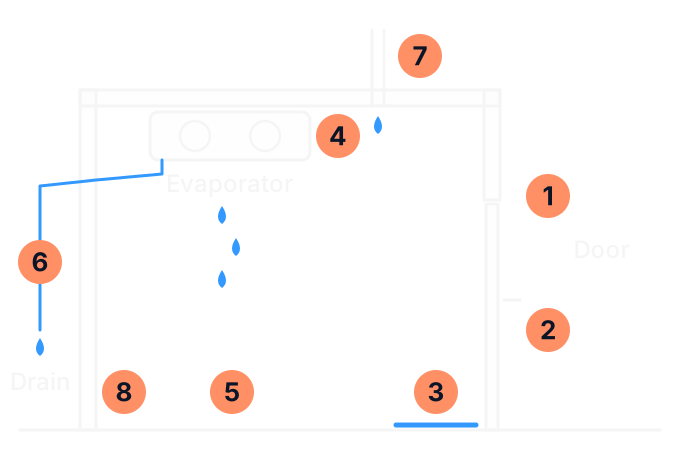
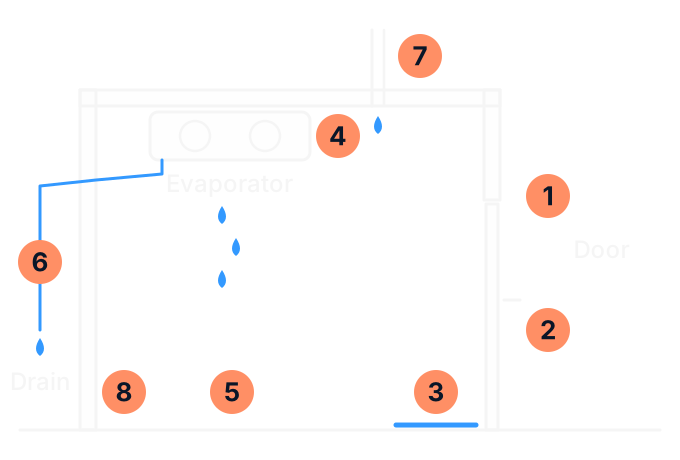
- The door frame and threshold, on the outside: moisture or ice along the frame.
- The door seal: ice, a tear, or a gap when the door is shut.
- The floor inside the door: a film of ice or water.
- The evaporator: frost or ice on the coil face and fan guards, seen from the floor.
- The floor under the evaporator: drips or ice.
- The drain: water or ice where you can see it, and whether water comes out of its open end.
- Where pipes and cables pass through the ceiling: drips or stains.
- Panel joints and the base of the walls: damp, stains, a bulge or a gap.
- Look and photograph from the floor. No ladders, and no climbing on stock, shelving or the room itself.
- Open nothing. No covers, panels or grilles come off.
- Do not go into a freezer room alone to look, and keep the door able to open from inside.
- Take a wide photo and a close one, with the time, and one of the nameplate.
Ice on a freezer floor
Ice on the floor is first a slip hazard. WorkSafe Victoria (opens in a new tab) lists working in cold rooms and freezers among the conditions that cause slips, and an employer has a duty to control the risk. Its guidance (opens in a new tab) is to fix the causes of spills as well as cleaning them up. So keep people off the ice, mark it, and record where it is and how fast it comes back.
- Note whether it forms inside the door, under the evaporator or somewhere else.
- Note how long the door stays open on a busy day. A door left open for long periods lets a film of ice form on floors, walls and ceilings.
- SafeWork SA (opens in a new tab) advises against people working alone in coldrooms. Two people check, not one.
- Cracking or lifting in a freezer floor is a different problem: ground freezing under the slab and pushing it up. Record where and how much, and leave it for an assessment.
Moisture and ice around a freezer door
A freezer room door usually has heaters built into its frame. They keep the frame and the threshold above the dew point of the air outside, so they stay dry, and they stop the door seal freezing to the frame and tearing. When moisture or ice shows around the frame of one freezer door, the usual reasons are warm air leaking past the seal or a heater that has failed. Both need a technician.
- Note whether it is along the top, the sides or the threshold, and whether it is water or ice.
- Note whether the door shuts tight and latches by itself, or a frozen seal is stopping it.
- Leave the heaters, the door, its closer and its seal to the technician. The heaters are electrical, so do not switch them, wire them or touch their connections.
- If water reaches the light switch or anything electrical by the door, follow the warning at the top of this page.
Frost around a freezer evaporator
Some frost on an evaporator is normal, and the defrost clears it. Frost that builds up, comes back quickly or never fully clears has a list of possible causes: warm air getting in, high humidity, poor airflow, the defrost settings, the refrigeration running too cold, a drain problem, or the refrigerant supply to the coil. From the floor you can record:
- whether the frost is even across the coil, or heavier on one side or near the door
- whether it clears during a defrost, and how soon it comes back
- whether the fans are turning and the air coming off them feels weak
- ice in the drain pan or water refreezing under the coil, where you can see it
Do not chip, scrape or melt the ice off the coil, and do not defrost the room by hand. A tool can puncture the coil, and the technician needs to see the frost as it is.
Joints, ceilings, holes and damage
A coolroom's panels are sealed against vapour on their outside face. Where that seal breaks, at a joint, around a pipe or cable, at a fixing hole or where something has hit the panel, moist air gets into the insulation. In a cool room it runs as condensation, and in a freezer it freezes. Wet insulation stops insulating, and water that freezes inside a panel makes it bulge.
| Where | What to record |
|---|---|
| Joints between panels | Damp, stains or ice along a joint, inside or out, and any bulge nearby. |
| Pipes and cables through the ceiling | Drips or stains below the hole. Every pipe, cable, support and light fitting that passes through a panel needs its own seal. |
| After an impact | What hit it and when, the size of the dent or puncture, and any bulge that appears later. A forklift tine can puncture a panel and let water in. |
| Holes left after shelving or equipment came out | Where they are and how big. Each one has to be sealed again. Other trades often make these holes, so agree who seals them before the work starts. |
| The base of the walls | Water lying against the panel base, or gaps where the panel meets its base channel. |
Panels that are not sealed can be waterlogged within months, so a damp joint is worth reporting early. Sealing panels again is work for the panel contractor or for us.
Drainage questions for the designers
Water from the evaporator has to leave the room and must not drip onto the floor or onto food. A drain line runs through a trap, with a steady fall, to an open drain, and the trap sits in a warm space. In a freezer the drain line and the drain pan fitting are heated and insulated, or the water freezes in them. If you are planning a new room or a change to an old one, these are the questions to put to the refrigeration and plumbing designers:
- Where does each evaporator's drain go, and is the open drain it runs to within reach?
- Where is the trap, and is it in a warm space?
- In a freezer, how are the drain line and the pan fitting kept from freezing?
- If the room sits on a suspended floor, what is below it? Moisture can form on the underside of the slab.
- Where does water go when the floor is washed down, and does it drain away from the panel base?
A display cabinet in a humid shop
A commercial cabinet is built for a range of room conditions, shown as its climate class. Under the federal rules for refrigerated cabinets (opens in a new tab), class 3 is 25°C at 60% relative humidity, class 4 is 30°C at 55% and class 5 is 40°C at 40%, and display cabinets are tested at class 3. A shop that is warmer or more humid than a cabinet's class can make its glass and frame sweat. Some cabinets are rated above their test class, so the label and the manual for your model decide.
- Note the climate class on the cabinet's label.
- Note the temperature and humidity in the shop where it stands, and the weather outside.
- Note whether the door closes by itself, how often it is opened, and the state of its seal.
- Note whether a doorway, a heater or the sun is near it.
For what climate classes mean when you buy, see the guide to commercial fridge climate classes.
Moisture and frost record
When to call
Call when moisture or ice keeps coming back in the same place, when it builds into ice, when it comes with the room losing temperature, or when it is near anything electrical. Sweating that comes and goes with humid weather and nothing else is still worth recording, and raising at the next service. ABL repairs walk-in coolrooms, freezer rooms, display fridges and commercial kitchen refrigeration, and the commercial refrigeration repairs page explains how to book. Have the record in front of you when you call.
Sources (23)
Checked on 19 November 2026
- Australian Building Codes Board: condensation in buildings handbook, June 2023 (opens in a new tab)
- AIRAH: Skills Workshop 131, insulated enclosures for coldrooms, May 2020 (opens in a new tab)
- HVAC&R News: vapour barriers in refrigeration, 23 October 2025 (opens in a new tab)
- BlueScope: technical bulletin 31, COLORBOND Intramax steel for coolroom panels, December 2020 (opens in a new tab)
- Australian Government, energy.gov.au: refrigeration guide for businesses (opens in a new tab)
- Postharvest management of vegetables (Hort Innovation): cool rooms (opens in a new tab)
- Food Standards Australia New Zealand: Safe Food Australia, chapter 3.2.3, food premises and equipment (opens in a new tab)
- Federal Register of Legislation: Greenhouse and Energy Minimum Standards (Refrigerated Cabinets) Determination 2024 (opens in a new tab)
- Ontario Ministry of Agriculture, Food and Agribusiness: troubleshooting cold storage problems, 2025 (opens in a new tab)
- Danfoss: cold room troubleshooting and fault diagnosis (opens in a new tab)
- Danfoss (DEVI): cold store protection systems, application manual (opens in a new tab)
- Heatcraft: installation and operations manual for unit coolers (opens in a new tab)
- Norlake: Kold Locker walk-in installation manual, 2018 (opens in a new tab)
- Bromic: modular coldroom installation manual, May 2005 (opens in a new tab)
- Norlake: maintaining your walk-in (opens in a new tab)
- Bally: walk-in coolers and freezers service manual, 2013 (opens in a new tab)
- Hussmann: Innovator glass doors installation and operation, February 2021 (opens in a new tab)
- SKOPE: refrigeration choice and GEMS climate classes (opens in a new tab)
- SKOPE: SC112N-A user manual, January 2022 (opens in a new tab)
- WorkSafe Victoria: slips and trips under 2 metres, reviewed 25 August 2026 (opens in a new tab)
- WorkSafe Victoria: injury hotspots, slips, trips and falls, reviewed 26 February 2026 (opens in a new tab)
- SafeWork SA: cold storage facilities (opens in a new tab)
- Bureau of Meteorology: latest weather observations, Bairnsdale (opens in a new tab)
Related pages
- Coolroom temperature recovery: load, conditions and fault information
If the room is also slow to come back to temperature.
- Commercial fridge climate classes: questions for the supplier
What a cabinet's climate class means in a humid shop.
Want a technician to look at it?
Call ABL or send an enquiry. Have your notes ready: the brand, the model and what the unit is doing.
Filled in the record? Copy or print it first: it is not sent with a call or an enquiry.