
VRF heat pump or heat recovery: does your building need heating and cooling at once?
When a heat pump VRF is enough and when heat recovery earns its cost, why rooms on one system conflict over modes, and what to ask before you approve a design.
Last updated
A heat pump VRF heats every room on it or cools every room on it, though each room still sets its own temperature. A heat recovery VRF can heat some rooms while it cools others, moving heat out of the rooms it cools and into the rooms it heats through branch units in the ceiling. You need heat recovery when rooms on the same system regularly want opposite modes at the same time: a sunny side and a shaded side, inner rooms full of people and equipment beside cold outer offices, or hotel rooms with guests who each want something different. Where the rooms can be grouped by how they behave, a separate heat pump system for each group can do the same job.
How to use this guide
Step 1: Understand the mode
How a heat pump system picks heating or cooling, and what a room set the other way does.
Go to Heat pump modeStep 2: Compare the arrangements
Heat pump, two-pipe and three-pipe heat recovery.
Go to Two or three pipes
How does a heat pump VRF decide whether to heat or cool?
On a heat pump VRF the outdoor unit runs in one mode for the whole system, so every indoor unit on it heats or every indoor unit cools. Something has to decide which. Makers do it in a few usual ways, and many systems can be set up to use more than one:
| How the mode is set | What it means day to day |
|---|---|
| One master controller | Only one room's controller can choose heating or cooling. The others show a symbol to say the mode is set elsewhere, and follow it. |
| The first room to run | Whichever room was running first sets the mode. A room that asks for the other mode waits on standby, and its mode symbol may blink. |
| A set indoor unit | The system follows the mode of one chosen indoor unit, so that room decides for all. |
| A central controller | A facilities manager sets the mode for the whole system, or the controller follows the rooms. On one maker's controller, for example, the mode is reviewed every 15 minutes and follows what most of the rooms ask for, weighted by the size of each indoor unit. |
| A changeover switch | A separate switch on the wall sets heating or cooling for everything on the system. |
The manual for your system says which of these it uses and how it is set. Find out who in the building holds the master controller or the central controller, because that person decides the mode for everyone.
Mode conflict: why will one room not heat while the others cool?
On a heat pump VRF, a room set to the opposite mode from the rest of the system is not broken. It is doing what the system is designed to do: waiting until the mode changes. The same holds for a commercial multi-split, where several indoor units share one outdoor unit. Before you report a fault, check what the controller shows.
| What you see | What it usually means | What to do |
|---|---|---|
| A symbol on the controller saying the mode is under central control, and the mode button does nothing | This controller is not the one allowed to choose heating or cooling. | Ask whoever holds the master or central controller. The manual shows the symbol. |
| The mode symbol blinks, and the room gets only fan or nothing | Other rooms on the same outdoor unit are already running in the other mode. | Note the time and which rooms were running. It is normal on a heat pump system. |
| The mode changes on its own every so often | A central controller is set to follow the majority of the rooms. | Ask how the central controller is set, and by whom. |
| The same rooms want opposite modes every day at the same times | Those rooms want opposite things at once, often because of sun, people or equipment. | Record it on the sheet below. It is a design question, not a repair. |
| A code on the controller, a unit that stops, or every room affected | That points to a fault, not a mode conflict. | Write down the code and what each room is doing, and call for service. |
If conflicts are part of daily life, the fix is a design one: regroup the rooms onto systems that behave alike, change who sets the mode, or move to heat recovery when the system is next replaced.
How does heat recovery work?
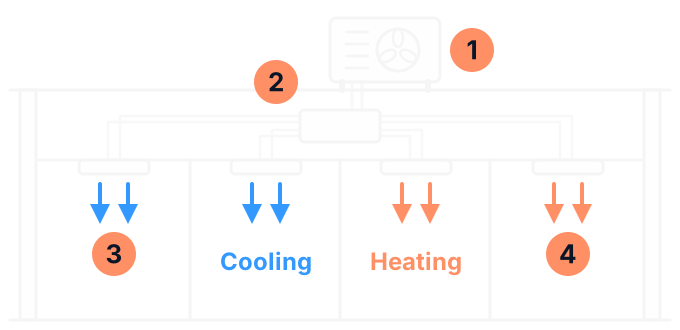
A heat recovery VRF sends each indoor unit the refrigerant it needs to heat or to cool, through branch units that sit between the outdoor unit and the rooms. Heat taken out of a room being cooled is carried to a room being heated, so the system does two jobs with one lot of energy. The outdoor unit runs in whichever mode most of the rooms need at the time.
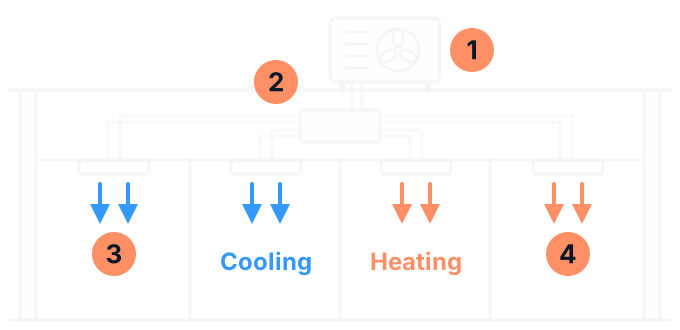
- Outdoor unit: runs in heating or cooling, whichever most of the rooms need, and makes up the difference.
- Pipes and branch unit: two or three pipes run from the outdoor unit to the branch unit, depending on the maker. The branch unit sends each room the refrigerant it needs. It sits in the ceiling space and needs power and room to be serviced.
- Rooms being cooled: the heat taken out of these rooms is not thrown away outside.
- Rooms being heated: they are warmed partly with the heat taken from the rooms being cooled.
Two-pipe or three-pipe: what is the difference?
Both are heat recovery. They differ in how the refrigerant gets from the outdoor unit to the branch units, and in what the branch units look like. Makers sell both kinds in Australia.
| What you compare | Heat pump | Two-pipe heat recovery | Three-pipe heat recovery |
|---|---|---|---|
| Pipes from the outdoor unit | Two, branching to each indoor unit. | Two, to a branch controller that separates the refrigerant into gas and liquid. | Three: a liquid pipe and two gas pipes, one high pressure and one low. |
| What sits between | Branch joints or headers in the pipework only. | A branch controller, often written BC controller, with sub-controllers on larger systems. | Branch selector boxes, each serving one indoor unit or several through its ports. A quote may call them BS boxes, flow selectors or heat recovery units, depending on the maker. |
| Heating and cooling at once | No. One mode for the whole system. | Yes. | Yes. |
| Rooms that share a mode | Every room on the system. | Indoor units joined to the same branch port. | Indoor units joined to the same branch port. |
The number of pipes does not tell you which system will serve your building better. Makers make claims for their own kind, such as fewer pipe joints. Some call the part in between a mode control unit or a heat recovery changer, so ask how many pipes it takes. What matters for your building is which rooms share a branch port, how far each room is from its branch unit, how the controls work, and where the branch units can go. Compare the quotes on those.
There are other ways to the same end. One maker's hybrid system runs refrigerant only as far as a branch controller and carries heat to the rooms in water, which keeps refrigerant out of the occupied rooms. Whatever is proposed, ask how it heats and cools rooms at the same time, and what sits in the ceiling to do it.
What do the branch units need?
The branch units are the part a heat pump system does not have, and the part most often squeezed into a ceiling as an afterthought. Settle these before the layout is fixed:
- Ceiling depth. Branch units in two of the main ranges stand about 250 to 300 mm tall, plus room for pipes and insulation.
- Power. They usually need a single-phase supply.
- A drain. Some need a condensate drain, and some are drainless up to a certain number of ports.
- Service access. Each branch unit needs servicing space: an access panel in the ceiling below it and room to work.
- Noise. Refrigerant moving through a branch unit makes a small sound, so keep them away from bedrooms and quiet rooms. A corridor or store room ceiling is a better home than a consulting room or a hotel room.
- Distance. Each maker limits how far an indoor unit can be from its branch unit, typically about 50 to 90 m.
When is heat recovery worth it?
Heat recovery adds branch units, more pipework and more joints, so it costs more to install than a heat pump system of the same size. It earns that back only where rooms on one system really do want opposite modes at the same time. Your answers on the sheet below show whether they do.
- Heat recovery usually suits offices with glass on more than one side, buildings with busy inner rooms and cold outer rooms, rooms that hold computer or business equipment beside offices, hotels and serviced rooms, and clinics with consulting rooms used on different schedules.
- Separate heat pump systems usually suit buildings where the rooms fall into groups that behave alike, such as one system for the sunny side and one for the shaded side, or one for the shop floor and one for the offices. Each group then has its own mode.
- A room that needs cooling day and night, such as a comms room, can be served by heat recovery during the day, but keeps the system running after hours for one room. Ask whether it is better on its own system.
Whichever way you go, the smallest room on the system needs checking for refrigerant safety. The guide to mini-VRF or separate split systems explains why. For open-plan floors, see the guide to planning air conditioning for offices and shared workspaces.
Questions to ask before you approve a VRF specification
- Is the system heat pump or heat recovery, and which rooms did you expect to need the other mode at the same time?
- On a heat pump system, how is the mode decided, who holds that control, and what does a room set the other way show?
- On a heat recovery system, which rooms share each branch port, and so share a mode?
- How many branch units are there, where does each one go, and how is each one reached for service?
- Does each branch unit need a drain, and where do the power and the drain come from?
- Is any branch unit above a room where its noise could matter?
- Which is the smallest room on the system, and how is the refrigerant limit met there?
- Which controllers are included, who sets up the schedules, and how does the system connect to any building management system?
- How many spare branch ports are there for rooms added later?
Heating and cooling requirements sheet
Who to call
Installing and servicing a VRF system is licensed refrigerant work, and you can check any technician's licence at Look for the tick (opens in a new tab). If your system shows a fault code, call for service and have the code, the rooms affected and the time it started ready.
ABL's commercial work includes VRF systems, for businesses in Bairnsdale and East Gippsland. Our commercial air conditioning page covers the service, and the enquiry form is on our air conditioning services page. As at November 2026, ABL offers a free site assessment and a free quote. Send your requirements sheet with the enquiry.
Sources (19)
- ABL Refrigeration: air conditioning services (opens in a new tab) ABL's own page. Checked on 20 November 2026.
- ASHRAE Handbook, HVAC Systems and Equipment 2024, chapter 18: variable refrigerant flow (opens in a new tab) Checked on 20 November 2026.
- UNSW and the Australian Government: Commercial buildings, best available HVAC&R retrofit technologies, July 2022 (opens in a new tab) Checked on 20 November 2026.
- Panasonic Australia: VRF and mini VRF range (opens in a new tab) Checked on 20 November 2026.
- Panasonic Australia: 3-pipe FSV-EX MF3 series (opens in a new tab) Checked on 20 November 2026.
- Daikin Australia: VRV general catalogue PCTVAU2301, 2023 (opens in a new tab) Checked on 20 November 2026.
- Daikin Australia: VRV R heat recovery (opens in a new tab) Checked on 20 November 2026.
- Daikin: VRV IV-S installation and operation manual, 2025 (opens in a new tab) Checked on 20 November 2026.
- Daikin Australia: what do the symbols on my controller mean (opens in a new tab) Checked on 20 November 2026.
- Daikin Europe: conflict in operation modes (opens in a new tab) Checked on 20 November 2026.
- Mitsubishi Electric Australia: City Multi VRF brochure, 2019 (opens in a new tab) Checked on 20 November 2026.
- Mitsubishi Electric Australia: City Multi VRF systems (opens in a new tab) Checked on 20 November 2026.
- Mitsubishi Electric Australia: City Multi BC controller (opens in a new tab) Checked on 20 November 2026.
- Mitsubishi Electric: City Multi PAR-33MAAG remote controller instruction book (opens in a new tab) Checked on 20 November 2026.
- Toshiba Australia: SHRMe 3-pipe heat recovery VRF (opens in a new tab) Checked on 20 November 2026.
- LG Electronics Australia: Multi V S brochure, 2021 (opens in a new tab) Checked on 20 November 2026.
- Samsung Australia: DVM S Mini heat recovery (opens in a new tab) Checked on 20 November 2026.
- Australian Refrigeration Council: frequently asked questions (opens in a new tab) Checked on 17 November 2026.
- Australian Refrigeration Council: Look for the tick (opens in a new tab) Checked on 17 November 2026.
Related pages
- Commercial air conditioning in Bairnsdale and East Gippsland
ABL's commercial air conditioning service, and how to enquire.
- Mini-VRF or multiple independent splits?
Whether one system or a split in each room suits the building.
- Planning air conditioning for offices and shared workspaces
Working out whether you need heat recovery?
Send ABL your requirements sheet with an enquiry, or call and talk the zones through.
Filled in the record? Copy or print it first: it is not sent with a call or an enquiry.