
How much ice a fishing trip needs: building the ice brief
Work out the ice a fishing trip needs: ice to chill the catch, ice lost to heat in the hold, and what the machine and pens supply. With a worksheet.
Last updated
A fishing boat needs enough ice for two jobs: chilling each haul to about 0°C, and replacing the ice that heat coming into the hold melts until you land. Published starting points for temperate waters run from about a third of a tonne to a tonne of ice for every tonne of fish, rising with the length of the trip, and more again in warm water. Your own figure comes from the two jobs. The first depends on how much fish you catch and how warm it is when it comes aboard. The second depends on the hold, the weather and the length of the trip. Add the two, allow for losses, and check the answer against the ice left in the hold when the last fish comes out.
How to use this guide
What decides how much ice a trip needs?
These are the figures a sizing works from. Most of them you already know. The ones in the last column are where an estimate is usually weakest.
| Input | Why it matters | Where the figure comes from |
|---|---|---|
| How much fish, and when | Every kilogram of catch needs ice to chill it. The heaviest day matters as much as the trip total, because that is when the ice runs lowest. | Your landing records over a season, by trip and by day. |
| How warm the fish are when they come aboard | The warmer the fish, the more ice it takes to bring them to 0°C. | A probe thermometer in a few fish, and the sea temperature on the grounds in the warmest month you fish. |
| How long until landing | Ice keeps melting for as long as the catch is on board. | Days from the first haul to unloading, on your longest usual trip. |
| The hold and its insulation | Heat comes in through the hull, the deck and the engine room bulkhead. An uninsulated hold takes a great deal more ice. | What the hold is lined with, and how much ice is left at landing. |
| Air and sea temperature | A warmer sea and a hot deck push more heat into the hold. | Your own readings in the warmest months. |
| How the catch is stowed | Bulk in pens, boxes and tubs each use ice differently, and boxes lose more to their surfaces. | How you stow now, and any change you plan. |
| Whether the hold is refrigerated | Published rules of thumb allow about 30 to 50 per cent less ice when the hold is refrigerated. It holds the temperature; only ice chills the fish. | The hold equipment, and whether it runs at sea. |
The species changes the answer less than you might think. Oily fish take a little less ice to chill than lean fish, but the difference is small, so the sum treats every catch as lean. Prawns and other high-value catch are usually given more ice than the cooling needs, as insurance against delays.
The two jobs ice does on a trip
Job one is chilling the catch. This amount is fixed by the weight of the fish and how warm they are. It cannot be reduced, only supplied. To bring fish down to 0°C takes about 1 kg of ice for every 100 kg of fish for each degree they start above zero:
kg of ice to chill = kg of fish × starting temperature in °C ÷ 100
| Fish temperature when caught | Ice to chill it |
|---|---|
| 10°C | About 100 kg |
| 15°C | About 150 kg |
| 20°C | About 200 kg |
| 25°C | About 250 kg |
That is the floor, not the answer. Some reference tables put it between a tenth and a fifth higher, and none of it allows for keeping the fish cold afterwards.
Job two is holding the catch cold. Heat leaks into the hold through every surface for the whole trip, and each kilogram of ice that melts takes up a fixed amount of it. How much depends on the area of the hold, how well it is insulated, how much warmer the sea and air are than the hold, and how many days the catch is aboard. Heat gets in fastest through the engine room bulkhead and a deck in the sun, and below the waterline the hull sits in water all trip. This is the part insulation and refrigeration can reduce.
For a boat, the heat coming in is rarely worked out from first principles: it needs the build of every surface. It is far more reliable to measure it. The ice left at landing tells you how much the hold used, and a simple meltage test does the same for a box or a tub.
Then the losses. Some ice is wasted when the catch is iced, usually a few per cent, and part of the weight of stored ice is meltwater on its surface. Ice also has to sit under, around and on top of the fish, whatever the cooling sums say: the guide to flake ice or crushed block ice covers how deep each layer goes.
Is there a rule of thumb for ice to fish?
There are several, and they differ because trips differ. Handbooks written for small fishing vessels worldwide give these starting points. In temperate waters they run from about 0.7 tonnes of ice for every 2 tonnes of fish on a trip of under a week, through 1 tonne for every 2 tonnes on a longer trip, to tonne for tonne. In tropical waters tonne for tonne is the usual minimum, and up to three of ice to one of fish is used. Trip length moves the ratio more than anything else. None of these figures was worked out for East Gippsland boats.
The same handbooks build a quick estimate the same way: the ice to chill the catch, plus the ice packed among the fish, plus 30 per cent or more for heat getting in, and more again for a hold with poor insulation. Use a ratio to check a worked figure, not to replace it. The test of any figure is at landing: the fish should be close to 0°C in the core, with ice still among them.
Why ice production and ice storage are two different numbers
A machine rated at a tonne a day does not mean a tonne of ice is there when you need it. Three numbers decide whether the ice keeps up:
- What you can load before you leave. The ice pens or bin set the limit, and space is measured in volume, not weight. A tonne of flake ice takes more room than a tonne of crushed block ice. The guide to flake ice or crushed block ice gives the space each form needs.
- What the machine makes while you fish. Its output is rated at the water and air temperatures on its data sheet, which differ from maker to maker. Warmer feed water means less ice: as a general guide, every 5°C warmer takes about 3 per cent off. The seawater version of a model can make less than the freshwater version.
- When the catch comes aboard. A big haul needs its chilling ice at once, and the machine cannot catch up in the hour it matters.
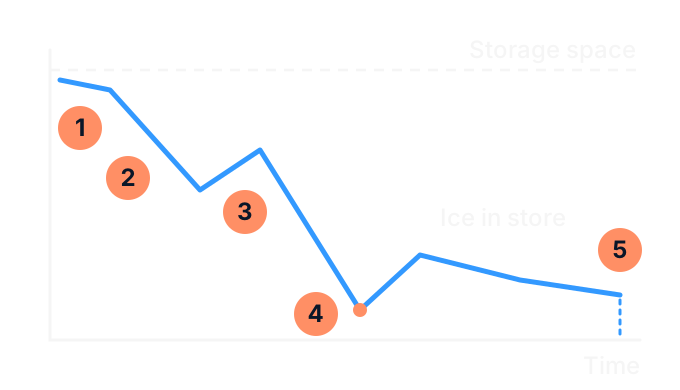
- The load at departure, limited by the ice storage space.
- A fishing day: ice goes into chilling each haul, and some melts from heat coming into the hold.
- The machine making ice overnight, at what it really makes in that water and weather.
- The lowest point. In this drawing it comes after the heaviest day.
- Ice left at landing: the check on the estimate.
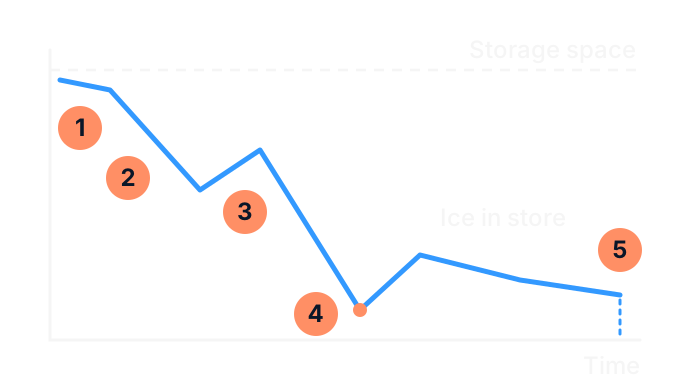
So a trip can run short of ice with a big machine and small pens, or with big pens and a machine that cannot refill them between hauls. For how the water a machine freezes changes its output, see the guide to freshwater or seawater ice. To find out what your machine really makes, the guide to a marine ice machine maintenance schedule has a 15 minute check of its output, and a machine that makes less than it used to is a service question.
Which figures are worth measuring before a sizing?
A ratio or a sum is a starting point. Measured figures from your own trips beat both, and a season of them settles most questions. Record, trip by trip:
- the ice loaded at departure, and where it came from
- the catch by day, and the total landed
- the temperature of a few fish as they come aboard, and the sea temperature on the grounds
- the ice left at landing, and the core temperature of a few fish as they are unloaded
- how many hours the machine ran, and how much ice it made in that time if you can weigh or count it
For boxes or tubs, a meltage test measures the heat that gets in. Weigh an empty container, fill it with ice, weigh it again and keep it out of the sun. Note the air temperature, drain and weigh it every couple of hours, and the ice lost over a day is that container's melt rate at that temperature. Containers kept in the sun lose more.
A fictional example: what a missing figure changes
This boat is made up to show the method. It is not one of our jobs and the figures are not a recommendation. Its skipper fishes three days, lands on the fourth, and expects up to 1,500 kg of fish a trip, with 700 kg on the best day. The hold is insulated, the catch goes into pens in bulk with flake ice, and a machine aboard tops the ice up.
| Figure | What the skipper has | What the gap means |
|---|---|---|
| Catch | Up to 1,500 kg a trip and 700 kg on the best day, from last season's landings. | Enough to work from. The best day sets the lowest point. |
| Fish temperature | Not measured. | At 14°C the catch needs about 210 kg of ice to chill. At 20°C it needs about 300 kg. Measuring a few fish in the warmest month settles which. |
| Heat getting into the hold | No meltage figure. The skipper remembers "not much left" at the last landing in February. | This is the biggest unknown. The next question is how much ice was loaded and how much came out, on two or three trips. |
| What the machine makes | The data sheet figure, at the maker's test conditions. | The next question is how much it makes in summer water. That can be under the data sheet figure, and less again for a seawater version. |
| Storage | The pens hold about 1,200 kg at departure. | With a full load at the start, the question is whether the machine refills the pens overnight after the 700 kg day. |
With those gaps open, the honest answer is not a machine size but three measurements: the fish temperature, the ice in and out on a few trips, and the machine's real output. Each one narrows the range, and none of them needs anything opened or adjusted.
Trip ice worksheet
Your assessment pack
Send the worksheet with photos of the machine's nameplate and the ice pens, the hold's rough dimensions, and any landing records or meltage figures you have. Those let a sizing start from your boat, not from a rule of thumb.
We supply, install, service and repair ice machines on commercial fishing vessels, and we help you choose the right machine for your catch and trip length when we quote. As at November 2026, the quote is free. We work on boats in port at Lakes Entrance, Paynesville, Metung and Bairnsdale. Our marine ice machines page explains how to enquire. If a new or bigger machine is in view, the guide to retrofitting an ice machine on a fishing boat lists what else to gather.
Sources (10)
Checked on 20 November 2026
- FAO Fisheries Technical Paper 331, Ice in fisheries: chapter 3, quantity of ice required (opens in a new tab)
- FAO Fisheries Technical Paper 331, Ice in fisheries: chapter 8, chilling fish at sea (opens in a new tab)
- FAO Fisheries Technical Paper 436, The use of ice on small fishing vessels: chapter 4, ice and chilled seawater on fishing vessels (opens in a new tab)
- FAO Fisheries Technical Paper 436: chapter 7, calculations for insulated containers and fish holds (opens in a new tab)
- FAO Fisheries Technical Paper 436: chapter 6, containers and fish holds (opens in a new tab)
- FAO Fisherman's workbook: fishing vessel operations (opens in a new tab)
- FAO Fisheries Technical Paper 331, Ice in fisheries: chapter 5, ice-making machines (opens in a new tab)
- JBT Marel: MAJA RVE-2S flake ice machines for fresh water and seawater (opens in a new tab)
- ZIEGRA: trawler ice machines for fresh and salt water (opens in a new tab)
- ABL Refrigeration: marine ice machines (opens in a new tab) ABL's own page.
Related pages
- Marine ice machines for commercial fishing vessels
Supply, installation, servicing and repairs, and how to enquire.
- Freshwater or seawater ice for an onboard system
How the water a machine freezes changes what it makes.
- Flake ice, crushed block ice or slurry: choosing ice for the catch
How each form packs, stores and chills.
Planning ice for a bigger catch or a new machine?
Send us your trip worksheet and the machine's nameplate. We work on boats in port at Lakes Entrance, Paynesville, Metung and Bairnsdale.
Filled in the record? Copy or print it first: it is not sent with a call or an enquiry.