
Retrofitting an ice machine on a fishing boat: what to gather first
What to gather before an ice machine is fitted to a working vessel, what the Marine Orders require, and how to compare installed quotes, with a survey pack.
Last updated
Retrofitting an ice machine on a fishing boat starts with the vessel, not the brochure. An installer needs to know how the boat fishes, how much ice it needs and of what kind, where a machine could stand, how it would get power and water and get rid of its heat, and how the ice reaches the hold. Put that in one survey pack, send the same pack to every installer you ask, and check what the vessel rules say about the change before any work starts.
How to use this guide
Step 1: Gather the pack
The vessel, the ice, the space and the services, with photos.
Go to the recordStep 3: Compare like with like
The same scope from every installer, then the handover.
Go to Comparing quotes
What does an installer need to know about your vessel?
Most of a sound quote rests on facts only the owner and crew have. Gather these before anyone quotes. Leave a gap where you do not know, and say so: a guess passed on as a fact is how a machine ends up too small or in the wrong place.
| What to gather | Why the installer needs it |
|---|---|
| How the vessel works | The fishery, trip length, crew and season. A machine that runs for a week at sea has a different job from one that tops up ice between day trips. |
| The ice it needs | The most ice you use on the busiest day, and the form you want. The guide to building an ice-demand brief for a fishing trip works out the quantity, and the guide to flake ice or crushed block ice for fishing compares the forms. |
| Seawater or fresh water for the ice | It decides which machines can be considered at all, because a machine built for fresh water is not converted by changing its supply. The guide to freshwater or seawater ice for an onboard system covers the choice. |
| The present machine, if there is one | The make, model and serial number from its plate, the refrigerant the plate names, its age and what is wrong with it. Take a photo of the plate. |
| Where it could go | The position for the machine, and for a separate condensing unit if there is one, with photos and rough measurements of the space, the access to it and the route to the hold. |
| The services on board | Voltage, phase and frequency, the generator and what else it runs, any spare through-hull or sea chest, and where a drain could go. |
| The window for the work | When the vessel can be out of fishing, and dates it has to fish. |
Where does an ice machine connect to the vessel?
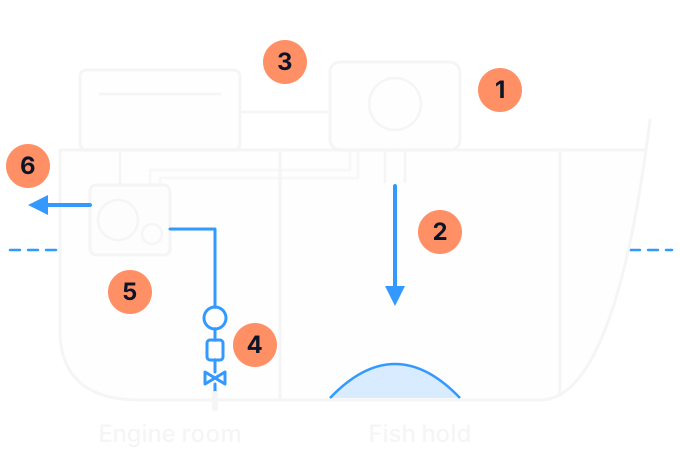
Every installation touches the same few parts of the vessel. Walk the boat with this drawing and photograph each point before you ask for quotes.
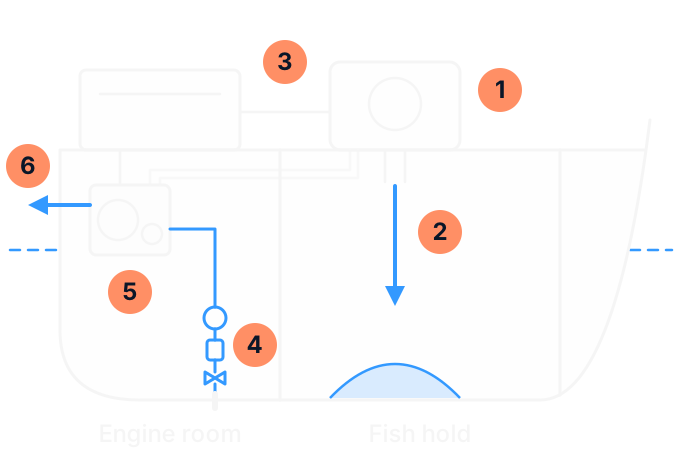
- The ice machine, with room around it to service it and to fit the chute.
- The ice route: through a hatch or chute into the hold or an insulated bin.
- Power from the vessel's switchboard and generator.
- The seawater intake below the waterline: a through-hull, a seacock, a strainer and a pump. It feeds a water-cooled condenser, and the ice-making water on a seawater machine.
- The condensing unit in the engine room, joined to the ice machine by refrigerant lines. A self-contained machine has it built in.
- The overboard discharge for the condenser water.
Self-contained or remote, air-cooled or water-cooled?
On a vessel, flake ice machines are usually mounted on deck or in the deckhouse over the hold, so the ice drops straight in through a small hatch. Below deck is harder, because most machines rely on gravity to get the ice from the drum into storage. Where the refrigeration plant goes is the next choice.
| Layout | What it is | When it suits |
|---|---|---|
| Self-contained | The ice maker and its refrigeration in one unit, on deck or in the deckhouse. | One unit to place and connect, where there is room on deck or in the deckhouse for all of it and its cooling. |
| Remote condensing unit | The ice maker over the hold, with its condensing unit in the engine room and refrigerant lines between them. | Less on deck, with the heavier plant lower in the vessel, where deck space is short. |
| Connected to the vessel's own plant | An ice maker with no condensing unit, run from a refrigeration plant already on board. | A vessel whose plant has the spare capacity the maker states for that model. |
Many machines made for fishing vessels are water-cooled, using seawater through the circuit in the drawing above. Ask the installer whether the machine needs its own through-hull, and where the pump has to sit to stay primed when the boat heels. The condenser needs to be a marine type, usually cupro-nickel, because copper tubes corrode in seawater. An air-cooled condenser needs no seawater, but it needs air below the maker's ambient limit, which runs from about 35°C to 42°C depending on the maker and the condenser, and protection from salt air, such as coated condenser fans. Check that limit against your engine room on a summer day.
One large ice machine or two smaller ones?
One machine usually costs less to buy and fit, and needs one set of services. Two smaller machines give you some ice when one breaks down or is being serviced, and let you run one in a quiet week and both at the peak. A machine that is too small runs almost continuously and tends to need more maintenance. Some spare capacity is usually worth paying for, but one that is far too big costs more to run than it is worth.
- One machine is usually the better choice where space, power and budget are tight, and where a breakdown can be covered by buying ice ashore for a trip or two.
- Two machines are usually the better choice where losing ice costs a trip, where demand swings a lot through the season, or where one machine on seawater cannot make enough. A machine usually makes less ice from seawater than from fresh water, by something like 15 to 30 per cent, so ask for the seawater rating of each model you are quoted.
Two machines need room for both, enough power for both at once, and either a seawater intake each or a manifold sized for both. Ask each installer to price both arrangements if you are unsure.
What to ask the supplier for, model by model
Power, water, drainage and heat are set by the model, not by a rule of thumb. Ask for the installation manual of each machine you are quoted, and check it against what the vessel has.
| Requirement | What to ask for and check |
|---|---|
| Power | Voltage, phase and frequency. Models are built for 50 Hz or 60 Hz and are not swapped between them. The supply usually has to stay within about 10 per cent of the nameplate voltage, starting included, and each unit wants its own circuit and isolator. |
| Generator | The running load and the starting load, so your electrician can check the generator carries it with everything else that runs at the same time. |
| Ice-making water | Seawater or fresh, the temperature range and pressure, and the strainer or filter. Ice made from seawater is only as clean as the water it is made from. |
| Condenser cooling | Air or seawater. For seawater, the flow it needs and the water temperature it is rated at, and whether it can share an intake. |
| Drains | A drain that falls by gravity, and where condensate goes. |
| Heat and air | The ambient range the model is built for, and the ventilation it needs, including the condensing unit's space. |
| Mounting and motion | How it is held down, with stainless fixings and vibration mounts, and whether the maker allows it on deck, below deck or forward. Machines made for vessels are built to keep making ice when the boat pitches and rolls. |
| Service access | The space the maker asks for around the machine for servicing and for the ice chute. |
| Ice storage | The insulated storage the machine needs, which the maker sizes against a day's production. Ask for the figure for the model. |
Output figures come with the water and air temperatures they were measured at, for example 16°C water and 20°C air. Ask what the machine makes at your summer water and engine room temperatures.
Changing the ice storage bin
A new bin or pen is rarely a refrigeration job on its own. It changes how the ice drops, where the ice level sensor sits, the insulation, the drainage of meltwater and the weight in the hold. Include the machine's delivery and the bin in one scope, and ask your surveyor whether the change counts as a change to the vessel.
What do the vessel rules say about fitting an ice machine?
Weight matters as well as paperwork. Weight added at deck level raises the vessel's centre of gravity and reduces its stability, and a heavy item placed high reduces it further. Marine Order 504 also asks the owner of most classes of vessel to record any modification that affects stability, with a description and the date.
| Part of the job | Who usually does it | What you do |
|---|---|---|
| The ice machine and its refrigeration | A refrigeration technician. Work that involves handling a scheduled refrigerant needs a refrigerant handling licence. For fitting or servicing an ice machine in port that is usually the full refrigeration and air conditioning licence: the restricted marine licence (opens in a new tab) covers work only when the vessel is at sea. See the licence types (opens in a new tab). | Ask for the licence number and check it with the Australian Refrigeration Council (opens in a new tab). |
| Wiring and the generator | An electrician. | Get the model's electrical requirements to them early. |
| Through-hulls, deck openings and foundations | The trades your surveyor or vessel builder agrees. | Agree who supplies and fits each fitting before work starts. |
| Stability | Your accredited marine surveyor, where the change needs assessing. | Give them the machine's weight and position, and the bin. |
| Notices and records | You, as the owner or operator. | Tell the Authority where your certificate of operation requires it, and keep the modification record. |
Planning the changeover around fishing
- Book the work for a quiet part of the season, and allow for the survey after it where your certificate of survey needs one.
- Ask how long the new machine and its parts take to arrive, and order before the old one comes out.
- Count the removal of the old machine in the plan. Its refrigerant is recovered by a licensed technician, and for a vessel in survey, removing a refrigeration system can itself be a listed change under Marine Order 503, as above.
- Plan where your ice comes from for the trips either side of the work.
How do you compare installed quotes?
Compare what is included, not the price of the machine. Two quotes for the same machine can differ by a whole seawater circuit, the removal of the old unit or the commissioning. Ask every installer to quote from your survey pack, and check each quote states:
| Item | What to check |
|---|---|
| The machine | Make and model, seawater or fresh water, and its rated output and conditions. |
| Removing the old machine | Taking it out, recovering its refrigerant, and what happens to the old fittings. |
| Water and cooling | The through-hull, seacock, strainer, pump, piping, overboard discharge and bonding, or which of them are reused. |
| Power | The circuit, isolator and cable run, and who does the electrical work. |
| Refrigeration lines | For a remote layout, the line run, insulation, leak test and charge. |
| Mounting | Foundations, fixings and vibration mounts. |
| Ice route and storage | The chute or hatch, the bin or pen, and the ice level sensor. |
| Drains | Where each drain goes. |
| Commissioning | Start-up to the maker's checklist, a measured output check, and a walk-through for the crew. |
| Warranty | What it covers and for how long. Terms for a seawater machine can be much shorter than for the same maker's freshwater machines, so ask for the warranty in writing for the model and the water it will run on. |
| Exclusions | Anything left out, such as slipping, structural work, survey fees or electrical work, and anything still unknown. |
| Price and time | A total including GST, and how many days the vessel is out of fishing. |
What to collect at handover
- the installation and operation manual for the model, kept on board
- the start-up record, with the measured output and its conditions
- the refrigerant type and the charge, recorded at start-up
- proof that the warranty is registered, where the maker asks for it
- any record your electrician gives you of the electrical work
- a walk-through for the crew: controls, the seawater strainer and seacock, and what the crew may and may not do
- who does each maintenance task and how often, which the guide to the marine ice machine maintenance schedule and service log turns into a calendar
- a new certificate of survey, and the entry in your modification record, where the change needs them
Vessel ice machine survey pack
Who to send it to
ABL supplies, installs and services ice machines on commercial fishing vessels: saltwater flake machines, and freshwater flake and cube machines. Our marine ice machines page explains how to get in touch. Send your survey pack with your enquiry, and if you are weighing a repair against a new machine, see the guide to repair or replace a marine ice machine.
Sources (18)
Checked on 20 November 2026
- Marine Order 503 (Certificates of survey, national law) 2026, made 10 November 2026, in force from 1 December 2026 (opens in a new tab)
- Marine Order 503 (Certificates of survey, national law) 2018, compilation of 1 September 2023, repealed from 1 December 2026 (opens in a new tab)
- Marine Order 504 (Certificates of operation, national law) 2024, in force from 1 June 2025 (opens in a new tab)
- Australian Refrigeration Council: frequently asked questions (opens in a new tab)
- Australian Refrigeration Council: licence types (opens in a new tab)
- Australian Refrigeration Council: refrigerant handling licence questions (opens in a new tab)
- Australian Refrigeration Council: how to check if someone is licensed (opens in a new tab)
- FAO Fisheries Technical Paper 436, The use of ice on small fishing vessels (2003), chapter 2: the manufacture of ice (opens in a new tab)
- FAO Fisheries Technical Paper 436, The use of ice on small fishing vessels (2003), chapter 3: planning (opens in a new tab)
- FAO Fisheries and Aquaculture Technical Paper 517, Safety practices related to small fishing vessel stability (2009) (opens in a new tab)
- Dometic: Eskimo Ice EI540D installation and operation manual, L-3040 Rev. A (opens in a new tab)
- Scotsman: MAR1400 and MAR2000 scale ice makers, service manual (opens in a new tab)
- Howe: Rapid Freeze ice flaker installation and service manual, remote condensing unit, Rev. 06/2017 (opens in a new tab)
- Howe: shipboard ice flaker brochure (opens in a new tab)
- JBT Marel: MAJA RVE-2S flake ice machines (opens in a new tab)
- JBT Marel: MAJA ice machines catalogue, February 2024 (opens in a new tab)
- ASHRAE Journal, April 2011: Controlling corrosion in marine refrigeration systems (opens in a new tab)
- ABL Refrigeration: marine ice machines (opens in a new tab) ABL's own page.
Related pages
- Marine ice machines
How to get in touch with ABL about an ice machine on a vessel.
- Building an ice-demand brief for a fishing trip
Work out how much ice the machine has to make.
- Freshwater or seawater ice for an onboard system
Seawater or fresh water for the ice, before you choose a machine.
Planning an ice machine for your vessel?
Send ABL your survey pack with an enquiry, or call and read it out.
Filled in the record? Copy or print it first: it is not sent with a call or an enquiry.