
Commercial ice machine sizing: what it makes and what it stores
Size a hospitality ice machine from your busiest day: what it must make in 24 hours in a hot room, what the bin must hold for the rush, and a worksheet.
Last updated
Size a commercial ice machine from two numbers. The first is the ice your venue uses across its busiest day, which the machine has to make in 24 hours in your room on a hot day. The second is the ice drawn in your busiest service, which the bin has to hold when that service starts. Work both from your own uses, then check a machine against its output at 32°C air and 21°C water, not the cooler figure on the front of its sheet.
How to use this guide
Why does an ice machine need two numbers?
A machine makes ice at a steady rate, day and night. A venue uses it in rushes. So production and storage do different jobs:
- Production is the kilograms the machine makes in 24 hours. It has to cover the whole of your busiest day and have the bin full again by the next morning.
- Storage is the ice in the bin when a rush starts. It has to cover what the rush takes beyond what the machine makes while it runs.
A machine big enough for the day can still run short in the evening, because the bin empties faster than it refills. Where the shortfall comes only at the peak, a bigger bin is usually the cheaper fix, because storage costs a fraction of the same amount of production.
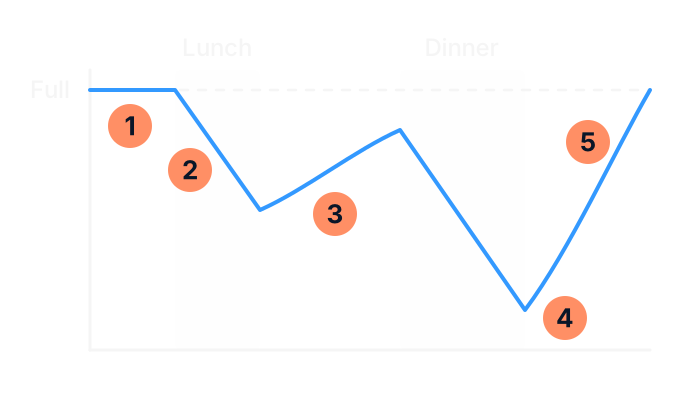
- Opening. The bin is as full as the machine fills it.
- Lunch takes ice out faster than the machine makes it, so the level falls.
- Between services the machine refills the bin at its hourly rate.
- The busiest service takes the level to its lowest point of the day. If the line reached the bottom, the bin would be empty and staff would run out.
- Overnight the machine brings the bin back to full before the next day starts.
What is your ice used for, and when?
Start from what your venue does, not from a rate per seat. A rate per seat is a check at the end: the ice machines page has the usual daily figures per person, per seat and per room. List every use on your busiest day, and when in the day it happens.
The quickest way to measure a use is to weigh it. Fill a glass the way your staff do, tip the ice into a container on kitchen scales, and write the weight down. Do the same for an ice well, a bottle bucket and a display tray.
| Use | How to work it out | What to watch for |
|---|---|---|
| Drinks | Drinks served in each service, times the ice in one glass. A 300 ml glass filled with ice usually takes about 0.15 kg, and a 450 ml one about 0.25 kg. | A soft drink poured over a full glass of ice takes far more than a spirit with two cubes. |
| Drinks from a cold plate | A soft drink dispenser that chills drinks through a plate under the ice. Allow about half as much ice again as the drinks alone. | Count it only where the drinks are chilled through the ice. |
| Ice wells, buckets and cocktails | Weigh a full well or bucket, and count how often it is filled in each service. | Refills late in the night, and ice tipped out at close. |
| Displays | The tray's volume in litres times about half a kilogram, times the number of times it is filled in a day. | Seafood and salad displays are usually refilled more than once a day. |
| Guest rooms and functions | Rooms let, or guests at a function, times the ice each one takes. | Guests filling an esky take far more than a glass. |
| Ice you buy in | Bags bought on a busy day, times the weight of a bag. | This is ice your present machine is not making. |
Put each use in the service it falls in: lunch, the afternoon, dinner, a function. The total for the day is what the machine has to make. The biggest service is the peak the bin has to carry.
What does the output on a spec sheet mean?
A machine's daily output is measured at a set air temperature and water temperature, and makers headline different ones. Australian sheets use at least four. One maker's sheet lists the same machine at 165 kg, 145 kg and 140 kg a day, depending on the row.
| Air and water | What it tells you |
|---|---|
| 10°C air, 10°C water | A cool room and cold water. The highest figure, and well short of a summer service. |
| 21°C air, 10°C water | A comfortable room with cold water. Often the headline figure. |
| 21°C air, 15°C water | A comfortable room with cool water. Also used as a headline. |
| 32°C air, 21°C water | A hot room and warm water. Australia's minimum energy standard for ice makers uses this point to say which machines it covers. Use this figure, or the maker's figure at your own room and water temperatures. |
At 32°C air and 21°C water, most air-cooled machines make about 70 to 85 per cent of their 21°C figure. A few lose less than 10 per cent, and machines cooled by water or by a remote condenser often lose less than air-cooled ones, though not on every model. In a hotter room output keeps falling, so ask for the maker's table if your room runs above 32°C.
- Read the conditions beside the number. Ask for the output at 32°C air and 21°C water, or the maker's table at the temperature of your room and your tap water.
- Check the power supply on the sheet. A figure from a United States sheet is for 60 Hz power. Output on Australia's 50 Hz supply is lower, so use the Australian sheet.
- Ask for the registration number. Commercial ice makers supplied in Australia come under a minimum energy performance standard (opens in a new tab). A covered model's registration number has to be shown on the product and wherever it is advertised, and the capacity its supplier declares cannot be higher than the capacity it was tested at. That is as at November 2026.
To find your own conditions, put a thermometer where the machine would stand during a summer service, and measure the water from the nearest cold tap on a warm afternoon. If the room is hot, see the guide to an air-cooled or water-cooled ice machine.
How much ice does the bin really hold?
Bin capacity is quoted two ways, and one bin can carry two figures. One way counts 80 per cent of the bin's volume at a lighter packing of ice, and the other counts 90 per cent at a heavier packing. One bin on an Australian sheet is rated at 319 kg the first way and 406 kg the second. Ask which way a figure was worked out before you compare two bins.
Some self-contained machines stop making ice well before the bin is full: one maker's sheets give about 80 kg in a 110 kg bin and 23 kg in a 38 kg bin. Ask whether the storage figure on a sheet is the most the bin holds or the level the machine stops at. The ice you can count on at the start of a rush is the lower of the two.
- Built-in bins are small next to the machine. On the sheets we have worked through, a self-contained machine holds between a quarter and three quarters of what it makes on a hot day.
- A modular head sits on a bin you choose, so its storage can be sized to the peak rather than to the machine.
- A dispenser holds very little. One holds about 4 kg against about 85 kg made on a hot day, so at a dispenser the machine's hourly rate is the supply during a rush.
Will the bin last the rush, and refill in time?
Use the output at your conditions to work out the machine's hourly rate, then test it against your busiest service. The worksheet follows the same four steps.
- Hourly rate. Divide the daily output at your conditions by 24. A machine making 115 kg a day at 32°C makes about 4.8 kg an hour.
- Ice made during the peak. Multiply the hourly rate by the length of your busiest service. Over a 3-hour dinner, that machine makes about 14 kg.
- Storage needed at the start. Take the ice the service uses and subtract what the machine makes during it. If dinner uses 60 kg, the bin needs about 46 kg in it when service starts.
- Time to refill. Divide the ice the bin has to win back by the hourly rate, and compare it with the hours until the next rush. Winning back 46 kg at 4.8 kg an hour takes nearly 10 hours.
On the sheets we have worked through, refilling an empty built-in bin at 32°C takes from about 7 hours to about 19, and more than 10 on most. A bin emptied by a late Friday night may not be full again for Saturday lunch, so work out the two services together, or choose a larger bin.
Self-contained, a head on a bin, or a dispenser?
The ice machines page describes the three kinds of machine. For sizing, what matters is how much each one stores and the room it takes.
| Layout | Room it takes | Storage | Check with the supplier |
|---|---|---|---|
| Self-contained | From about 800 mm high under a bench to about 1.6 m as an upright cabinet, plus the clearance its manual sets. | Built in and fixed. | That the ice the bin keeps, not only its maximum, covers your peak. |
| Modular head on a bin | About 1.5 to 2.4 m high together. Clearance above the head runs from about 200 to 600 mm, depending on the model. | Chosen separately, so it can be sized to the peak. | That the head and bin are made to go together: the width, an adapter for a narrower head, and the deflector that guides ice into the bin. A head wider than its bin does not fit. |
| Dispenser | About the size of a small cabinet. | A few kilograms. | That the hourly rate covers the rush at that point. |
A busy venue can put two heads on one bin, side by side under a bin top made for two, or stacked with the maker's stacking kit. Not every machine can go side by side or be stacked, so the supplier confirms each combination against the makers' tables, and fitting it is a technician's job.
Ice machine sizing worksheet
Who to talk to
We sell ice machines for hospitality venues. Send the worksheet with an enquiry from the ice machines page. If you are replacing a machine, add its brand and model and whether it kept up. If yours is making less ice than it used to, see the guide to an ice machine making less ice first.
Sources (24)
Checked on 20 November 2026
- Federal Register of Legislation: Greenhouse and Energy Minimum Standards (Commercial Ice-makers) Determination 2025 (opens in a new tab)
- Federal Register of Legislation: explanatory statement, Commercial Ice-makers Determination 2025 (opens in a new tab)
- Hoshizaki Lancer: IM-240PE-23 cube ice maker specification sheet, 2026 (opens in a new tab)
- Hoshizaki Lancer: IM-130CPE-23 undercounter cube ice maker specification sheet, 2026 (opens in a new tab)
- Hoshizaki Lancer: KM-140C-HC crescent cube ice maker specification sheet (opens in a new tab)
- Hoshizaki Lancer: KM-60C-HC crescent cube ice maker specification sheet (opens in a new tab)
- Hoshizaki Lancer: DCM-120KE-P cubelet ice dispenser specification sheet (opens in a new tab)
- Hoshizaki Australia: commercial ice machine buying guide (opens in a new tab)
- Hoshizaki: ice sizing guide (copy held by a reseller) (opens in a new tab)
- Moffat: Scotsman NB 948 ice storage bin specification sheet (copy held by a reseller) (opens in a new tab)
- Moffat: Scotsman NW 307 modular ice maker specification sheet (copy held by a reseller) (opens in a new tab)
- Moffat: Scotsman ECM 227 self-contained ice maker specification sheet (copy held by a reseller) (opens in a new tab)
- Scotsman: commercial product guide 2026 (opens in a new tab)
- Scotsman: ice storage bins specification sheet, 2017 (opens in a new tab)
- Scotsman: stacking kit installation instructions (opens in a new tab)
- Manitowoc: UP0190 undercounter ice machine service bulletin, production and cycle charts, 2025 (copy held by a reseller) (opens in a new tab)
- Manitowoc: Indigo NXT iP0500 50 Hz specification sheet, 2025 (copy held by a reseller) (opens in a new tab)
- Manitowoc: ice storage bins specification sheet and head compatibility tables (copy held by a reseller) (opens in a new tab)
- Manitowoc: S model ice machines installation, use and care manual, 2019 (copy held by a reseller) (opens in a new tab)
- Comcater: Brema ice machine range brochure with production table (opens in a new tab)
- Bromic: IM0113SSC self-contained ice machine specification sheet (copy held by a retailer) (opens in a new tab)
- Follett: ice storage versus ice production, bin selection sheet, 2019 (opens in a new tab)
- Ice-O-Matic: how much ice do you need, 2018 (copy held by a reseller) (opens in a new tab)
- ABL Refrigeration: commercial refrigeration services (opens in a new tab) ABL's own page.
Related pages
- Ice machine repairs and sales in Gippsland
Kinds of ice and machine, usual daily figures, and what the site needs.
- Air-cooled or water-cooled ice machine: site trade-offs
When the room is too hot for an air-cooled machine.
- Ice machine making less ice: what to record before service
When the machine you have is not keeping up.
Choosing an ice machine?
Send ABL your sizing worksheet with an enquiry, or call us to talk it through.
Filled in the record? Copy or print it first: it is not sent with a call or an enquiry.