
Choosing milk vat size around your tanker collections
How to work out the milk your vat must hold between tanker pickups at peak, why a vat can be too big, and what to check before a new or used vat.
Last updated
Size a milk vat from the most milk you make between two tanker pickups at your peak, counted in milkings, for the herd you expect in a few years, and decide how much room to leave for a late tanker. Then check the other end: on many vats the first milking after a pickup has to cover the agitator before cooling can start, so a vat can be too big as well as too small. The volume and the timing are yours to work out. The cooling design is a refrigeration job, and whether milk is accepted is your milk company's decision.
How to use this guide
How much milk does the vat have to hold?
Work in milkings, not days, and use your real pickup times, not the timetable. As at November 2026, Gippsland milk companies collect every day or every second day, and some prefer a vat that holds two days of milk. Your supply agreement says which, and how old milk can be when it is collected.
| Collection pattern | Milkings to hold | Why |
|---|---|---|
| Every day, milking twice a day | Two, or three if the pickup time moves | If the tanker comes before the morning milking one day and after it the next, three milkings are in the vat at the second pickup. |
| Every second day, milking twice a day | Four, with a fifth as an allowance to weigh | Four milkings is two days of milk. Some overseas guidance plans for five, so a pickup that comes after the next milking still fits. Weigh the fifth against the first-milking check below and your milk company's limit on how old milk can be. |
| Automatic milking | The litres made in the longest gap between pickups | Milk comes in around the clock, so count litres, not milkings. |
Then do the sum for the herd you expect to milk in about five years, at its peak:
Peak litres a day ÷ milkings a day × milkings to hold = litres the vat has to hold
As a made-up example: 300 cows at a peak of 25 litres a day is 7,500 litres a day, or 3,750 litres a milking. Picked up every second day, four milkings is 15,000 litres, or 18,750 litres with a fifth. Take the peak from your own milk dockets, not from a district average.
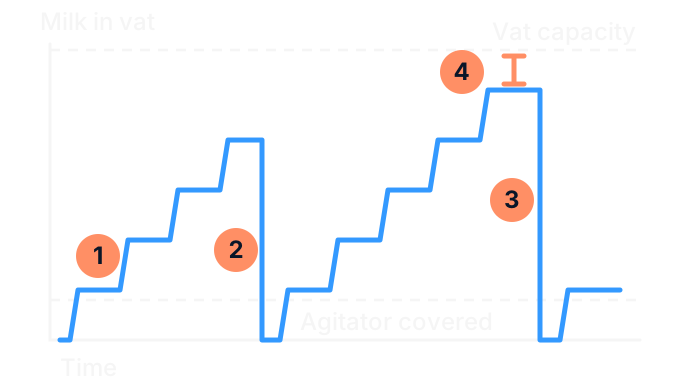
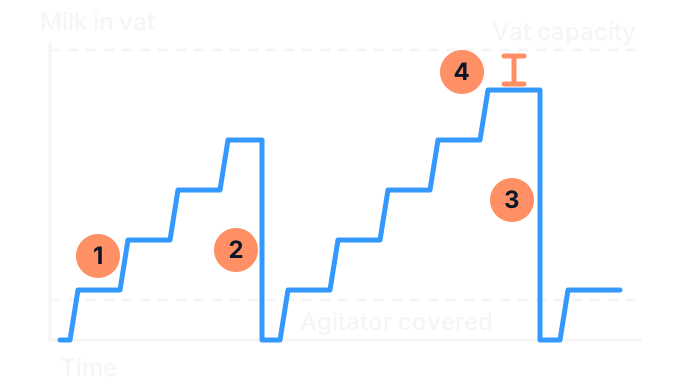
- The first milking after a pickup. On a direct expansion vat it has to cover the agitator before the cooling starts.
- The tanker empties the vat.
- A late tanker: the vat takes one more milking than usual.
- The room left below the vat capacity when the vat is at its fullest: your margin.
Can a milk vat be too big?
Yes. Most vats are direct expansion: the refrigerant cools the floor of the vat itself, and that surface can run below 0°C. Cooling should not start until the agitator paddle is covered, or milk can freeze against the cold surface, and milk company quality manuals can forbid frozen milk. In a vat much bigger than the first milking, cooling starts late, and the temperature probe may not even be in the milk at first.
So check the first milking after a pickup in your lowest month, not only at peak. Some newer vats are built to cool small volumes from the start, with chilled glycol, compressors that turn down, or cooling plates low in the vat. Ask the maker for the smallest volume the vat can start cooling, and compare it with your smallest first milking. On an automatic milking farm the first milk after the tanker leaves is a small volume, so raise this at the start.
What happens when the tanker is late or cannot come?
Supply agreements ask the farm to keep the road open to the tanker in all weather, around the clock, and to tell the milk company or carrier straight away about anything that could stop or delay a pickup. When flood, fire or a closed road stops the tanker, milk company agreements generally leave the loss with the farm, and milk that cannot be collected or kept cool is dumped on farm on the milk company's advice. A margin in the vat buys time. Whether a bigger vat is worth it comes down to how often your access closes and what a lost vat of milk costs you, against the price of the extra capacity and the power to cool it.
An early tanker matters too. In industry practice milk is cooled to 5°C or below within 3.5 hours from the start of milking. If the tanker collects inside that time and the milk still measures above 5°C, for example because it arrives before chilling is complete, the milk goes through the milk company's risk assessment, and milk that fails it cannot be used for human consumption. Your milk company's own program decides. Our farm and dairy refrigeration page sets out what the rules ask.
Does a bigger herd mean the cooling needs a review?
Usually, yes. More cows, a longer peak, a faster milk pump or a new milking system change two separate things:
- The volume in the vat, which is the sum above. A direct expansion vat's refrigeration is sized to the vat, and the area of its cooling floor caps how much heat it can take out. A bigger refrigeration unit alone may not keep up with a vat the herd has outgrown.
- The rate milk arrives, which the pre-cooling has to handle. A plate cooler is sized to the peak flow from the milk pump, so more milk an hour can overload one that coped before. The guide to one-stage or two-stage milk pre-cooling covers that side.
Milking a large herd can itself take longer than 3.5 hours, and the cooling finishes later with it. Milk companies ask for the cooling to be checked at peak production, and at least one asks to be told when vat capacity changes. For a larger change to the cooling itself, see the guide to direct expansion or stored cooling for milk.
How do you replace a vat without missing a collection?
Plan the swap around a pickup, with your milk company in the loop from the start. At least one requires you to contact it before a vat is replaced or moved. Milk companies can arrange extra pickups by agreement, for example after a breakdown or when vat capacity falls short, and some charge for them. The table sets out the questions to settle, and who answers each.
| When | What to settle | Who |
|---|---|---|
| Months ahead | The new vat's size from the sum above, where it stands, tanker access to it, and the outlet position and fitting your milk company asks for. | You, the milk company and the vat supplier |
| Weeks ahead | Whether the new vat can stand beside the old one, or has to take its place. A changeover date in a low-production month. Power for the new refrigeration unit. | You, the installer and an electrician |
| The milk on the day | If both vats fit, the old vat can keep cooling until the new one is commissioned and cooling. If the new vat takes the old one's place, ask the installer how long the farm will be without a vat, time the swap straight after a pickup, and ask the milk company how the milk from that gap will be collected. | You, the installer and the milk company |
| After | A cooling check on the new vat at its first peak, and the records your milk company asks for. | You and the refrigeration technician |
As at November 2026, one Gippsland milk company's handbook asks for the vat outlet within three metres of the vat room door, a tanker parking spot that needs no more than six metres of hose, and an outlet that can be adapted to a 76 mm fitting. Another sets similar figures as conditions of its rebate for a replacement vat. Check your own agreement before the vat's position is fixed.
Moving or taking out the refrigeration of an old vat is licensed work. In Australia, work that involves handling a scheduled refrigerant, or a part of the equipment that could release one, needs a refrigerant handling licence (opens in a new tab). That includes installing, servicing and decommissioning.
What should you check on a used milk vat?
A well-kept vat can last 20 years or more, so a used one can be good buying. Have a refrigeration technician look at it before you commit, and check these:
| Check | Why it matters |
|---|---|
| Its capacity, and the collection pattern it was built for | A vat's cooling is sized for the collection pattern it was built for. One built for daily pickup is made to cool a bigger share of its volume at each milking than one built for every second day. Ask what share of the vat one milking may fill, and compare it with your biggest milking. |
| The type of cooling | Direct expansion or chilled water or glycol. It decides the smallest first milking it can cool. |
| The refrigeration unit, its age and its refrigerant | Older refrigeration units are commonly replaced when a used vat is sold on, and some old direct expansion vats are not built for the pressures of newer refrigerants. Units on R22 can keep running and be serviced, but the Australian Refrigeration Council (opens in a new tab) says R22 imports end on 1 January 2030, as at November 2026. |
| The agitator | Noise, leaks and the direction it turns. |
| Seals and the outlet valve | A leaking outlet valve leaves milk sitting between the valve and its cap, where it is not cooled. |
| The temperature display | Milk company manuals ask for the readout to be checked against a calibrated thermometer, and one allows 1°C either way. |
| The outlet fitting | Whether it suits your milk company's tanker connection. |
Do you need the vat maker's authorised mechanic?
While a vat is under its maker's warranty, it can matter. Vat makers handle this differently: some publish a network of authorised mechanics, one says its refrigeration and electrical service should be done by its authorised dealers, and at least one voids its warranty if anyone else services the vat. Read the warranty and ask the maker who may work on the vat before you book a repair under it.
Outside the warranty, the refrigeration side of a vat is serviced by a licensed refrigeration technician, and milk companies ask for the service records at audit. Keep them with the vat's cooling checks.
Vat capacity planning sheet
Who decides which part?
| Part of the decision | Who decides it |
|---|---|
| How much milk, and when the tanker comes | You, from your own records and your supply agreement. |
| Collection pattern, tanker access, outlet and cooling checks | Your milk company, through its supply agreement and farm quality manual. |
| Cooling capacity of the vat and the pre-cooling | A refrigeration technician, from your figures and the site. |
| Whether warm or late-cooled milk is accepted | Your milk company, through its risk assessment. |
| The dairy licence and its food safety program | Safe Food Victoria (opens in a new tab), the dairy regulator. |
| Wiring and power supply | A licensed electrician. |
We install, service and repair refrigeration for farms across East Gippsland, including milk vat cooling and bulk milk storage, and we plan farm refrigeration around milking times and tanker collections. Our farm and dairy refrigeration page explains how to book a visit or ask for a quote. Bring your planning sheet.
Sources (29)
Checked on 20 November 2026
- Dairy Australia: milk cooling and collection (opens in a new tab)
- Food Standards Australia New Zealand: guide to Standard 4.2.4, primary production of dairy (opens in a new tab)
- Safe Food Victoria: dairy licences (opens in a new tab)
- Saputo Dairy Australia: Gippsland milk supply agreement and supplier handbook 2026 to 2027 (opens in a new tab)
- Lactalis: milk supplier handbook 2026 to 2027 (opens in a new tab)
- Bulla: milk supply agreement 2026 to 2027 (opens in a new tab)
- Bega: farm quality assurance manual, 2025 (opens in a new tab)
- Bulla: farm quality assurance manual, June 2025 (opens in a new tab)
- Dairy Australia: milk tanker operator information kit (opens in a new tab)
- Dairy Australia: preparing for power outages (opens in a new tab)
- Dairy Australia: missed milkings due to adverse events (opens in a new tab)
- Dairy Australia: saving energy on dairy farms (opens in a new tab)
- Dairy Australia and FutureDairy: management guidelines for pasture-based automatic milking farms (opens in a new tab)
- Teagasc: dairy farm infrastructure handbook, bulk tank size (opens in a new tab)
- Milk Development Council report on bulk milk tank cooling efficiency (hosted by Teagasc) (opens in a new tab)
- BSI: BS EN 13732:2022, bulk milk coolers on farms, scope (opens in a new tab)
- Pac Cool: horizontal milk cooling tanks flyer, 2023 (opens in a new tab)
- Milkplan: milk cooling tank manual and warranty (opens in a new tab)
- Paul Mueller: milk cooler preventative maintenance (opens in a new tab)
- Fonterra Farm Source: understanding your milk cooling system (opens in a new tab)
- DeLaval: milk cooling brochure (opens in a new tab)
- Paul Mueller: robotic milk cooling (opens in a new tab)
- Dairy-Tech Refrigeration: direct glycol milk cooling tanks (opens in a new tab)
- Dairy-Tech Refrigeration: authorised sales and service network (opens in a new tab)
- Dairy-Tech Refrigeration: about, and warranty (opens in a new tab)
- Australian Refrigeration Council: fact sheet 26, R22 gas and equipment (opens in a new tab)
- Australian Refrigeration Council: what work requires a refrigerant handling licence (opens in a new tab)
- Australian Refrigeration Council: frequently asked questions (opens in a new tab)
- ABL Refrigeration: commercial refrigeration (opens in a new tab) ABL's own page.
Related pages
- Dairy and farm refrigeration in Gippsland
Milk vat cooling, servicing and repairs, and what the rules ask.
- Milk plate cooler: one stage or two stage pre-cooling?
Whether the pre-cooling keeps up with more milk an hour.
- Direct expansion vs ice bank milk cooling: which suits you?
Choosing how the milk is cooled.
Planning a new or bigger milk vat?
Bring your planning sheet. We plan farm refrigeration around milking times and tanker collections.
Filled in the record? Copy or print it first: it is not sent with a call or an enquiry.