
Dairy and farm refrigeration service in Gippsland
Milk vat cooling, produce cold rooms and on-farm meat chillers in Gippsland. Which job is yours, who answers for what, and what to tell ABL.
If a vat or a cold room has stopped cooling, call ABL and use the emergency line if it is urgent. For a new project or servicing, send an enquiry with the farm record on this page. Either way, have the make and model of the equipment ready, and your milking times or harvest dates.
How a farm enquiry runs
Milk vat repairs: when the vat is not cooling
If the milk in the vat is not cooling, call ABL, and use the emergency line if milk is at risk. Then:
- Write it down. The vat temperature and the time, when milking started, and the litres in the vat. Note any alarm or code on the vat controller, and whether the refrigeration unit outside is running.
- Follow your food safety program. Its corrective action for milk that is not cooled in time can include telling your milk company or the transport company. Your program may require you to tell them about a cooling failure before the tanker arrives, so do that as well as calling us.
- Leave the equipment closed. What is inside the refrigeration unit and the vat controller is for the technician.
Which farm job is yours?
ABL works across Gippsland from Bairnsdale. That takes in dairy country such as the Macalister Irrigation District (opens in a new tab) around Maffra, Stratford and Sale, and vegetable growing on the Mitchell River flats (opens in a new tab) around Lindenow. Our farm work falls into three kinds of job.
| Kind of job | What we work on | Have ready |
|---|---|---|
| Dairy milk cooling | Milk vat cooling, bulk milk storage, and refrigeration for cheese making facilities. | The make, model and capacity of the vat and its refrigeration unit, your milking times, the litres at peak, and when the tanker collects. |
| Produce storage | Cold rooms for fruit, vegetables and cut flowers. | The crops, how much comes in on a peak day, how it is packed, how warm it is when picked, and how long it stays. |
| Meat and processing rooms | Hanging chillers, blast freezers and processing room refrigeration for on-farm butchering. | What you kill and how many at a time, how long carcases hang, what you freeze, and whether the meat is sold. |
If your plant runs on ammonia or glycol, tell us before a visit is booked.
For a cold room on any site, see the coolroom and freezer room installation page. Our other work is on the commercial refrigeration page.
A new project, servicing or a fault?
| Kind of enquiry | How to make it | What we need from you |
|---|---|---|
| A fault now | Call ABL. If milk or stock is at risk, use the emergency line. | What the equipment is doing, the temperature it shows, when it started, any alarm or code, and the make and model. |
| Servicing | Send an enquiry or call. | A list of the equipment, its last service report, and what your food safety program or milk company asks to be checked. |
| A new project or an upgrade | Send an enquiry with the farm record on this page. | What you produce or store, at your peak, and the site: power, water, access and where the plant could go. |
For what a planned visit covers, see the commercial refrigeration maintenance page. For what to do with stock while equipment is down, see the coolroom and commercial fridge repairs page.
How a milk cooling system fits together
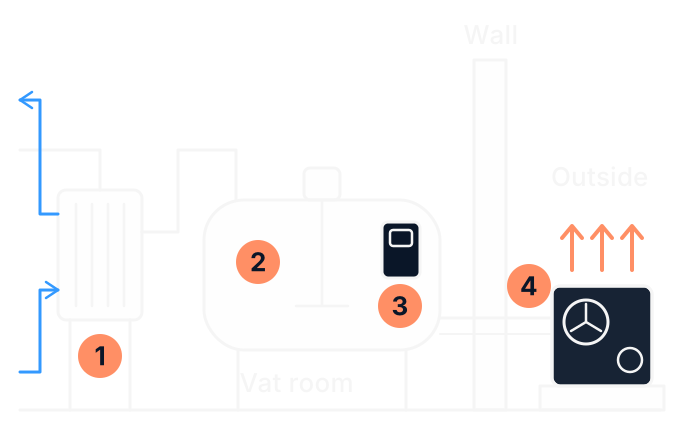
Many dairies cool milk in two stages. A plate cooler takes the first heat out with water as the milk leaves the milking plant, and the refrigerated vat brings it the rest of the way down and holds it until the tanker comes. Knowing which part is which helps you describe a fault.
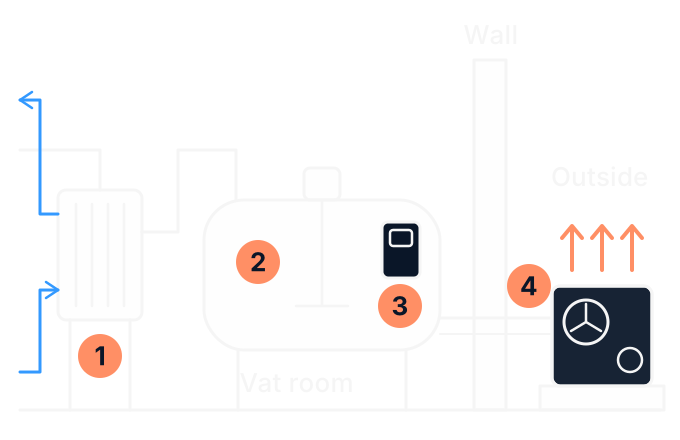
- The plate cooler. Milk runs along one side of thin steel plates and water or a coolant along the other, so the milk reaches the vat already cooler.
- The milk vat, with its agitator, which stirs the milk.
- The vat controller, with the temperature readout your records use.
- The refrigeration unit, outside the vat room. It gives off the heat taken from the milk, so it needs cool, open air around it.
- How fast a vat cools depends on the vat, the kind of refrigeration unit, the volume of milk, when the tanker collects, and the weather.
- Direct expansion is the most common arrangement: the refrigeration unit cools the milk in the vat itself. Thermal storage chills water or glycol ahead of time, holds it in an insulated tank and uses it to cool the milk through a plate cooler. It lets the refrigeration run at cheaper times, and can be the only option where grid power is limited.
- A plate cooler is doing its job when the milk leaves it no more than about 2°C warmer than the water or coolant going in. A strip thermometer on the two pipes shows it. A bigger gap is a job for a refrigeration technician to check, because a blocked plate cooler or the wrong water flow puts more work on the vat.
The guides go deeper: comparing milk-vat refrigeration and stored-cooling systems, comparing milk pre-cooling arrangements, heat recovery from dairy refrigeration and choosing milk storage capacity around tanker collections.
Milk cooling: what the rules ask, and who answers for what
A dairy farm business in Victoria is licensed by Safe Food Victoria (opens in a new tab), which took over from the old dairy regulator on 1 July 2026. Standard 4.2.4 of the food standards asks the farm to cool and store milk at a temperature that prevents or reduces the growth of microbiological hazards. The long-held industry regime, as FSANZ's guide to the standard (opens in a new tab) of January 2008 describes it, is 5°C or less within 3.5 hours from the start of milking.
A farm that writes that regime into its food safety program does not have to prove that the regime keeps milk safe. It does have to validate that its own cooling equipment achieves it: see the cooling check in the records below. A farm that uses a different regime has to validate the regime too, and may need to work with the company that takes its milk to do so. Most milk companies supply a farm quality assurance program that may meet the requirements for a food safety program.
| Who | What they answer for |
|---|---|
| The farm | Its food safety program: the cooling regime, checking the vat temperature, keeping the records, and the corrective action when milk is not cooled in time, which can include telling the milk company or the transport company. |
| The milk company | Its farm quality assurance program and what it accepts. In practice, milk collected within the 3.5 hours while it is still above 5°C, for example when the tanker arrives before cooling is complete, is risk-assessed by the processor, and milk that fails cannot be used for people. Your milk company's own program decides. |
| Safe Food Victoria | The dairy farmer licence, the approval of the food safety program, and monitoring compliance, including the audits set by the licence conditions. |
| A refrigeration technician | Installing, servicing and repairing the refrigeration, and a report of the work for your records. The technician does not decide whether milk is accepted. |
| Your milking machine technician and electrician | The milking plant, and the power supply. |
Servicing keeps equipment working. It does not make a farm meet its licence: that rests with the farm and its program. Making cheese brings further requirements under the dairy standard and Safe Food Victoria's licences. Those process controls belong to the business and its regulator, and we provide the refrigeration.
Records that make a service visit count
Milk companies' farm quality manuals commonly ask for these. Check what yours asks for, and have them ready for a service visit.
- the vat temperature before and after each milking
- a cooling check at least twice a year, for example in mid-summer and at peak production: how long milking takes, and how long the milk takes to reach 5°C
- the vat readout checked against a calibrated thermometer, or against the tanker docket at collection, at least twice a year
- the service records for the cooling equipment, kept for audit
If a cooling check shows the vat is slower than it should be, those figures are the first thing a technician asks for.
Produce and flower storage at harvest
A produce cold room has two jobs: taking the field heat out of what comes in, and holding it at the right temperature after that. The first is usually the harder one at harvest.
- Room cooling is slow. Bins simply placed in a cold room cool mostly from the outside in. The centre of a half-tonne bin can take several days to drop from over 20°C to below 5°C, and lined or unvented bins are slower still.
- Moving air through the load is faster. Forced-air cooling pulls cold air through the bins or cartons, which cools the produce faster and avoids condensation.
- Warm product keeps arriving. A room that is loaded with warm produce all day carries a bigger load than one that holds cold stock.
- Colder costs more. A room built to run below 0°C usually costs more than one that runs at 2°C or above.
Tell us what you pick, how much on your heaviest day, how it is packed and how long it is stored. The storage temperatures for common crops are on the coolroom installation page. For planning the room around a peak, see the guide to planning cold-storage loading during a harvest peak.
Chillers and freezers for on-farm meat
Who you sell to changes what the room has to do. Safe Food Victoria says you do not need its licence to slaughter animals on a farm and eat the meat yourself. Meat for sale needs a licence, and which one depends on the animal and on how the meat is sold: poultry and game, for example, need their own licences. Safe Food Victoria's meat and poultry licences (opens in a new tab) page lists them. Licence conditions require the facility to meet the relevant Australian and Victorian standards and guidelines. That is as at November 2026.
If you hold a licence or are applying for one, tell us, and bring what your licence and program ask of the rooms. We build and service the refrigeration. Proving that a chilling process meets the licence is the business's work with its regulator.
- A hanging chiller takes carcases down from the kill and holds them while they hang. Tell us how many carcases at a time, their size, and how long they hang.
- A blast freezer pulls product down to frozen fast. A storage freezer is built to hold product that is already frozen. Tell us how much you freeze at once and how often.
- A processing room is chilled so meat stays cold while it is cut and packed. Tell us how many people work in it and for how long.
What we look at on a farm site
| What we look at | Why it matters | What to have ready |
|---|---|---|
| Power | A larger refrigeration unit may need more supply than the farm has spare, back to the transformer. Fixed wiring is work for a licensed electrician, as Energy Safe Victoria (opens in a new tab) sets out. | Whether the supply is single-phase or three-phase, where the switchboard is, and your electrician. |
| Water for a plate cooler | A plate cooler can only cool the milk towards the temperature of the water it gets. | Where the water comes from: bore, dam, tank or mains, and how warm it runs in summer. |
| Where the plant sits | An outdoor unit needs cool air moving through it, and works harder in full sun or where its own warm air comes back to it. | Photos of the unit, or of where a new one could go, and what is around it. |
| Access | A vat, panels or a refrigeration unit has to come in by truck and be put in place. | The way in for a truck, any gates, and the doorway into the vat room or shed. |
| Washdown | Vat rooms and processing rooms are washed down, so water and electrics have to be kept apart. | Where hoses are used, and where the drains are. |
Your farm record
Towns ABL covers
ABL is based in Bairnsdale and works on farms across Gippsland, so tell us your town or locality. A town with a link has its own page.
- Bairnsdale
- Benambra
- Bruthen
- Buchan
- Cann River
- Churchill
- Eagle Point
- Ensay
- Heyfield
- Lake Tyers
- Lakes Entrance
- Lindenow
- Maffra
- Mallacoota
- Marlo
- Metung
- Moe
- Morwell
- Nowa Nowa
- Omeo
- Orbost
- Paynesville
- Sale
- Stratford
- Swan Reach
- Swifts Creek
- Traralgon
If your town is not here, call and ask. See also service areas.
Sources (22)
- ABL Refrigeration: commercial refrigeration services (opens in a new tab) ABL's own page. Checked on 20 November 2026.
- ABL Refrigeration: service areas (opens in a new tab) ABL's own page. Checked on 20 November 2026.
- Australian Government: Triple Zero (000) (opens in a new tab) Checked on 20 November 2026.
- Food Standards Australia New Zealand: guide to Standard 4.2.4, dairy primary production, January 2008 (opens in a new tab) Checked on 19 November 2026.
- Safe Food Victoria: dairy farmer licence guidance (opens in a new tab) Checked on 19 November 2026.
- Safe Food Victoria: home page, updated 10 November 2026 (opens in a new tab) Checked on 20 November 2026.
- Safe Food Victoria: compliance programs for dairy (opens in a new tab) Checked on 19 November 2026.
- Safe Food Victoria: meat and poultry licences, updated 29 June 2026 (opens in a new tab) Checked on 19 November 2026.
- Safe Food Victoria: abattoir licence (opens in a new tab) Checked on 19 November 2026.
- Safe Food Victoria: further meat processing facility licence (opens in a new tab) Checked on 19 November 2026.
- Energy Safe Victoria: electrical licence types (opens in a new tab) Checked on 20 November 2026.
- Dairy Australia: milk cooling and collection (opens in a new tab) Checked on 19 November 2026.
- Bega Group: farm quality assurance manual, May 2025 (opens in a new tab) Checked on 19 November 2026.
- Bulla: farm quality assurance manual, June 2025 (opens in a new tab) Checked on 19 November 2026.
- Fonterra Farm Source (New Zealand): understanding your milk cooling system, 2023-24 (opens in a new tab) Checked on 19 November 2026.
- Postharvest management of vegetables (Applied Horticultural Research for Hort Innovation): cooling methods (opens in a new tab) Checked on 19 November 2026.
- Postharvest management of vegetables (Applied Horticultural Research for Hort Innovation): cool rooms (opens in a new tab) Checked on 19 November 2026.
- Williams Refrigeration Australia: the risks of cooling without a blast chiller (opens in a new tab) Checked on 19 November 2026.
- Williams Refrigeration Australia: operating manual for upright and counter refrigeration, July 2025 (opens in a new tab) Checked on 19 November 2026.
- Dairy Australia: thermal storage for cooling systems, July 2023 (opens in a new tab) Checked on 19 November 2026.
- Southern Rural Water: Macalister Irrigation District modernisation (opens in a new tab) Checked on 19 November 2026.
- East Gippsland Catchment Management Authority: cluster of activity in Lindenow (opens in a new tab) Checked on 19 November 2026.
Related pages
- Comparing milk-vat refrigeration and stored-cooling systems
Direct expansion or thermal storage for your vat.
- Choosing milk storage capacity around tanker collections
Size the vat to your milk and your pickups.
- Planning cold-storage loading during a harvest peak
Plan a produce room around your busiest weeks.
Farm refrigeration to fix, service or plan?
Call ABL about a fault, or send an enquiry with your farm record for servicing or a new project.
Filled in the record? Copy or print it first: it is not sent with a call or an enquiry.