
One-stage or two-stage milk pre-cooling: how to choose for your shed
How one-stage and two-stage milk plate coolers differ, what your water, power and vat decide, and a sheet to fill in over one milking.
Last updated
A one-stage plate cooler cools milk with water alone, so the milk leaving it can only get to within a couple of degrees of that water. A two-stage cooler adds a second set of plates fed with something colder: ice water or glycol can take the milk close to storage temperature before it reaches the vat, while a tank of chilled water leaves more of the finishing to the vat. Which suits your shed comes down to how cold and how plentiful your water is through the year, how fast milk flows at peak, and what your vat refrigeration and power supply can carry.
How to use this guide
Step 1: Read the temperatures
During a normal milking, read the water and the milk either side of the cooler.
Go to ReadingsStep 2: Fill in the sheet
Record the water, the milk, the vat and any changes to the shed.
Go to the record
How do one-stage and two-stage plate coolers work?
A plate cooler is a stack of thin stainless steel plates. Milk runs along one side of each plate and cooling water or coolant along the other, in the opposite direction, so heat passes from the milk into the water through the plate. Milk leaves the cow at about 35°C and the target is 5°C or below, so every degree the cooler takes out is a degree the vat refrigeration does not have to remove.
- One stage: one plate pack, cooled by water from a bore, a dam, a river, a rainwater tank or the mains. The vat refrigeration takes the milk the rest of the way.
- Two stage: the same first stage, then a second plate pack cooled by ice water, a food-grade glycol mix or chilled water. The cold comes from a chiller that runs during milking, or from an ice bank or a tank of chilled water built up beforehand. The milk can only leave the second stage a little warmer than the fluid going in, so ice water or glycol below 0°C can bring it close to storage temperature, and a chilled-water tank that runs warmer leaves more for the vat to finish. The vat holds the milk until pick-up either way.
You will hear second stages called a glycol chiller, snap or instant chilling, an ice bank or ice builder, or a double-bank cooler, which is one plate pack with two banks of plates.
Where the cold for a second stage comes from is a choice of its own, with its own effect on your power supply and running costs. The guide to comparing milk-vat refrigeration and stored-cooling systems covers it.
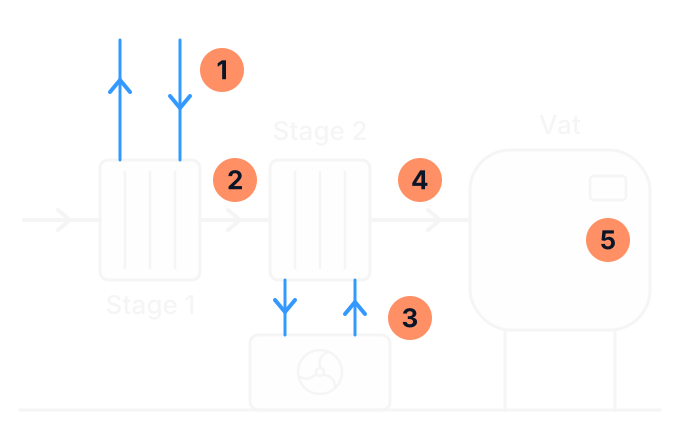
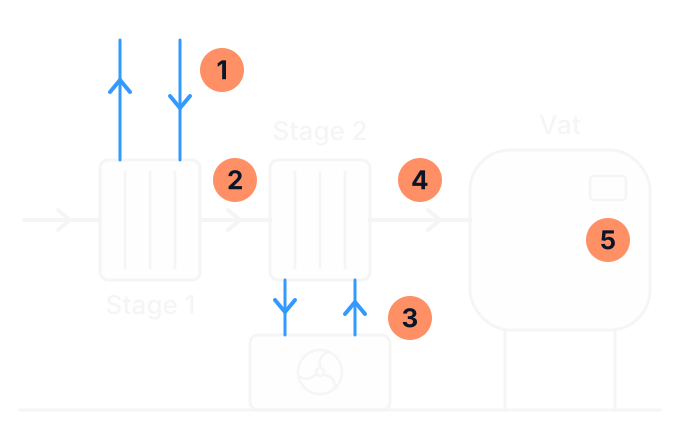
- Water into the first stage: your bore, dam, tank or mains water as it reaches the cooler.
- Milk out of the first stage: on a one-stage cooler, this is the milk going to the vat.
- The chiller or ice bank display: the temperature of the fluid going to the second stage, where the unit shows one. The lines on this side are usually lagged, so read the display, not the pipe.
- Milk into the vat, after the second stage.
- The vat display: the reading at the end of milking, and how long the milk took to reach 5°C.
One stage or two: how do they compare?
| What you are comparing | One stage | Two stage |
|---|---|---|
| What cools the milk | Water from your bore, dam, tank or the mains. | Water first, then chilled water or glycol. |
| How cold the milk gets before the vat | At best a couple of degrees warmer than the water going in. Warmer water in summer means warmer milk to the vat. | Close to storage temperature with ice water or glycol below 0°C. A little above the store temperature with a chilled-water tank. |
| Water it needs | About 2 to 3 litres of water for every litre of milk while milk is flowing, depending on the cooler, and as cold as you can get it. | The same for the first stage. The chilled water or glycol goes back to be cooled again, and two-stage pre-cooling can cut the water used for milk cooling. |
| Power it needs | A pump for the cooling water. The vat refrigeration does the rest during and after milking. | A chiller during milking adds to the load at milking time. A store of ice or chilled water can be built earlier, but uses more energy overall. |
| What it asks of the vat | The vat refrigeration removes all the heat the water did not, so its size and the vat set how fast the milk gets to 5°C. | The vat has much less to remove and may need only a smaller compressor, but it still holds the milk cold until pick-up. |
| Upkeep | Clean plates and a steady water flow. Running the plant wash with a filter sock in place keeps soiling out of the plates. | The same, plus a chiller or cold store that needs servicing by a licensed refrigeration technician. |
| What goes into the price | The plate pack, pipework, and a pump sized for the flow. | The second plate pack, the chiller or cold store, its pump, controls and insulation, and any power upgrade it needs. |
Neither is right on every farm. A one-stage cooler with plenty of cold water does a lot of the work for very little power, and it is the cheapest cooling in the shed. A second stage costs more to buy, and where its cold comes from changes the running cost. So a second stage earns its place where it solves a problem: water too warm or too short to do enough, vat refrigeration that cannot keep up, or a power supply that cannot carry a bigger vat unit at milking time.
Get the first stage right before you price a second. Dairy Australia puts milk cooling at 20 to 30 per cent of a dairy shed's energy use, and in energy assessments done for the Victorian Government's Agriculture Energy Investment Plan, many farms still had 3 to 5°C of pre-cooling to gain. The fix was often a new pump for the cooling water or a clean of the plate cooler.
Where a second stage does fit, it is usually planned with the rest of the shed. In one Agriculture Victoria case study, a dairy at Binginwarri building a 60-unit rotary chose a two-stage cooler, bore water and then a chilled water and glycol mix, so the milk would reach the vat at about 6°C and the vat would need only a smaller compressor.
What decides which one suits your shed?
The comparison above says how the two differ. These are the numbers from your own shed that decide between them, and where to find each one.
| What to find out | How to find it |
|---|---|
| The temperature of your cooling water through the year | Read it at the cooler during a milking in winter, and again in summer. Water that warms in a sunny tank or a shallow line cools less. |
| How much water goes through the cooler | The timed bucket reading in the next section, where the water already runs from an open pipe. If the flow falls short, adding plates may not help. |
| Peak milk flow | Your milking machine fitter knows the milk pump, and a cooler is sized for its fastest flow, not the average. Litres per milking and the length of milking give you the average. |
| What the vat refrigeration can do | How long the vat takes to reach 5°C, and how its refrigeration runs once it is there. A vat's cooling surface limits how much heat it can remove, however big the unit on it. |
| What your power supply can carry at milking time | A licensed electrician can tell you, and does any work on it. Single-phase power and the capacity of the supply to the shed are the usual limits on a bigger vat unit or a chiller. |
| The plate cooler you have | The brand and model from its nameplate, and whether it has one bank of plates or two. |
| Plans for the herd and the shed | More cows, a bigger vat or a faster dairy raise the peak milk flow. Write down what you expect to change in the next few years. |
Water quality, flow and the design of any second stage are worked out for your shed by the people who size and fit it. These numbers are what that work starts from.
How do I check what my plate cooler is doing now?
These are readings, not adjustments. Take them during a normal milking, from outside the equipment, and write them on the observation sheet.
| Reading | How to take it, then write down |
|---|---|
| Water into the cooler | A strip thermometer stuck to a clean, dry metal section of the water inlet pipe, close to the cooler, gives a good enough reading. Write down the temperature. |
| Milk out of the cooler | The same, on the milk outlet pipe. On a two-stage cooler, read the milk between the stages where you can reach the pipe, and again where it leaves the second stage. Write down each one. |
| The gap between them | On a plate cooler in good order, the milk leaves no more than about 2 to 3°C warmer than the water going in: water in at 10°C, milk out at 12°C or a little more. A bigger gap at the busiest part of milking is worth reporting. Write down the gap at the start, the busiest part and the end of milking. |
| Water flow | Only where the cooling water already runs out of an open pipe you can reach from the ground: at the busiest part of milking, time how long it takes to fill a bucket of known size. A 20 litre bucket that fills in 10 seconds is 2 litres a second, or 120 litres a minute. Undo nothing, climb no tank, and do not try this on a hydrant or a high-pressure line. Write down the litres and the seconds, or "not measured". |
| The second stage, if you have one | Read the temperature on the chiller or ice bank display, if it shows one. Write down what it shows during milking. |
| The vat | Read the vat display at the end of milking, and note how long after the start of milking it showed 5°C or less. Write down both. |
| The vat refrigeration once the milk is cold | Watch and listen from where you stand. Write down whether it switches on and off normally, runs nearly all the time, or clicks on and off often. |
| Where the cooling water goes | Follow the outlet pipe. Write down whether it goes back into the tank it came from, to another tank, or to a job in the shed or yard. |
Is it the vat or the pre-cooling?
When milk is slow to cool, your readings point to which stage to look at first. They do not tell you which part has failed. That is the technician's job, with your readings as the starting point.
| What your readings show | Where to look first | Who looks at it |
|---|---|---|
| Milk leaves the cooler more than about 3°C warmer than the water going in | The plate cooler: the water flow, the plates, or soiling inside them. | Your milking machine fitter or a refrigeration technician. |
| The gap is small, but the water itself is warm | The water supply: a tank in the sun, water going back into the tank it came from, or lines near the surface. | You and your fitter for the tanks and lines. A second stage is a design question. |
| Milk reaches the vat at its usual temperature, but the vat is slow to get to 5°C | The vat refrigeration. | A licensed refrigeration technician. |
| The vat refrigeration runs nearly all the time once the milk is cold, or clicks on and off often | The vat refrigeration. | A licensed refrigeration technician. |
| The chiller or ice bank display reads warmer than usual, or the milk out of the second stage is warmer than it used to be | The chiller, ice bank or chilled-water tank, and its pump. | A licensed refrigeration technician. |
| It started after a change to the shed or the herd | Whether the cooler, the water and the vat still match the new milk flow. | Your fitter and your refrigeration technician. |
If the vat is not getting the milk to 5°C in time, that is a fault to act on now, not a planning question. Follow the corrective action in your food safety program, which can include telling your processor or the milk carrier, and have the cause found. If the tanker collects milk before it has cooled to 5°C, the processor assesses the risk, and milk that fails that assessment cannot be used for human consumption.
How cold does the milk have to be, and how fast?
Standard 4.2.4 of the Food Standards Code requires milk to be cooled and stored at a temperature that prevents or reduces the growth of microbiological hazards. The industry regime, as Food Standards Australia New Zealand's guide to the Standard (opens in a new tab) describes it, is milk at 5°C or less within 3.5 hours from the start of milking. A large herd can take longer than that to milk, and the guide allows a farm in that position an alternative cooling regime, which it may need to show works with its processor or the regulator. In Victoria the dairy regulator is Safe Food Victoria (opens in a new tab).
How cooling is checked on your farm is set by your food safety program and your processor. Most programs ask you to monitor and record milk cooling and to have the vat thermometer checked for accuracy, and the maintenance part of the program should say how often the cooling equipment is checked. A filled-in observation sheet sits well with those records. A pre-cooler helps the vat get the milk cold in time. It does not make the farm's cooling records for it.
What happens to pre-cooling in a dry season?
A plate cooler is only as good as the water it gets. In a dry season the bore, dam or tank can run low and warm up at the same time, and the milk going to the vat warms with it. Plan for that before it happens, rather than counting on this summer's cooling to match last winter's.
- Measure what the shed uses, job by job, at mid-lactation, so you know how much of it goes through the cooler.
- Water sent round and round through one tank warms over a milking. Recycling it works when the tank holds enough water to stay cool, and a small tank fed back on itself does not.
- Keep the water cold on its way to the cooler: tanks in the shade on the south side of the shed, lighter-coloured tanks, and buried supply lines.
- Ask whether the vat can still get warmer milk to 5°C in time on a hot day. If it cannot, the case for more vat capacity or a second stage is better made before that day than during it.
More water for the cooler from a bore, a dam or a creek in a dry year is a licence question before it is a plumbing one. Water used in a dairy shed is a commercial use under the Water Act 1989. As at November 2026, water for it from a watercourse, a dam that captures overland flow, a spring or a bore needs a licence from the water corporation, while roof rainwater, town water and recycled water do not, as Agriculture Victoria explains (opens in a new tab) (page updated June 2020). Every river basin in Victoria now has a cap, and where a basin is fully allocated Southern Rural Water (opens in a new tab) issues no new licences, though an unused licence may be bought or temporarily transferred.
Can plate cooler water be used elsewhere on the farm?
Yes, for jobs that do not need your best water. Milk cooling can be the biggest use of water in the shed if none of it is reused, and once it is recycled the cooler uses very little of its own. Match each use to the quality of water it needs.
| Use | What to know before you send cooler water there |
|---|---|
| Pit and shed cleaning | This needs water of adequate quality for hosing down, and cooler water suits it. Recycled effluent is not used inside the shed. |
| Platform sprays | The same quality as pit and shed cleaning, so cooler water suits it. |
| Yard washing | This can also take recycled effluent, which keeps the cooler water for the shed. |
| Vat and milking machine washing | This needs the highest-quality water you have, such as rainwater. Keep it for this job. |
Water quality matters to the cooler as well. Iron in bore water builds up on plates and pipework and cuts their performance, so tell us if your water carries iron. When you measure, count each litre once: water reused after the cooler is not extra water.
Hot water made from the refrigeration's waste heat is a different system, covered in the guide to heat recovery from dairy refrigeration.
Will cooling keep up after a milking-system upgrade?
A faster dairy moves the same milk through the cooler in less time. A rotary in place of a herringbone, more units, a bigger milk pump or more cows all raise the peak milk flow, so the cooler needs more water per minute and the vat takes in heat faster. Newer, larger plate coolers usually need less water per litre of milk than the smaller coolers in older sheds, which helps. Before the change, or soon after it, ask:
- Is the plate cooler sized for the new peak milk flow?
- Can the water supply give enough water for the new peak?
- Can the vat refrigeration still get the milk to 5°C in time, with a bigger vat, a bigger herd or a longer or shorter milking?
- Has the power supply room for a bigger vat unit or a chiller at milking time?
- Will the pick-up pattern change as the herd grows?
How much milk the vat has to hold between pick-ups is covered in the guide to choosing milk storage capacity around tanker collections.
Milk and water observation sheet
Who looks at which part?
Milk cooling spans more than one trade. The plate cooler, its pump and the water supply are usually the milking machine fitter's work. The vat refrigeration and any chiller or ice bank are refrigeration work. When we look at milk cooling on a farm, we usually:
- compare the water and milk temperatures either side of the cooler with your sheet
- check how the vat refrigeration runs from the start of milking until it is holding, and that its condenser is clean and has free air around it
- say which part of the cooling chain needs attention first: the vat refrigeration, or the plate cooler and its water
What a change costs depends on which parts it involves: plates, pumps and pipework, a chiller or cold store with its controls and insulation, any power upgrade, and the running cost on your tariff. Work that involves handling a scheduled refrigerant needs a technician licensed by the Australian Refrigeration Council (opens in a new tab). Work on the power supply is for a licensed electrician.
ABL's refrigeration work includes milk vat cooling and bulk milk storage. Our farm and dairy refrigeration page explains how to book. Have your observation sheet in front of you when you call.
Sources (14)
Checked on 19 November 2026
- Dairy Australia: milk cooling and collection (opens in a new tab)
- Dairy Australia: milk cooling, energy fact sheet, August 2023 (opens in a new tab)
- Dairy Australia: thermal storage for cooling systems, energy fact sheet, 2023 (opens in a new tab)
- Fonterra Farm Source: understanding your milk cooling system, 2023 to 2024 (opens in a new tab)
- DairyNZ: milk cooling, checking plate cooler performance (opens in a new tab)
- AHDB: ice builder and second stage plate cooler (opens in a new tab)
- Teagasc: optimised milk cooling, technology update, January 2014 (opens in a new tab)
- Agriculture Victoria: measuring water use in the dairy, updated June 2020 (opens in a new tab)
- Agriculture Victoria: water savings planned with new dairy, a case study, updated June 2020 (opens in a new tab)
- Southern Rural Water: taking water from rivers and creeks, fact sheet (opens in a new tab)
- Food Standards Australia New Zealand: a guide to Standard 4.2.4, dairy primary production, January 2008 (opens in a new tab)
- Safe Food Victoria: compliance monitoring for dairy, updated 1 July 2026 (opens in a new tab)
- Australian Refrigeration Council: frequently asked questions (opens in a new tab)
- ABL Refrigeration: commercial refrigeration services (opens in a new tab) ABL's own page.
Related pages
- Comparing milk-vat refrigeration and stored-cooling systems
Where the cold for a second stage or the vat comes from, and what it asks of your power.
- Heat recovery from dairy refrigeration
Putting the heat taken out of the milk to use for hot water.
- Choosing milk storage capacity around tanker collections
How much the vat has to hold between pick-ups as the herd changes.
Planning a change to your milk cooling?
Call ABL with your observation sheet in front of you, or send an enquiry.
Filled in the record? Copy or print it first: it is not sent with a call or an enquiry.