
Air conditioning a coastal or lakeside home: siting and care for the real exposure
How to judge a coastal or lakeside site's real salt and wind exposure, place the outdoor unit, question the model's warranty and keep a care record.
Last updated
The name of the town tells you little. How much salt an air conditioner takes depends on the site: how far it is from the water, whether that water is breaking surf or a calm lake, which way the strong winds blow, and how sheltered the outdoor unit is. Judge those for your own property, put the outdoor unit where it takes the least salt and can still be serviced, follow the manual for the model, and keep a record of its condition. Position and care cut the salt a unit takes. They do not remove it, so the record is what tells you how it is going.
How to use this guide
How exposed is your site to salt?
Breaking surf throws salt spray into the air, and the wind carries it inland. Calm, sheltered water gives off far less. The corrosivity categories used for building metals in Australia, based on AS 4312, give a useful sense of scale. They are a guide, not a rule for any one house:
| Where the site is | Usual exposure |
|---|---|
| Within about 200 metres of a surf beach | The harshest. |
| About 200 metres to 1 kilometre from surf | High. Strong onshore winds can carry it further inland. |
| About 1 to 10 kilometres from surf | Moderate, and higher where prevailing winds carry the salt inland. |
| About 100 metres to 3 to 6 kilometres from open water exposed to the wind, such as a less sheltered bay | Moderate. |
| On the shore of calm salt or brackish water, within about 50 metres | High at the water's edge, even with no surf. |
| About 50 metres to 1 kilometre from calm water | Moderate. |
Then adjust for the site itself. Four things move it up or down: the prevailing wind, the shelter of buildings, banks and trees, the height above the water, and parts that rain does not wash.
The Gippsland Lakes are joined to the sea at Lakes Entrance, and sea water moves in and out on the tide and on storm surges. How salty the water is changes with rainfall and the runoff from the catchment. A marine exposure guide based on the same standard lists the lake shores at Paynesville, Metung and Lakes Entrance as calm salt water, not surf, so for a lakeside site start with the two calm water rows. In the same district, a house facing an open beach and one on a sheltered inlet can sit in very different conditions.
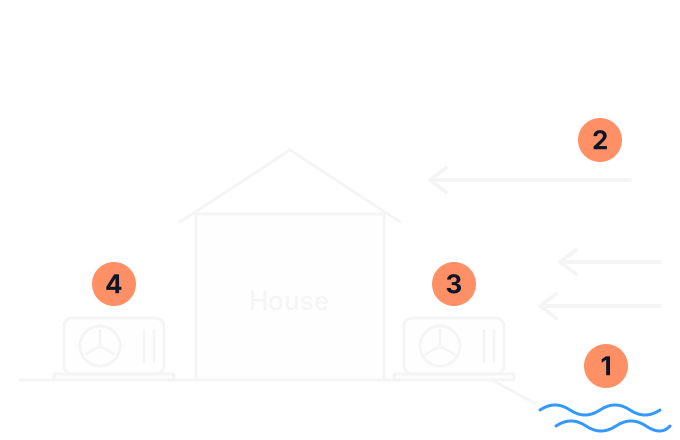
- The water. Note whether it is open surf, open water exposed to the wind, or a calm, sheltered lake or inlet, and how far away it is.
- The prevailing wind. Salt travels inland on onshore wind. Note the direction the strong winds come from.
- Facing the water and the wind. This position takes the most salt spray.
- On the far side of the house. Out of the direct wind, this position takes less salt. If it also sits under deep eaves, the rain does not rinse it, so the salt that does land stays until it is cleaned.
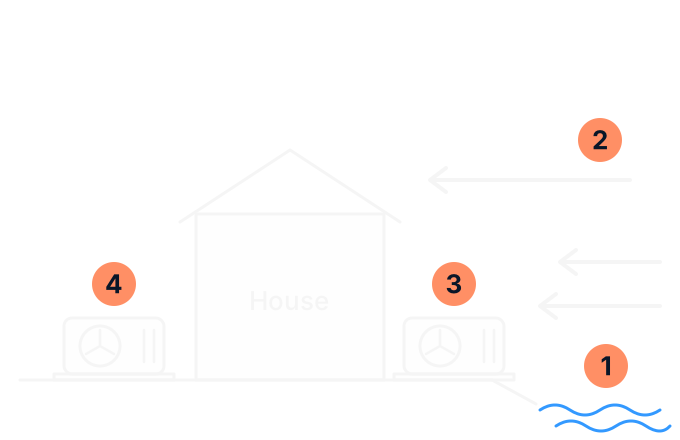
Where should the outdoor unit go on a coastal site?
Several makers' installation manuals list salty places, such as the seaside, among the places to avoid, and say the unit should not face strong wind. That does not mean a coastal home goes without air conditioning. It means the position matters more, and the manual for the model has to be followed, because an installation that ignores it can affect the warranty. These are the things we look for in a coastal position:
- Out of the direct sea or lake wind, on the far side of the house or behind a wall, where the manual allows.
- Air outlet away from the strong wind. Some manuals give a way to set a unit on a windy site, such as facing its outlet towards a wall or fitting an air guide.
- Clear of drifting sand, leaf litter and garden beds, because litter that builds up on the casing can speed up corrosion.
- On a firm, level base where water drains away, and high enough to stay clear of water that pools after rain.
- The clearances the manual asks for, so air flows freely and a technician can reach every side.
- Somewhere you can see it, so you notice build-up, damage or rust early.
The rest of the choice is the same as anywhere: noise, airflow and the length of the pipe run. See the guide to choosing an outdoor unit location, and the guide to slab or wall bracket for what the unit stands on.
What changes on a lakeside property?
Two things: the wind across open water, and the water level. An open stretch of salt or brackish water exposed to onshore wind brings salt with it even where there is no surf. Use the same siting points as on the coast, and note the wind direction on your record.
The lakes also flood. The VICSES Gippsland Lakes local flood guide (opens in a new tab) lists storm surge and abnormally high tides among the causes, and records the major flood of June 2007. Before an outdoor unit goes in on a low-lying lakeside block, look up the flood levels in the local flood guide for your area and ask where the unit and its isolating switch would sit against them.
What should you ask about the model?
Makers differ on coastal sites, and the manual and the warranty for the exact model are what count. Ask the installer, or look up these answers yourself before you choose:
| Ask | Why it matters |
|---|---|
| What does the installation manual say about salt and wind? | Some manuals list seaside sites among the places to avoid and ask you to contact the maker first. The position has to fit what the manual allows. |
| Is the outdoor coil coated, and what does the maker say the coating does? | Some makers treat their outdoor coils with an anti-corrosion coating as standard, and some offer a coating as an option. Read the maker's own words on what it does. A coil coating is on the coil: the casing, the fixings and the parts inside need their own care. |
| What does the warranty say about salt air? | Makers' warranties commonly exclude damage caused by salt air or other corrosive conditions. Some go further and make extra corrosion protection the owner's responsibility in a corrosive environment such as sea air. |
| What maintenance does the maker ask for near salt water, and how often? | A maker's schedule can add a yearly corrosion treatment of the outdoor unit by a technician where it is installed near salt water. Missing required maintenance can affect a warranty claim. |
| May the owner rinse the outdoor unit? | Makers disagree. Some give a cleaning routine, and others warn against washing the unit with water because of the risk of electric shock or fire. Do not hose the unit unless the manual for your model says to, and then only as it says. |
The guide to warranties, workmanship and consumer guarantees explains how a maker's warranty sits beside your rights under the consumer law.
What does a coastal air conditioner cost to own?
More than the same unit inland, mostly in care. How many years salt takes off a particular unit cannot be predicted, because it depends on the exposure, the model and how it is looked after. What you can price is the care. Ask for these before you buy, and set them beside the purchase price:
- the cost of a service, and how often the site calls for one
- any corrosion treatment the maker asks for, and how often
- the price of a coated coil, where it is an option
- what the warranty covers on this site, and what it asks of you
- how easy the outdoor unit is to reach, because a hard position costs more at every visit
We recommend a service at least once a year, and twice a year in coastal areas, because salt air is hard on an outdoor unit. Where your unit sits in the exposure bands above helps decide which applies. The guide to planning an AC service covers what a service includes, and our air conditioner servicing page explains how to book one.
For a business near the water, write the coastal checks and their frequency into the maintenance agreement, not only the visits. The guide to maintenance agreement questions lists what to ask, and our commercial air conditioning page covers business systems.
What should a coastal inspection look at?
You can look at the outside of the outdoor unit yourself, without opening it, and write down what you see. A technician looks further. These are the priorities on a coastal unit:
| What | What to look for | Who looks |
|---|---|---|
| The coil fins at the back and side | Salt crust, corrosion on the fins, and litter packed against them. | You can look. The technician checks and cleans it. |
| The casing and panels | Rust spots, bubbling or flaking paint, and loose panels. | You can look. The technician deals with it. |
| The stand, brackets and fixings | Rust on bolts and brackets, and a unit that rocks or has moved. | You can look. The technician checks it is secure. |
| Pipe insulation and covers | Cracked or missing insulation and covers, and gaps where the pipes enter the wall. | You can look. The technician repairs it. |
| Wiring, terminals and the parts inside | Corrosion that cannot be seen from outside. | The technician only. Do not open the unit or its covers. |
Note changes around the unit too: a storm, a flood, a building or fence that now shelters it, trees that have come down, or a garden that has grown over it. Each one changes how much salt it takes.
Coastal exposure and care record
Fill in the site and the model once, then add an inspection each time you look at the unit or it is serviced. Send the first part with an enquiry for a new system: our split system installation page explains how to ask for a quote.
Other questions about coastal air conditioning
How far from the beach counts as coastal?
There is no single line. Exposure is highest within a few hundred metres of surf and on the edge of salt water, and drops with distance and shelter, but a strong onshore wind can carry salt many kilometres inland. Judge your own site with the table above.
Should I buy a coastal model?
Ask what the maker offers for the model you are considering, in its own words: a coil coating as standard, one as an option, or nothing specific. Then check what the manual and the warranty say about your site. The position and the care matter as much as the model.
Can a unit be moved to a more sheltered spot later?
Yes, but moving an outdoor unit is a refrigerant job for a licensed technician, and it costs more than choosing the spot well at the start. If the first position is a compromise, say so when you ask for the quote.
Sources (21)
- Galvanizers Association of Australia: corrosivity of the environment, a quick guide to AS 4312 (opens in a new tab) Checked on 20 November 2026.
- BlueScope: technical bulletin TB-35, Australian salt marine classifications, March 2026 (opens in a new tab) Checked on 20 November 2026.
- AIRAH: residential air conditioning best practice guide (Victoria), second edition 2026 (opens in a new tab) Checked on 20 November 2026.
- Mitsubishi Electric Australia: installation manual for MSZ-AP25 to AP50 split systems (opens in a new tab) Checked on 20 November 2026.
- Mitsubishi Electric Australia: installation manual for the PUZ-ZM71VHA outdoor unit (opens in a new tab) Checked on 20 November 2026.
- Fujitsu General Australia: installation manual for AOTG18 to 24 KMTC outdoor units (opens in a new tab) Checked on 20 November 2026.
- Samsung Australia: user manual for AR TXHY and TYHY split systems, 2020 (opens in a new tab) Checked on 20 November 2026.
- Daikin Australia: operation manual for FTXM AVMA split systems, 2026 (opens in a new tab) Checked on 20 November 2026.
- Daikin Australia: living near the coast and rust on the outdoor coil (opens in a new tab) Checked on 20 November 2026.
- Daikin Australia: air conditioner warranty card, 2026 (opens in a new tab) Checked on 20 November 2026.
- Mitsubishi Electric Australia: air conditioning warranty card, 2025 (opens in a new tab) Checked on 20 November 2026.
- Samsung Australia: air conditioner warranty card, August 2024 (opens in a new tab) Checked on 20 November 2026.
- LG Australia: warranty terms (opens in a new tab) Checked on 20 November 2026.
- ActronAir: warranty terms, document 892A, July 2025 (opens in a new tab) Checked on 20 November 2026.
- East Gippsland Catchment Management Authority: the Gippsland Lakes (opens in a new tab) Checked on 20 November 2026.
- Gippsland Ports: dredging, commonly asked questions, January 2024 (opens in a new tab) Checked on 20 November 2026.
- VICSES: Gippsland Lakes local flood guide, reviewed May 2025 (opens in a new tab) Checked on 20 November 2026.
- Energy Safe Victoria: energy safety during floods, reviewed 16 March 2026 (opens in a new tab) Checked on 20 November 2026.
- Australian Refrigeration Council: frequently asked questions (opens in a new tab) Checked on 17 November 2026.
- ACCC: misleading consumers about their rights under the consumer guarantees (opens in a new tab) Checked on 17 November 2026.
- ABL Refrigeration: air conditioning services (opens in a new tab) ABL's own page. Checked on 20 November 2026.
Related pages
- Air conditioner service in Bairnsdale and East Gippsland
How to book a service, and what it includes.
- Choosing an outdoor AC location: airflow, noise and access
Clearances, noise and access for the outdoor unit.
- Planning an AC service: scope, frequency and quotes
How often, and what a service covers.
Living near the water?
Send your exposure record with an enquiry, or call ABL to talk about the position and the service plan.
Filled in the record? Copy or print it first: it is not sent with a call or an enquiry.