
Choosing an outdoor unit location: airflow, noise and access
Where an outdoor unit can go when space is tight: clearances, courtyards, decks, screens, neighbours and gardens, with a site sketch to fill in.
Last updated
An outdoor unit needs three things wherever it goes: air moving freely through it, distance from the bedrooms nearby, yours and the neighbours', and room for a technician to reach it. In a courtyard, a side passage or under a deck, the usual trouble is the first one: the unit breathes its own air back in and works harder for less. That air is hot in summer and cold in winter, when the unit heats, and the same rules apply to both. Sketch the spots you have, then check each against the clearances in the manual for the model before one is chosen.
How to use this guide
How much space does an outdoor unit need?
The maker sets the clear space for each model, and the installer has to keep it. Across current home split systems the minimums usually fall in these ranges:
| Where | Usual minimum | What it is for |
|---|---|---|
| Behind, where air is drawn in | 100 to 200 mm | Air reaching the coil. |
| Each side | 100 mm on one side, and 250 to 350 mm on the side with the pipes and valves | Air, and room to connect and service the pipes. |
| In front of the fan | 500 mm to 1 m to a wall or fence in front. Less only where the other sides are open. | Hot air blowing away, not back into the unit. |
| Above | Open sky is best. Under an eave, a deck or an awning, 100 to 600 mm, and the low end only where the front and sides are open | Hot air rising away, and access to the top. |
- Not walled in on all sides. Leave at least one side open, and where you can, no more than two sides blocked.
- More is better. The figures are minimums.
- Two units side by side usually need about 250 mm between them, and should not blow into each other.
- Room to work. A unit a technician cannot reach safely is harder to service, and you may not get warranty service where safe access does not meet the maker's instructions.
The manual for the model decides, so ask the installer for its clearances when the model is chosen.
Which spots work when space is tight?
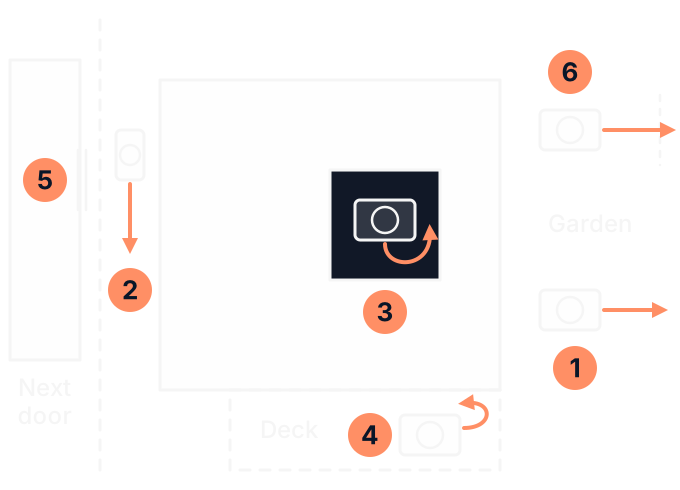
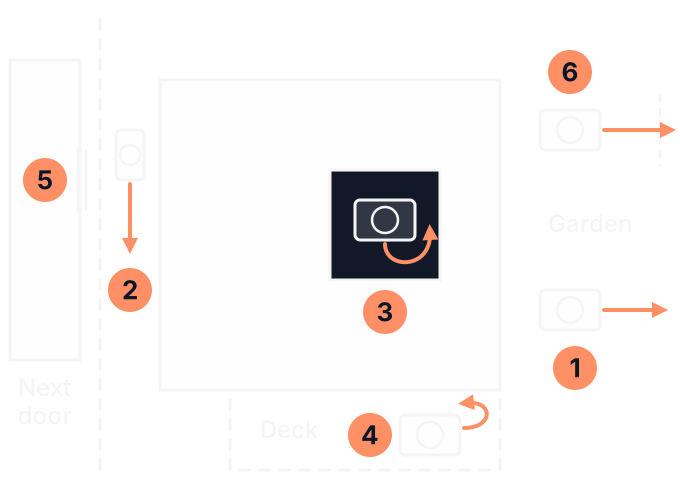
- The open garden. Air flows freely, there is room to work, and it is clear of windows. The usual best choice.
- A narrow side passage. The unit blows along the passage beside the fence, close to the bedroom window next door.
- A courtyard walled on four sides. Hot air from the fan curls back into the unit, and the walls echo its noise.
- Under a deck. The boards hold hot air over the unit, so the maker's clear space above has to be met.
- The bedroom window next door, where noise counts under Victoria's rules.
- Behind a screen. Louvred, set back by the maker's clearance, and opening for service.
| Spot | What can go wrong | What makes it work |
|---|---|---|
| Open ground beside the house | Little, if it is clear of windows. | Shade or a south side, which helps in cooling. A slab and clear space all round. |
| A narrow side passage | The fan blows into a fence or wall and the air comes back. Noise carries along the passage. Little room to work. | The front and side clearances met, the fan blowing along the passage, and the unit clear of bedroom windows on both sides of the fence. |
| A small townhouse courtyard | Walls trap hot air and reflect noise, and every nearby wall adds to what the neighbours hear. | At least one side open, no more than two sides closed in, and the unit clear of the doors and windows you open in summer. |
| An internal courtyard walled on four sides | Hot air recirculates. For a space closed in on all four sides, the manual for the model either rules it out or sets a minimum floor area as well as the clearances. | Often another spot. A larger courtyard can work if the manual allows it and its floor area and clearances are met. A multi-split can serve several rooms from one outdoor unit placed elsewhere: see the guide to single, multi-split or ducted layouts. |
| Under a deck, a verandah or an eave | Hot air builds up under the boards, and the space is hard to reach. | The maker's clear space above met, the sides open, a drain for its water and a way to reach it. |
| Behind a screen or in an enclosure | A tight screen chokes the unit and can void the warranty. | Louvres or slats, set back by the maker's clearance, and a panel that opens for service. Some makers sell their own deflectors. |
| Beside a bedroom window, yours or next door | Noise at night, when the rules are strictest. | Another wall, the far end of the house, or the fan facing away from the window. |
| On a wall bracket, a roof or a balcony | Vibration, falling water and harder access. | See the guides to a slab or a wall bracket and apartment installations. |
Covering or boxing in a unit to hide it is a common cause of trouble. If you want it out of sight, plan the screen with the installer, against the maker's clearances, before it is built.
Noise and the neighbours
As at November 2026, EPA Victoria (opens in a new tab) says residential noise is unreasonable if it happens during prohibited times and someone in a habitable room of another residence can hear it. For an air conditioner used for cooling, the prohibited times are before 7 am and after 11 pm on weekdays, and before 9 am and after 11 pm on weekends and public holidays. For one used for heating, the mornings are the same and the evening limit is 10 pm. During a heat health warning you can run an air conditioner at any time, though a council officer can still find its noise unreasonable. A council officer can also find noise unreasonable inside the allowed times, for example if its volume is unnecessarily excessive. At night it counts whether or not the neighbour's window is open, the EPA's guideline for residential equipment (opens in a new tab) says. Councils enforce the rule.
The spot does more for noise than anything added later. What helps:
- Distance from windows. Keep the unit away from bedrooms and living rooms, yours and next door's. Facing it towards the back boundary or the street can help.
- Fewer hard surfaces nearby. A wall, a second wall and a big eave each bounce sound back, so a corner or a courtyard is louder than an open wall.
- A solid fence with no gaps. A unit low on the ground can be screened by a solid fence that hides it from the neighbour's windows. Trees and hedges do not stop the sound.
- Room to age. Units get a little louder as they age, so allow some margin.
If you live in a townhouse or a unit, the owners corporation's rules on noise may set their own hours. For choosing a quieter model and its night settings, see the guide to choosing a quiet air conditioner for a bedroom. For a unit that has become noisy, see the guide to rattling and vibration noise.
Do you need a permit to put a unit near the boundary?
Usually not, but check three things first. As at November 2026:
- Planning. An air conditioner is one of the domestic services normal to a dwelling, which the Victoria Planning Provisions (opens in a new tab) exempt from a planning permit unless the planning scheme specifically requires one.
- Heritage overlay. Under a heritage overlay (opens in a new tab), domestic services need a permit if they are visible from a street, other than a lane, or from a public park. Ask the council before the unit goes on a wall that faces the street.
- Owners corporation. Under the model rules (opens in a new tab), an owner needs the owners corporation's written approval before changing the external appearance of their lot, and before altering common property, such as by putting a unit on it. Its own rules may say more.
Victoria's planning provisions and Building Regulations give no set distance an outdoor unit must keep from the boundary. A council, a covenant or an owners corporation can set its own, so ask. For new building work that needs a building permit, the Building Regulations (opens in a new tab) let heating and cooling equipment sit up to 500 mm into the side and rear setbacks. Near the boundary, the neighbour's windows and the noise rule are what decide the spot.
Gardens, plants and keeping it clear
- Keep the hot air off plants. In summer the fan blows hot air, and plants in its path suffer.
- Plants can shield the unit, as long as they leave its clearances open. Leaves and litter that build up around a unit block its air and can shelter small animals that get inside.
- Keep the hose and the sprinklers off it. An outdoor unit is built to stand in the weather, but do not hose it down, and aim sprinklers away from it.
- Its own water. In heating, the outdoor unit sheds water when it defrosts. It can drain onto a garden bed or paving that falls away from the house. See the guide to planning the condensate drain.
As the garden grows, keep the clearances you started with: trim back plants and clear leaves from around the unit. Do not move, tilt or box in the unit yourself. If the space around it has closed in, mention it when the unit is next serviced, so the technician can check it still has the room it needs.
Outdoor unit site sketch
Other questions about where the outdoor unit goes
How far does the outdoor unit have to be from the indoor unit?
A short pipe run is better. Each model has a longest run its maker allows, and some have a shortest one too. Our split system installation page covers where units go.
We live near the coast. Does that change the spot?
Yes. Keep the outdoor unit out of salty air where you can, and a unit near the sea may need special treatment. See the guide to coastal installation.
What about snow in the high country?
In snow country the unit stands above the snow that builds up, on a raised stand, with a cover or baffle where snow drifts or blows. Tell us where the house is when you ask for a quote.
Who to call
We settle where the units go at the site assessment, and the maker's instructions set the exact clearances. Our split system installation page explains how to ask for a quote. Send your site sketch with it, and mark the windows next door.
Sources (21)
Checked on 20 November 2026
- Fujitsu General Australia: installation manuals for ASTH and AOTH 07 to 14 KMCD split systems (opens in a new tab)
- Fujitsu General Australia: installation manuals for ASTH and AOTH 18 to 24 KMTD split systems (opens in a new tab)
- Mitsubishi Electric Australia: installation manual, MSZ-AP25 to 50VGKD2 (opens in a new tab)
- Mitsubishi Electric Australia: installation manual, MXZ-2F52, 3F54 and 4F71VGD (opens in a new tab)
- Mitsubishi Heavy Industries Air-Conditioners Australia: installation manual, SRK ZRA-S wall split systems (opens in a new tab)
- Panasonic Australia: installation instructions, CS/CU-Z TKR split systems, December 2017 (opens in a new tab)
- Daikin Australia: can I put a cover over the front of my outdoor unit? (opens in a new tab)
- Daikin Australia: Cora operation manual, May 2026 (opens in a new tab)
- AIRAH: residential air conditioning best practice guide (Victoria), second edition 2026 (opens in a new tab)
- Building and Plumbing Commission: practice note MS 07, split system air conditioning, August 2024 (opens in a new tab)
- EPA Victoria: residential noise, updated 4 November 2026 (opens in a new tab)
- EPA Victoria: noise guideline, assessing noise from residential equipment, publication 1973 (opens in a new tab)
- EPA Victoria: reduce noise from your home (opens in a new tab)
- Victoria Planning Provisions: clause 62.02, buildings and works not requiring a permit (opens in a new tab)
- Victoria Planning Provisions: clause 73.01, general terms (opens in a new tab)
- Victoria Planning Provisions: clause 43.01, heritage overlay (opens in a new tab)
- Planning Victoria: local heritage protection, updated 29 May 2026 (opens in a new tab)
- Building Regulations 2018 (Vic), authorised version 032, 27 October 2026 (opens in a new tab)
- Consumer Affairs Victoria: model rules for an owners corporation (opens in a new tab)
- Consumer Affairs Victoria: what can an owners corporation make rules about? (opens in a new tab)
- ABL Refrigeration: air conditioning services (opens in a new tab) ABL's own page.
Related pages
- Split system installation in Bairnsdale and East Gippsland
How to ask for a quote, and where units usually go.
- Air conditioner outdoor unit: slab or wall bracket?
How the unit is mounted once the spot is chosen.
- Choosing a quiet air conditioner for a bedroom: a selection worksheet
Noise figures and night settings.
Short of outdoor space?
Send your site sketch with a quote request, and mark the windows next door.
Filled in the record? Copy or print it first: it is not sent with a call or an enquiry.