
Air conditioner outdoor unit: slab or wall bracket?
How a slab and a wall bracket compare for an air conditioner outdoor unit: support, vibration, water and servicing, with a mounting sheet for your installer.
Last updated
For most houses the ground is the first choice. An outdoor unit on a slab or a plinth is the most stable and the quietest arrangement, and the easiest to service. A wall bracket is the answer where the ground will not do: no clear space, wet or sloping ground, snow, or an upper storey. A bracket works well on a solid wall when it is fixed and cushioned properly. It is a poor choice on a lightweight wall with a bedroom behind it.
How to use this guide
Step 1: Compare the two
Support, vibration, water, servicing and the site, side by side.
Go to Slab or bracketStep 2: Fill in the mounting sheet
What the spot is like, what is behind the wall and who is next door.
Go to the recordStep 3: Send it with your enquiry
We settle the mounting when we look at the site, and write it into the quote.
Call (03) 5153 2650
Slab or wall bracket: how do they compare?
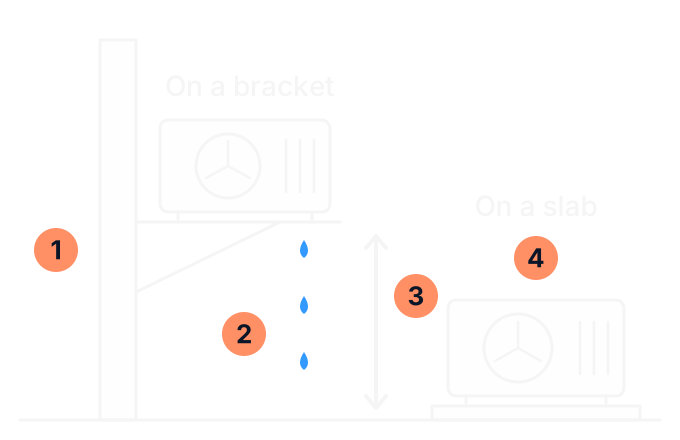
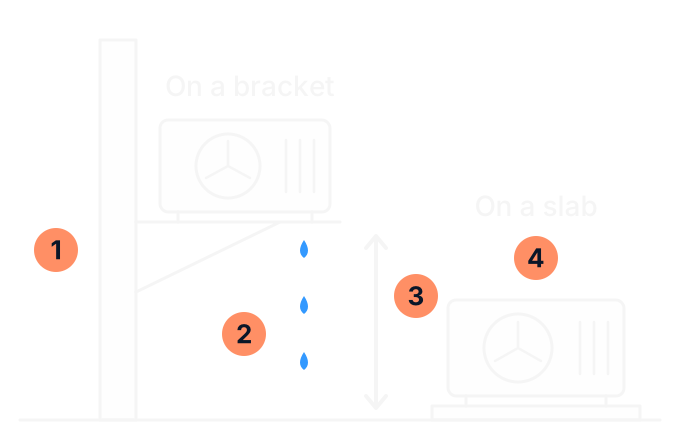
- The wall carries a bracketed unit. The bracket is fixed into the frame or the masonry. Vibration that gets past the rubber mounts travels into the wall and the room behind it.
- Water falls from under the unit in winter. An outdoor unit sheds water when it defrosts in heating mode. From a bracket, that water lands on whatever is below.
- Height decides how the unit is serviced. One that can be reached from the ground is simpler to service than one that needs a ladder.
- A slab carries the weight to the ground. The unit sits level on rubber pads, clear of the wall, and its water drains away at ground level.
| What matters | On a slab or plinth | On a wall bracket |
|---|---|---|
| Support | The ground carries the weight. The base has to be solid, level and on firm ground: a concrete slab or plinth, usually 75 to 100 mm thick, or a base made for the purpose. | The wall carries the weight. Heavy-duty brackets are fixed into the studs or the masonry, not into cladding or sheeting alone. |
| Vibration and noise | The quietest arrangement. Rubber pads between the unit and the slab take up most of the vibration, and the unit stands clear of the wall. | Vibration can pass through the brackets into the wall and be heard inside as a hum. Rubber mounts under the unit are a must, and a lightweight wall is best avoided. |
| Water in heating mode | Drains away at ground level. The ground should fall away from the house so that water does not pond against the wall. | Drips from height onto a path, a deck, a window or another unit below, so it may need a tray or a pipe of its own. |
| Servicing | Reached from the ground. | Depends on the height. Above head height, every service and repair needs a ladder or other safe access. |
| The site | Needs clear, firm ground that does not flood, where plants will not grow over the unit. | Keeps the unit off wet, sloping or snowy ground and out of the way of mowers, pets and garden beds. |
Either way the unit has to end up level, held down and with room to breathe. The maker's installation manual sets the clear space a model needs behind, beside and in front of it, and that space is part of the choice: a bracket that pushes the unit hard under an eave, or a slab squeezed into a corner, can leave it short of air.
When is the ground the better place?
- There is a clear strip of firm ground beside the wall, close to where the indoor unit will go.
- The wall is weatherboard, cladding or another lightweight construction, which passes vibration into the house more readily than brick.
- A bedroom or a living room is on the other side of the wall.
- You want servicing kept simple, with nothing to climb.
- It is a frost area, and water dripping from a height would land on a path and freeze.
A unit does not go straight onto soil or lawn. It needs a secure base under its feet, so that it stays level, stays out of the wet and does not pass vibration into the ground. Where a slab would sit on fill, on a slope or over a garden bed, a plinth or a bracket may be the sounder answer.
When is a wall bracket the better choice?
- There is no ground to spare, or the only ground is a path that has to stay clear.
- The ground floods, stays wet or slopes steeply.
- It snows. A unit set up high keeps its air intake and its drain clear of snow and ice.
- The room is upstairs, and a unit on the ground would mean a long run of pipe up the wall.
- The wall is solid brick or block, with a garage, a laundry or a hallway behind it.
The plumbing regulator covers both cases in one line. The Building and Plumbing Commission's practice note for split systems (opens in a new tab) says outdoor units, whether on wall brackets or at ground level on a support base, should be installed to prevent the transmission of vibration to the adjacent building structure, mounted level and restrained from movement by suitable fixings.
What about a roof or a balcony?
Both are harder than the ground or a wall, and both need more thought before a price is fixed.
- A roof is the most sensitive place for vibration, and noise can carry into the rooms below. The frame has to be fixed into the rafters or trusses, and every fixing through the roof is a place water could get in. For a metal deck roof, the Commission's practice note (opens in a new tab) says the weight of the unit must not be excessive for the roof structure, and that larger units may need an engineer's calculations.
- A balcony or a deck can amplify vibration through the floor. The practice note adds two points for balconies: water from the defrost cycle is not to run over the edge where it will cause a nuisance but must be run to the sanitary or stormwater system, and the unit's distance from the balustrade has to be considered, because a unit close to it gives a child something to climb.
A unit on a roof also costs more to look after for its whole life, because every visit starts with getting up there safely. For a flat or a unit, see the guide to apartment installation.
What if an outdoor unit is sending vibration through the wall?
A low hum or drone inside the house that comes and goes with the outdoor unit usually means vibration is reaching the wall. On a bracketed unit the usual reasons are rubber mounts that have hardened or were left out, fixings that have worked loose, a bracket fixed to a part of the wall that flexes, or a pipe or its cover touching the wall. An unbalanced fan or a worn compressor makes any of them worse, and units get a little noisier with age.
Before we look at it, it helps to know:
- which room you hear it in, and what the wall is made of
- whether it happens in heating, in cooling or in both
- whether it is there the whole time the unit runs or only as it starts and stops
- whether it is new, or has grown over months
- what the unit is mounted on, and roughly how high
Do not tighten, wedge or pad anything yourself: the unit is connected to pipes that hold refrigerant, and a bracket carries its whole weight. When we assess it we look at the mounts, the fixings, the pipe clips and the level of the unit, and then at whether better isolation will do or whether the unit is better moved to a slab. The guide to rattling and vibration noise has a sound log to fill in, and the signs that mean turn the unit off.
Who decides whether the wall or the ground can take it?
The installer chooses the mounting and is responsible for it. It is part of the plumbing work the installer signs for, and the Building and Plumbing Commission's audit checklist for split systems (opens in a new tab) asks whether the outdoor unit is mounted and supported correctly, whether it is level and in a safe location, and whether it can be reached for servicing.
Where the structure is in doubt, such as old brickwork, a lightweight wall, a roof or a deck, the installer may want a builder or an engineer to look first. Ask who makes that call and whether it is in the price. Have these written into the quote:
- where the outdoor unit goes, and at what height
- what it sits on or hangs from: slab, plinth, mounting feet, wall bracket or roof frame, and whether that is included in the price
- what isolates it from vibration
- where the water from the unit goes in winter
- how a technician will reach it to service it
- who confirms that the wall or the roof can carry it
The mounting also affects your neighbours. Under Victoria's residential noise rules (opens in a new tab), as at November 2026, air conditioner noise is unreasonable if it can be heard in a habitable room of another home during prohibited times. A unit low to the ground can be screened by a solid fence, and one high on a wall is much harder to screen. The guide to choosing an outdoor location covers where on the block the unit should go.
Outdoor unit mounting sheet
Note what you can see from where you stand. You do not need to measure closely, climb anything or decide the answer: the sheet tells the installer what to look at.
Other questions about mounting
Does the outdoor unit have to sit on a concrete slab?
No. It needs a firm, level base that carries its weight and does not pass on vibration. A poured slab, a concrete plinth, a base made for the purpose and mounting blocks under the feet all do that on the right ground. Bare soil does not.
Can an outdoor unit go on a weatherboard wall?
It can, if the brackets are fixed into the studs and the unit sits on rubber mounts. A timber-framed wall still carries vibration more readily than brick, so where there is firm ground beside it we would usually put the unit there.
How high should a wall-mounted unit be?
High enough to clear whatever the bracket is there to avoid, and no higher than it needs to be. The manual for the model sets the clear space the unit needs around it. The higher it goes, the harder it is to service.
Where does the water from the outdoor unit go?
In heating mode an outdoor unit sheds water when it defrosts. On a slab that drains away at ground level, and from a bracket it falls on whatever is below. The guide to planning the drain covers where it can go.
Can a unit be moved from a bracket to a slab later?
Yes, though it is not a small job. The pipes hold refrigerant, so moving a unit is work for a licensed technician. The guide to moving a split system explains what is involved.
Sources (6)
- Building and Plumbing Commission: practice note MS 07, split system air conditioning, 29 August 2024 (opens in a new tab) Checked on 19 November 2026.
- Building and Plumbing Commission: audit checklist 97.2, split system air conditioning (opens in a new tab) Checked on 19 November 2026.
- AIRAH: residential air conditioning best practice guide (Victoria), second edition 2026 (opens in a new tab) Checked on 19 November 2026.
- Fujitsu General Australia: installation manuals for ASTH and AOTH 09 to 24 KMTD split systems (opens in a new tab) Checked on 19 November 2026.
- Daikin Australia: does the outdoor unit need a concrete slab or brackets (opens in a new tab) Checked on 19 November 2026.
- EPA Victoria: residential noise, updated 4 November 2026 (opens in a new tab) Checked on 17 November 2026.
Related pages
- Split system installation in Bairnsdale and East Gippsland
What ABL installs, and how to ask for a quote.
- Standard and non-standard air conditioner installation
What a standard price assumes about where the units go.
- Choosing an outdoor AC location: airflow, noise and access
Where on the block the outdoor unit should sit.
Not sure where the outdoor unit should go?
Send an enquiry with your mounting sheet, or call ABL and talk it through.
Filled in the record? Copy or print it first: it is not sent with a call or an enquiry.