
Water leaking through the ceiling near commercial air conditioning
Water through a ceiling near commercial air conditioning: when to keep clear, what to record, and which trade assesses what before anything restarts.
Last updated
The water usually comes from the air conditioning's own condensate, from the roof, or from another pipe in the ceiling, and when it shows is the best clue to which. Record it from a dry spot, and have the electrical, air conditioning and roof trades assess it before anything that got wet is switched back on.
How to use this guide
Step 1: Make the area safe
Keep people clear, leave the air conditioning off, and catch the water where that is safe.
Go to First stepsStep 2: Record
Where the water is, when it shows and what got wet, with photos from the floor.
Go to the record
What to do first
- Move people away from the wet area, and leave anything electrical that is wet or standing in water where it is. Close the room if the water is spreading.
- Leave the air conditioning off. A system leaking its own condensate stops making more once it stops cooling. A safety switch or circuit breaker that has tripped stays off until a licensed electrician has checked it.
- Catch a drip with a bucket or towels, if you can reach the spot without standing in water or under a sagging ceiling.
- Stay off ladders, and leave ceiling tiles, hatches and the unit closed. A ceiling that is holding water is heavy and can come down.
- Photograph the water and the ceiling from the floor before anything is cleaned up, and note the time.
Where is the water coming from?
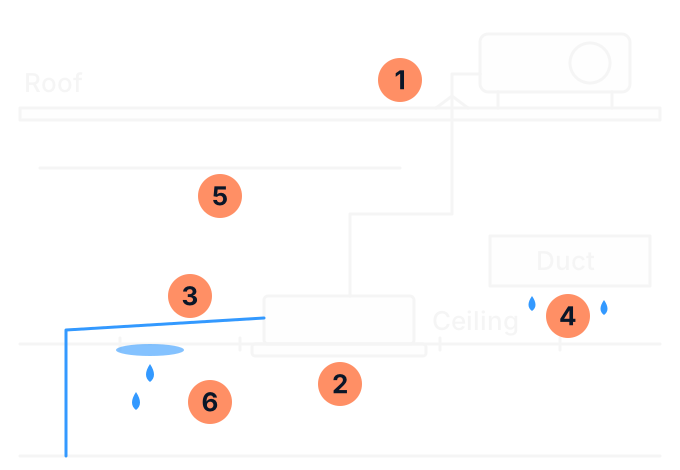
Looking at the water will not tell you, and the stain may not be under the source: water can run along a pipe, a duct or the ceiling frame before it drips. What you have already seen, when it showed and whether it eased once the system was off, is what narrows it down, which is why the record matters.
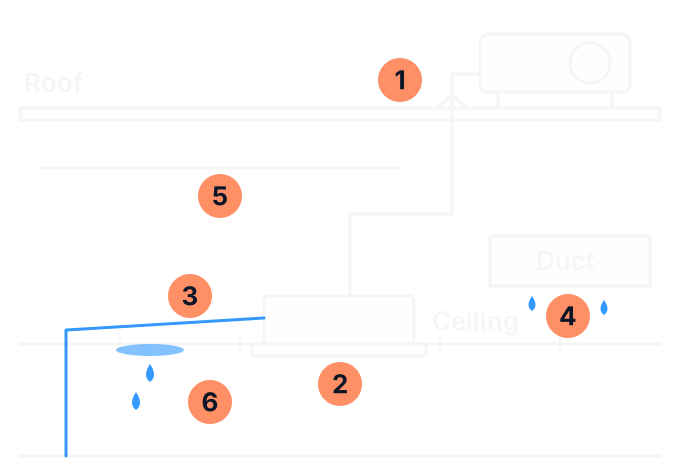
- Where pipes, ducts or a plant stand pass through the roof: rain gets in where the flashing has failed.
- The indoor unit: condensate collects in its tray and leaves through a drain, or a pump and a drain.
- The drain run: a blocked, sagging or broken drain lets water out along the way.
- A cold duct or pipe: where its insulation is damaged or missing, it sweats in humid weather.
- Another service pipe: water, waste or sprinkler pipes in the same ceiling.
- Where the stain shows: often some way from the source, because water runs along pipes and framing first.
| Source | The pattern that points to it | Who assesses it |
|---|---|---|
| The air conditioning's condensate | It shows while the system is cooling, more on a hot, humid day, and eases off once the system has been off for a while. It is under or near an indoor unit, a ceiling cassette or the run of its drain pipe. | An air conditioning technician. |
| Sweating ducts or pipes | Drips in hot, humid weather from a cold duct or pipe whose insulation is damaged, wet or missing, often at several spots along its run. | An air conditioning technician. |
| The roof or the building | It shows during or after rain, whether or not the air conditioning is running, often near where pipes, ducts or a plant platform pass through the roof. | A roof plumber. The air conditioning contractor as well, if the opening in the roof was made for their pipes or ducts. |
| Another service | It is there whatever the weather and whatever the air conditioning is doing. | A plumber, or the building manager. A fire services contractor if it is a sprinkler pipe. |
| Storm or flood water in the equipment | It follows a storm, a flood or a burst pipe that soaked the equipment itself. | A licensed electrician first, then an air conditioning technician. |
Condensate that shows in the room is not getting out through the unit's tray and drain. The guide to a split system leaking water inside covers the usual causes on a single wall unit, and the guide to drain and pump alarms on commercial air conditioning covers a unit that stops itself before it overflows.
Who assesses what
A water incident often needs more than one trade, and each tends to look only at their own part. One person on your side should hold the record, brief each trade from it, and collect what each one finds in writing.
| Who | What they assess | When |
|---|---|---|
| A licensed electrician | Anything electrical that got wet: lights, power points, wiring, the switchboard and the supply to the air conditioning. | First, wherever water reached anything electrical. After a tingle or a shock, once the electricity distributor has been called, as the warning at the top of this page says. |
| An air conditioning technician | Whether the air conditioning is the source, and what the water has done to it: the drains and trays, the pump if there is one, the pipe and duct insulation, the fan and the controls. | Once the area is safe to work in. |
| A roof plumber | Roof sheets, flashings, gutters and anything that passes through the roof. In Victoria, most work on roof sheeting, flashings and roof drainage is roofing (stormwater) plumbing work (opens in a new tab), which needs a plumber licensed or registered for that class. Flashing around a penetration made for the air conditioning can be part of the air conditioning work. | As soon as rain is part of the pattern. |
| A plumber or fire services contractor | Water, waste and sprinkler pipes near the leak. | When the water is there whatever the weather or the air conditioning is doing. |
| The landlord or building manager | The roof, the shared services and any air conditioning that belongs to the building, and whose insurance responds. Under a retail lease in Victoria (opens in a new tab), the landlord maintains the structure of the premises, including the roof, and the plant and equipment. | On the day, in writing, with your photos. Under a retail lease, the tenant must tell the landlord in writing as soon as practicable after loss or damage. |
| Your insurer | What is covered, and what they need from you. | Once the site is safe, and before you authorise building or repair work, including emergency repairs. Ask for their agreement in writing, because work done without it may not be covered. Making the site safe does not wait for the insurer. |
Ceiling tiles, plasterboard and insulation that stay wet for more than a day or two can grow mould, and moisture-damaged insulation and plasterboard is usually replaced. Ask whoever repairs the ceiling about that before a stain is painted over.
Before wet equipment goes back into service
Equipment that has had water through it stays off until it has been assessed. Drying out is not a test: a unit can run after getting wet and still have damage that shows up later.
Where water reached anything electrical, the electrical side comes first. Energy Safe Victoria's advice for a property that floodwater has entered is that the power is not put back on until the wiring has been tested by a licensed electrician (opens in a new tab), and that an appliance which has been under water is not plugged in or switched on until a licensed electrician has tested it. The Department of Health's flood advice (opens in a new tab) is that air conditioning damaged or contaminated by floodwater should not be used, and that where contamination is suspected, it is not used until it has been cleaned and checked by a qualified person.
A unit that overflowed its own tray stays off until an air conditioning technician has found the cause. The technician looks at the unit itself, its drains, its insulation and its controls, after the electrician wherever water reached anything electrical. The refrigerant handling code of practice (opens in a new tab) (2025 edition) tells owners that a unit that is not working properly should be seen by a competent service technician as soon as the problem appears.
Ask each of them to put what they tested, and what they found, in writing. Where the electrician does electrical installation work to put things right, Energy Safe Victoria requires a Certificate of Electrical Safety (opens in a new tab) for it. Keep both reports with the incident record. An all clear on wet equipment is a judgement on the day, and a report that says what was tested is worth more than a verbal one.
Rooftop units after a storm
Stay off the roof. After a storm it is wet, it may be damaged, and there may be cables on it. Look from the ground, from a window or from a neighbouring building, and note:
- panels that are missing, bent, dented or lifted on a unit
- a unit that has shifted on its platform or its stand, or a stand that has moved
- branches, sheeting or other debris on or against a unit
- pipes, ducts or cables that are hanging or pulled away
- water coming in below the unit, and whether it started with the storm
Leave the system off if you can see damage. Energy Safe Victoria's advice after a storm (opens in a new tab) that cut the power is to look for damage to cables, wiring and electrical equipment, and if there is any, not to turn the power on, not to touch the damaged equipment, and to call a licensed electrician to make it safe. A switchboard damaged by the weather is left alone until the electrician arrives. Stay at least 8 metres from a fallen powerline and from anything it is touching.
Then book an inspection by a technician with safe access to the roof. Hail and wind damage to an outdoor unit, its mounts and the flashings around it can be hard to see from below, and your insurer will want it recorded before repairs. The guide to a damaged air conditioner outdoor unit covers what to note about the unit, and the guide to air conditioner problems after a power outage covers a system that will not come back on once the power returns.
When the water keeps coming back
A leak that returns has been dried, not fixed. The way out is evidence, kept over time, that lets the trades agree on the cause.
- Keep one record for every event, with the date, the weather, what the air conditioning was doing, where the water showed and how much.
- Mark each event on a floor plan. Leaks that cluster under one unit point one way. Leaks that follow the rain point another.
- Give every trade the same records. A roof plumber who can see that the water shows only on humid days, and a technician who can see that it shows only in rain, can each point the search the right way.
- Have every defect that is found repaired, and write down what was fixed and when. If the water comes back, the record shows what has already been ruled out. Where the source is still unclear, a water test of one area at a time can find it.
- Then deal with the exposure. Ask whether the equipment under the leak can be moved or protected. The guide to drain and pump alarms on commercial air conditioning covers when a ceiling unit can have a safety tray under it.
If the equipment itself has been wet more than once, ask the technician whether it is still worth repairing. The guide to repairing or replacing a commercial air conditioning system sets out how to weigh that, and your insurer will want the records either way.
How urgent is it?
| What you see | What to do |
|---|---|
| Water near anything electrical, a tripped switch, a tingle or a shock, or water running from a unit or the ceiling | Act now, as the warning at the top of this page sets out. Do not wait for it to dry out. |
| A sagging or bulging ceiling | Clear the area under it and tell the landlord or building manager now. It may be holding water, and a ceiling can come down. |
| A stain that is not growing, with the system off | Photograph it, date the photo and book an assessment. |
| Water from the end of the drain pipe outside while the system cools, or under the outdoor unit | This is normal. The drain carries the condensate away, cold pipes at the outdoor unit can drip while it cools, and in heating the outdoor unit sheds water when it defrosts. |
Water incident record
Every trade who comes will ask the same questions, and so will the insurer and the landlord. Fill this in from a dry, safe position, give each of them the same copy, and add to it as they report. The line that sorts one cause from another is when the water shows.
Calling ABL
ABL repairs and services air conditioning for homes and businesses in Bairnsdale and East Gippsland. For water at or near an air conditioning unit, call and read out your incident record. If water has reached anything electrical, call a licensed electrician first. Our commercial air conditioning page covers the systems we look after for businesses, the air conditioning repairs page explains how to book a fault, and our air conditioning services page lists everything else we do.
Sources (16)
- Energy Safe Victoria: energy safety during floods, reviewed 16 March 2026 (opens in a new tab) Checked on 19 November 2026.
- Energy Safe Victoria: storms and energy safety, reviewed 9 May 2024 (opens in a new tab) Checked on 19 November 2026.
- Australian Government: Triple Zero (000) (opens in a new tab) Checked on 17 November 2026.
- Energy Safe Victoria: Certificate of Electrical Safety (opens in a new tab) Checked on 17 November 2026.
- Australia and New Zealand refrigerant handling code of practice, part 2, 2025 edition (opens in a new tab) Checked on 19 November 2026.
- Daikin: troubleshooting for split and multi-split air conditioners (opens in a new tab) Checked on 19 November 2026.
- ActronAir: installation and commissioning guide, variable capacity commercial ducted indoor unit, version 4 (opens in a new tab) Checked on 19 November 2026.
- Insurance Council of Australia: storms (opens in a new tab) Checked on 19 November 2026.
- Victorian Small Business Commission: repairs and maintenance under a retail lease (opens in a new tab) Checked on 20 November 2026.
- Plumbing Regulations 2018 (Vic), version 010, 1 May 2026: regulations 23 and 25 (opens in a new tab) Checked on 20 November 2026.
- Building Act 1993 (Vic), version 153, 13 November 2026: section 221D (opens in a new tab) Checked on 20 November 2026.
- Victorian Department of Health: floods, mould and your health, February 2021 (opens in a new tab) Checked on 20 November 2026.
- Building and Energy, Western Australia: be aware of the signs of a stressed ceiling, 24 July 2025 (opens in a new tab) Checked on 20 November 2026.
- US Environmental Protection Agency: moisture control guidance for building design, construction and maintenance (opens in a new tab) Checked on 20 November 2026.
- Rimkus: water leaks in commercial buildings, updated 14 October 2026 (opens in a new tab) Checked on 20 November 2026.
- ABL Refrigeration: air conditioning services (opens in a new tab) ABL's own page. Checked on 19 November 2026.
Related pages
- Repeated condensate alarm on commercial air conditioning
For a unit that stops itself with a drain or pump alarm.
- Split system leaking water inside: what to record before you call
The usual causes of a leak from a single wall unit.
- Damaged air conditioner outdoor unit: what to do and record
What to record about an outdoor unit after a storm.
Water near your air conditioning?
Call ABL with your incident record in front of you. If water has reached anything electrical, call a licensed electrician first.
Filled in the record? Copy or print it first: it is not sent with a call or an enquiry.