
Laying out a coolroom for stock picking: shelves, airflow and food safety
How to lay out a coolroom or freezer room so stock is easy to pick, air can move, food stays separate and the way out stays clear, with a layout record.
Last updated
Lay out a coolroom around three things: the air the evaporator has to move, the way stock comes in and goes out, and the way out for people. Keep stock clear of the evaporator, off the walls and off the floor. Put raw meat and seafood below ready-to-eat food or in a bay of its own. Keep the heaviest and most-picked stock between mid-thigh and shoulder height, near the door. Keep the path to the door and its inside release clear. Then sketch your room and check it against the manuals for the evaporator and the shelving.
How to use this guide
Step 1: Check the clearances
Around the evaporator, the walls, the floor and the door.
Go to ClearancesStep 2: Fill in the layout record
Zones, shelving, heavy stock, rotation and the way out.
Go to the record
The space the air needs
The evaporator blows cold air across the room, and the air has to reach every wall, the ceiling and the stock before it comes back. Stock packed into its path cools unevenly and makes the plant work harder. Overstocking a room or a cabinet beyond what it can chill, or blocking its air grilles, does the same.
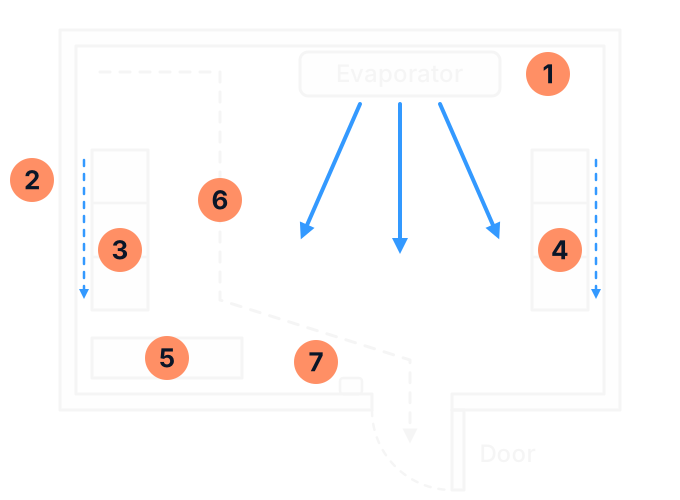
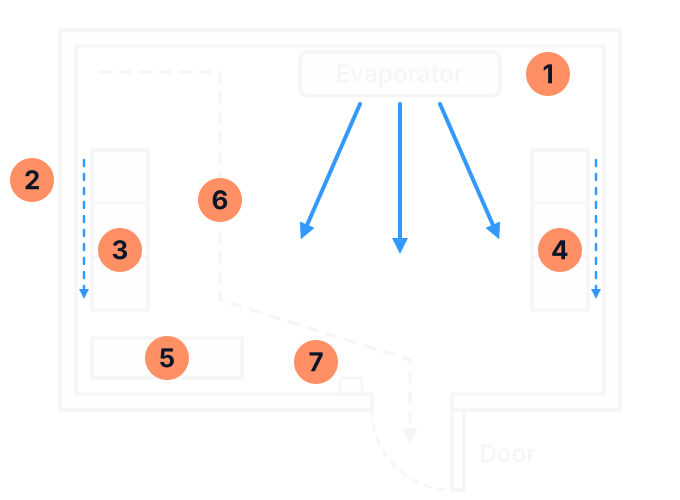
- The evaporator, throwing its air down the room towards the door. Nothing stacked in front of its fans.
- The gap between the shelving and the wall, so air can run along the wall.
- The ready-to-eat bay, including cooked meat and cooked seafood.
- The raw meat and seafood bay, apart from the ready-to-eat food, with heavy raw cartons on its middle shelves.
- The orders shelf, near the door, for orders waiting to go.
- The clear path from the furthest corner to the door.
- The light switch beside the doorway. Keep it, the release on the inside of the door and the alarm button clear of stock and trolleys.
| Where | What to leave | Why |
|---|---|---|
| Below and in front of the evaporator | Nothing stacked in front of its fans, and at least 25 cm of clear air between the top of the stock and the unit. Some units need a gap as deep as the unit is tall. The manual for your unit decides. | The fans need room to throw air across the room. |
| Around the evaporator for service | Room for a technician to reach the unit, including its electrical end. | On some units the defrost heaters slide out from one end, so the technician needs room there. |
| Walls | At least 10 cm between stock and the walls, and 10 to 15 cm at a wall that takes the sun. | Air has to run down the walls, where heat comes in. |
| Floor | All food on shelves or racks, off the floor. | FSANZ's advice is to store food off the ground. |
| Under the evaporator's drip path | No open food where condensation could fall. | Condensation from refrigeration equipment has to be kept off food. |
The evaporator was placed for the aisles and racks the room was designed with. If you change the layout a lot, add tall racks or block a wall, tell us, because the air pattern may no longer cover the room.
Loading a commercial fridge
- Keep stock below the load line and off the cabinet floor.
- Leave a gap at the back and the top so air can move, as the manual for your model shows.
- Spread the weight evenly, and do not block the evaporator fan or the air slots.
- Put in stock that is already cold. Storage cabinets are made to hold cold stock, not to cool it.
For choosing a cabinet format, see the guide to upright, underbench, drawer or roll-in fridges.
What goes where
| Zone | Where it goes | Why |
|---|---|---|
| Ready-to-eat food, including cooked meat and cooked seafood | Above raw food, or in a separate bay. | Juices from raw food must not drip onto it. |
| Raw meat and seafood | Below ready-to-eat food, or in a bay of its own. | FSANZ (opens in a new tab) asks for raw food to be stored separately or below ready-to-eat food. Thawing stock also sits where its juices cannot reach other food. |
| Ingredients containing allergens | Together with like allergens, in sealed, labelled containers, on lower shelves. | So a spill cannot fall onto other food. |
| Allergen-free food | In a separate area, or on the top shelf. | So nothing can fall or drip onto it. |
| Fruit and vegetables | Apart from each other where you can. | Some fruit gives off ethylene, which does vegetables no good. The guide to a coolroom or commercial fridges has more. |
| Held, returned or recalled stock | On a dedicated, labelled shelf. | So it cannot be used by mistake. |
| Orders waiting for collection or delivery | On a shelf of their own, near the door. | Picked orders stay cold until they leave. |
| Chemicals and cleaning products | Away from food, and outside the coolroom where you can. | Food is stored separately from chemicals. |
Raw meat at the bottom and heavy stock at waist height can pull against each other. A separate raw bay, with heavy raw cartons on its middle shelves, settles both.
Heavy, fragile and most-picked stock
- Heavy and often-used items between mid-thigh and shoulder height. That is WorkSafe Victoria's (opens in a new tab) advice for kitchens, and its advice for freezers is to load and unload between those heights too, using aids such as height-adjustable racking and trolleys.
- Place stock by weight, size and how often it moves. The lines you fetch most go nearest the door, at an easy height.
- Smaller cartons are easier to lift and stack than bulk packs.
- Room to reach. Leave enough space to get at each shelf without twisting, and a route a trolley can use.
- Nobody climbs the shelving. Keep walkways clear and marked.
- Glass away from open food. Food near broken glass has to be treated as contaminated, so keep jars and bottles below or apart from food that is not covered.
Rotation: oldest out first
- Check date marks, use older stock first, and discard anything past its use-by date.
- When you open a pack, keep its date mark with the food.
- Label the shelves, so new stock goes behind the old without anyone having to think about it.
- Leave room to load from the back, so older stock is not buried.
Rotation in a display cabinet
Bring the oldest stock to the front and put the newest behind it. A rear-loading cabinet lets staff restock from behind without moving older stock. Keep to the cabinet's load limit, keep stock and signs off the air grilles, and load a cabinet only once it is at its operating temperature. For food on open display, FSANZ (opens in a new tab) advises against adding fresh food to a dish already on display, so batches do not mix, and frozen food on display stays frozen hard.
Freezer rooms: pallets, racks and small orders
| How your stock moves | What suits it |
|---|---|
| Whole pallets in and out | Racking matched to your pallets and your forklift or pallet jack, with aisles wide enough for its turning circle. Drive-in racking does not suit stock that has to rotate quickly or be reached pallet by pallet. |
| Many small orders a day | Fast lines on shelves near the door at an easy height, so each trip is short. Upright or chest freezers outside the room cut the time staff spend in the cold. |
| Long-term stock alongside fast movers | Fast movers by the door; long-term stock further in, in date order, with room to rotate it. |
- Pallet racking has a safe working load. WorkSafe Victoria (opens in a new tab) says it should never be exceeded, that changing the racking configuration changes the safe working loads, and that racking should be inspected by a competent person every 12 months.
- Shelving rated for the cold. Choose shelving made for freezer temperatures and damp. Chrome can rust with regular moisture, so choose coated, galvanised or plastic shelving made for cold rooms.
- Check both ratings. Each shelf has a load rating and so does the whole unit, and mobile shelving is often rated lower than fixed. Spread the load evenly along a shelf.
- The floor has to carry it. Pallet jacks and forklifts in a freezer room need a floor built for them.
Fixing shelving to the panels
A coolroom panel is two thin metal skins around insulation. Every hole through a skin breaks its seal against moisture, and a puncture can let water into the insulation, where it freezes and makes the panel bulge. Freestanding shelving avoids holes altogether. If shelving has to be fixed to a wall, ask us first: a fixing into a panel often needs its load spread across the skin, and every hole needs sealing again. Shelves fixed to a wall still sit with a slight gap from it, so the wall behind can be cleaned.
For moisture at holes and joints, see the guide to coldroom condensation and frost.
Shelves that no longer fit the load
A shelf loaded past its rating can bend or fail, and a shelf that flexes under its load is a sign to take stock off it. Longer shelves can be rated lower than short ones. If what you store has outgrown the shelving, replace it with shelving rated for the load and the temperature, from the cabinet or shelving maker, rather than adding brackets or supports of your own.
Produce: shelves or pallets?
- Pallets cool slowly. A packed pallet or bin has little surface for its size, so produce in the middle takes a long time to cool. A lined bin is slower still.
- Line pallets up with the air. Run the pallet skids in the direction the cooling air moves.
- Shelves cool faster for small lots, because air reaches more of each box.
- Watch the cardboard. Condensation weakens cardboard packaging and encourages rot.
For loading a room during a harvest, see the guide to cold storage loading during a harvest peak. For the whole kitchen around a coolroom, see the guide to planning refrigeration in a commercial kitchen layout.
Farm-gate meat, seafood and online orders
Frozen meat sold at the farm gate
Plan the freezer around how you actually sell: how many lines, how often each sells, how much arrives from the processor at once, and how you restock. Frozen deliveries are accepted only if they are frozen hard. Safe Food Victoria (opens in a new tab) says a business that mainly handles meat, poultry, seafood or dairy needs a Safe Food Victoria licence, and other food businesses register with their council, so check which applies to you.
Raw seafood beside prepared food
Keep raw seafood below prepared food or in its own bay, in sealed containers, where its juices cannot reach anything else. Cooked seafood, including cooked prawns and crayfish in the shell, is ready-to-eat food and goes with the prepared food.
Online grocery orders
Picked orders need a cold shelf of their own until they leave, with chilled and frozen kept apart and hot food separate. FSANZ's guidance on food delivery (opens in a new tab) is to keep food at a safe temperature until the customer receives it where quick delivery cannot be promised, and frozen food frozen solid. Pick close to dispatch, so orders spend as little time out of refrigeration as possible.
Allergens: storage helps, the procedure is yours
A coolroom's controls and its temperature log are about keeping food cold. Managing allergens is a separate procedure. Safe Food Victoria (opens in a new tab) lists what it involves: keeping allergen-containing food apart, labelling, colour-coding, cleaning and training staff. Storage plays its part, with like allergens together in sealed containers and allergen-free food kept apart. Keep allergen records with your food safety records, not in the refrigeration log, and do not treat the coolroom's temperature or its log as an allergen control.
Keep the way out clear
The National Construction Code 2025 (opens in a new tab) asks for a walk-in refrigerated room to have a door that opens by hand from inside without a key, a light switch inside beside the doorway and an alarm worked from inside. Those only help if someone can reach them. So keep a clear path from the furthest corner to the door, and keep stock, trolleys and shelving away from the inside release, the light switch and the alarm button. SafeWork SA adds good housekeeping in stacking and storing, so nothing becomes a trip hazard.
Coolroom layout record
When to bring ABL in
Tell us before you fix anything to the panels, add tall racking or move stock into the evaporator's path, and when a room no longer holds what the business needs. The coolroom installation page covers fitout such as shelving and strip curtains. Send your sketch and the layout record with your enquiry, or have them in front of you when you call.
Sources (32)
Checked on 19 November 2026
- Food Standards Australia New Zealand: storing food safely, updated 1 October 2025 (opens in a new tab)
- Food Standards Australia New Zealand: Safe Food Australia, chapter 3.2.2 (opens in a new tab)
- Food Standards Australia New Zealand: Safe Food Australia, chapter 3.2.3, food premises and equipment (opens in a new tab)
- Food Standards Australia New Zealand: displaying food, updated 30 September 2025 (opens in a new tab)
- Food Standards Australia New Zealand: food delivery, updated 30 September 2025 (opens in a new tab)
- Food Standards Australia New Zealand: overview of food safety management tools, updated 1 October 2025 (opens in a new tab)
- Safe Food Victoria: allergens in food, updated 29 June 2026 (opens in a new tab)
- Safe Food Victoria: allergen fact sheets for food businesses (opens in a new tab)
- Safe Food Victoria: local council registered food businesses, updated 29 June 2026 (opens in a new tab)
- WorkSafe Victoria: pallet racking operation and maintenance, reviewed 8 April 2024 (opens in a new tab)
- WorkSafe Victoria: injury hotspots, warehousing and storage, reviewed 26 February 2026 (opens in a new tab)
- WorkSafe Victoria: injury hotspots for chefs and cooks (opens in a new tab)
- SafeWork NSW: hazardous manual tasks, supermarkets and grocery stores, 2018 (opens in a new tab)
- SafeWork SA: cold storage facilities (opens in a new tab)
- Australian Building Codes Board: National Construction Code 2025, Volume One, Part G1, clause G1D3 (opens in a new tab)
- Australian Government, energy.gov.au: refrigeration guide for businesses (opens in a new tab)
- Postharvest management of vegetables (Hort Innovation): cool rooms (opens in a new tab)
- Postharvest management of vegetables (Hort Innovation): cooling methods (opens in a new tab)
- Heatcraft: installation and operations manual for unit coolers, June 2026 (opens in a new tab)
- Danfoss: unit cooler instructions, 2021 (opens in a new tab)
- SKOPE: ReFlex storage cabinets user guide, October 2021 (opens in a new tab)
- Williams Refrigeration Australia: operator and user manual, April 2020 (opens in a new tab)
- Bromic: underbench fridges manual, June 2022 (opens in a new tab)
- Hussmann: Impact MT merchandiser installation manual, June 2010 (opens in a new tab)
- KPS Global: walk-in organisation tips, 16 October 2018 (opens in a new tab)
- KPS Global: walk-in cooler and freezer safety features, 8 July 2025 (opens in a new tab)
- Dexion: cold store pallet racking tips, 20 August 2020 (opens in a new tab)
- Metro: shelving for a walk-in cooler or freezer (opens in a new tab)
- Cambro: Camshelving specification guide, 2025 (opens in a new tab)
- Norlake: walk-in floor guide, 2025 (opens in a new tab)
- BlueScope: technical bulletin 31, COLORBOND Intramax steel for coolroom panels, December 2020 (opens in a new tab)
- Food Processing: Tecpro insulated panel mounting plates, 19 February 2019 (opens in a new tab)
Related pages
- Coolroom or commercial fridges: choosing storage format and capacity
If the layout shows you need more or different storage.
- Coldroom condensation and frost: an observation guide
For moisture at fixings, joints and the door.
- Planning refrigeration in a commercial kitchen layout
For the whole kitchen around the coolroom.
Changing how your coolroom is laid out?
Send ABL your sketch and layout record with an enquiry, or call and talk it through.
Filled in the record? Copy or print it first: it is not sent with a call or an enquiry.