
Air curtains and air conditioning at a busy shop entrance
What an air curtain does at an open shop door, what weakens it, how it works with the air conditioning, and an entrance sheet to fill in first.
Last updated
An air curtain blows a fast sheet of air down across a doorway, to cut the air that swaps between the shop and the street while the door is open. It cuts part of that exchange, not all of it. The design figures used in the industry run from about 30% to about 80%, depending on whether the unit has a tested figure, how it is controlled and looked after, and the wind and air pressure at the door. It does not cool the shop, it does not ventilate it, and it does not replace a door. Whether one suits your entrance depends on the size of the opening, how the door is used, the wind and the air pressure across the doorway, and how the air conditioning near the door is set up. Record those first, then have the air curtain supplier assess a proposal against them.
How to use this guide
Step 1: Know what decides it
The door, the wind, the pressure and the air conditioning nearby.
Go to Conditions at the doorStep 3: Compare the proposal
Ask the supplier the questions that matter at your door.
Go to Proposal questions
What does an air curtain do, and what does it not do?
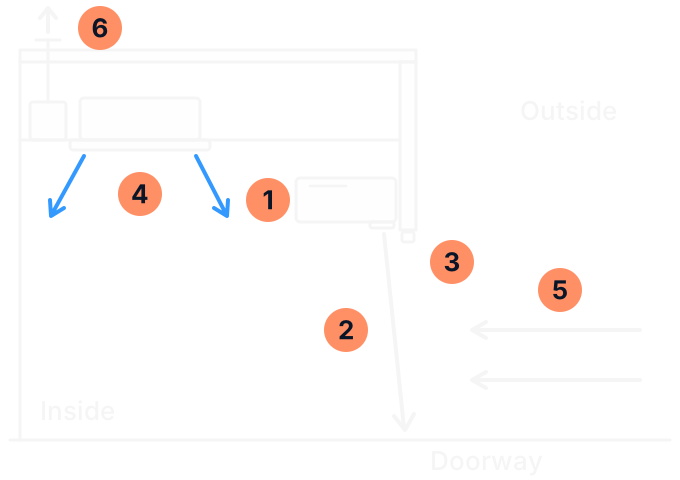
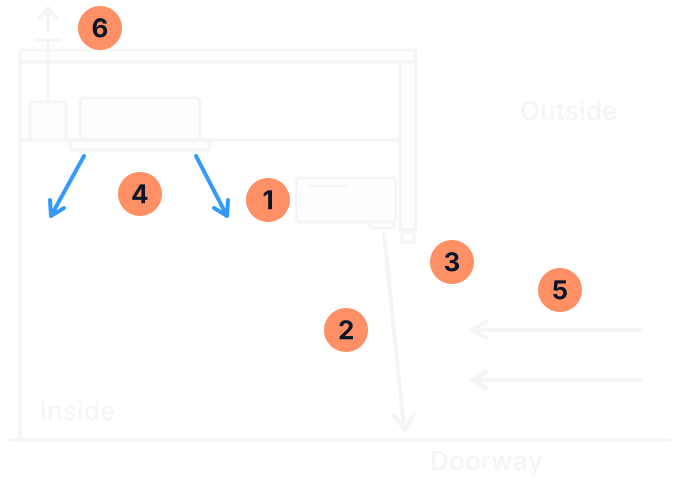
- The air curtain: inside, at the top of the opening.
- Its air stream: down to the floor, angled slightly outward.
- The door switch: tells the air curtain when the door is open.
- The air conditioning near the door: where it blows, and where its controller sits.
- Wind: pushes on the doorway and bends the air stream.
- Exhaust fans: pull air in through the doorway.
| It does | It does not |
|---|---|
| Cut the air exchange through an open door, which keeps more of the cooled air in on a hot day and the heated air in on a cold one. | Stop all of it. Some turbulence where the stream meets the floor lets air through. A stream that does not reach the floor can lose more than no air curtain at all. |
| Help keep out dust, fumes and flying insects, where it is chosen and set up for that. Keeping insects out takes a very high air speed across the whole opening. | Ventilate the shop. It only separates the air on each side of the door. Outdoor air for the people inside comes from the ventilation. |
| Warm the doorway, if it is a heated model, mainly for the people walking through and working near it. | Cool or heat the shop. An unheated air curtain only moves air. The air conditioning still does the cooling and heating. |
| Work best with a door that closes itself, running only while the door is open. | Replace a door. Where the wind is strong or other doors stand open, a lobby or a revolving door may still be needed. |
So whether an air curtain is the right answer depends on the door:
- It suits a door that has to stand open, or opens all day, in a doorway sheltered from the wind, in a building whose exhausts are balanced by air coming back in, with a door switch to run it.
- A self-closing door comes first where the door could simply close between customers. An air curtain can then be added above it for the times the door is open.
- It does not suit, on its own, an exposed doorway where strong wind is frequent, or a building where a kitchen exhaust runs without enough air coming back in. A revolving door or a lobby, or balanced ventilation, comes first there.
For new building work, the National Construction Code 2025 asks for an entrance to have an airlock, a self-closing door, a rapid roller door, a revolving door or the like (opens in a new tab), with exceptions. The code and its guide do not name air curtains, so ask your building surveyor how the rule applies to your entrance. That rule and the other choices at the door are in the guide to shopfront air conditioning when the doors stay open.
What decides whether an air curtain works at your door?
An air curtain is a balance between its air stream and the forces pushing air through the doorway. These are the things that decide which one wins.
| What decides it | Why it matters | What to record |
|---|---|---|
| The size of the opening | The unit has to be at least as wide as the opening, and several units can be joined across a wide door. The taller and wider the opening, the stronger the stream it needs, and each model has a maximum mounting height. | The clear width and height of the opening, and what sits above it: a door closer, an exit sign, a beam. |
| Wind | Wind on the doorway bends the stream inward. An air curtain copes with light wind only. Where strong wind is frequent, it is paired with a revolving door or an airlock. | Which way the door faces, how exposed it is, and how often the wind blows straight in. |
| Air pressure across the door | Even a small pressure difference weakens an air curtain a great deal. A building that exhausts more air than it brings in pulls air through the doorway, and an air curtain cannot make up that shortfall. The guide to air conditioning a cafe or restaurant dining area covers make-up air for a kitchen exhaust. | The exhaust fans in the building, such as a kitchen, and whether the door pulls in or is hard to close when they run. |
| Other openings | Doors or windows that stand open elsewhere let air flow straight through the building, and a tall stairwell or atrium draws air up like a chimney. | Other doors that stay open while you trade, and any stairs or high open spaces near the entrance. |
| How the door is used | An air curtain does most when it runs hard only while the door is open and drops back when it shuts, which a door switch does for you. | Whether the door stands open, opens for each customer or is open only at busy times. |
| How it is set | Too weak a stream does not reach the floor. Too strong a stream hits the floor hard, stirs up more exchange and blasts the people walking through. The speed and angle are set when it is commissioned. | Who sets it up, and who adjusts it if the conditions change. |
How does an air curtain work with the air conditioning?
- The air conditioning near the door. The air curtain keeps more of the cooled air inside, but the unit nearest the door still has the doorway to deal with. A unit that blows toward the door sends cooled air at the opening. A controller or temperature sensor near the door reads the doorway's air, so the system can run harder than the rest of the shop needs. Giving the entrance its own zone, with its own unit and control, keeps the rest of the shop from being overcooled to make up for it, as the guide to shopfront air conditioning when the doors stay open describes. Where an unconditioned zone is kept inside the entrance instead, the building code's handbook says heating and cooling should not be directed into it, and thermostats should not sit in it.
- Heating. An unheated air curtain uses the least energy but can feel cold to the people working near it in winter. Good controls on a heated one add only the heat that is needed, and some stop the heating automatically once it is warm enough outside.
- A heat pump air curtain. Some air curtains are heated, and some also cooled, by refrigerant from an air conditioning outdoor unit, either their own or a VRF system they share with indoor units. The refrigerant pipework makes installing one refrigeration work, and in Australia handling a scheduled refrigerant needs a refrigerant handling licence (opens in a new tab). While the outdoor unit defrosts in cold weather, the air curtain blows cool or room temperature air for a few minutes. Ask the supplier whether a heat pump model is available here. On a VRF system, whether it can heat while other rooms cool depends on the kind of system: the guide to heat pump or heat recovery VRF explains the difference.
- Power. An air curtain is wired in with its own isolating switch. An electrically heated one needs spare electrical capacity on site, often larger cables and sometimes a three-phase supply. In Victoria, fixed electrical installation work needs a licensed electrician (opens in a new tab).
- Noise at the counter. The sound depends on the fan speed, and a unit mounted lower than it was designed for can be louder. Where someone works all day under or near the air curtain, ask for the sound level at the speed it will actually run.
What to ask about an air curtain proposal
Give the supplier your entrance sheet and ask for a proposal in writing. Performance depends on the model and the site, so judge a proposal on how well it answers these questions for your door, not on a saving percentage.
| Ask about | What a good answer covers |
|---|---|
| The duty | The model, the height and width it is rated for, and the air speed it delivers at a set distance below the outlet. Ask how that was tested. AMCA International (opens in a new tab) runs a ratings program for air curtains tested to its Standard 220, and some makers publish figures to other test standards. |
| The placement | Where it will be mounted, how it covers the opening, the clearance it needs around its air intake, and how it avoids the door closer, exit signs and anything else above the door. |
| Your conditions | How the proposal allows for the wind at your door, the exhausts in the building and the air conditioning near the entrance, and whether a self-closing door or a lobby is still needed. |
| The controls | How it is switched with the door and for trading hours, how any heating is controlled, and whether it links to the building controls. |
| Heating and power | Unheated, electric, hot water or heat pump. The power supply it needs, and who connects the electrical supply and, for a heat pump model, the refrigerant pipework. |
| Noise | The sound level at the speed it will run, and the distance it was measured at. Makers measure at different distances, so compare like with like. |
| Access and maintenance | How the air intake grille or filter is cleaned, how often and by whom. The intake usually needs cleaning somewhere between every two weeks and every three months, depending on the dust, with an inspection at least once a year, and the manual for the model sets it. How a unit above a doorway is reached during trading, the access opening in the ceiling for a recessed unit, who services it and what the warranty asks for. |
| Running cost | An air curtain uses energy itself, so the saving has to outweigh its own running cost. Ask what any saving figure assumes about the wind, the door and the hours. |
Does a food business need one?
Food businesses must take all practicable measures to keep pests out. Food Standards Australia New Zealand (opens in a new tab) lists self-closing doors, double doors or air curtains at door entries among those measures, along with keeping doors closed when they are not in use. It is one option among several, not a requirement in itself. For a cafe or restaurant, see the guide to air conditioning a cafe or restaurant dining area.
Entrance assessment sheet
Who to call
The air curtain supplier assesses and quotes the air curtain. For a new installation, the guide to commercial air conditioning site surveys lists what to have ready for the air conditioning side.
ABL installs, replaces and maintains air conditioning for businesses in Bairnsdale and East Gippsland. For the air conditioning around your entrance, such as where the units sit, how the area by the door is zoned and how it is controlled, our commercial air conditioning page explains how to send an enquiry. Send the entrance sheet with it.
Sources (22)
- Eurovent: recommendation 16/5, air curtain units technical overview, March 2025 (opens in a new tab) Checked on 20 November 2026.
- Eurovent: recommendation 16/4, classification and correct positioning of an air curtain unit, August 2024 (opens in a new tab) Checked on 20 November 2026.
- Frico: technical handbook, air curtains (opens in a new tab) Checked on 20 November 2026.
- Frico: control for air curtains (opens in a new tab) Checked on 20 November 2026.
- Thermoscreens and Mitsubishi Electric: heat pump air curtains for Mr Slim outdoor units, installation manual (opens in a new tab) Checked on 20 November 2026.
- Thermoscreens and Mitsubishi Electric: heat pump air curtains for City Multi VRF systems, installation manual (opens in a new tab) Checked on 20 November 2026.
- Biddle and Daikin: CYA comfort air curtain installation, operation and maintenance manual, 2024 (opens in a new tab) Checked on 20 November 2026.
- Airtècnics: air curtain installation, operation and maintenance manual (opens in a new tab) Checked on 20 November 2026.
- Fantech: AC series air curtain installation and maintenance instructions, September 2021 (opens in a new tab) Checked on 20 November 2026.
- Hydor Ventilation Australia: HAC air curtain installation and maintenance instructions (opens in a new tab) Checked on 20 November 2026.
- Mitsubishi Electric Australia: GK-25 and GK-30 air curtain operating and installation instructions (opens in a new tab) Checked on 20 November 2026.
- AMCA International: air curtains, certified ratings (opens in a new tab) Checked on 20 November 2026.
- National Construction Code 2025, Volume One, Part J5 Building sealing (opens in a new tab) Checked on 20 November 2026.
- Australian Building Codes Board: guide to J5D5, windows and doors (opens in a new tab) Checked on 20 November 2026.
- Australian Building Codes Board: NCC 2025 commercial energy efficiency handbook (opens in a new tab) Checked on 20 November 2026.
- EnergyCut: air curtains, revolving doors and automated doors (opens in a new tab) Checked on 20 November 2026.
- City of Yarra: business energy efficiency checklist, March 2025 (opens in a new tab) Checked on 20 November 2026.
- Food Standards Australia New Zealand: controlling pests, updated 30 September 2025 (opens in a new tab) Checked on 20 November 2026.
- Food Standards Australia New Zealand: Safe Food Australia, 4th edition, revised November 2024 (opens in a new tab) Checked on 20 November 2026.
- Australian Refrigeration Council: frequently asked questions (opens in a new tab) Checked on 17 November 2026.
- Energy Safe Victoria: restricted electrical worker licence, reviewed 1 July 2026 (opens in a new tab) Checked on 17 November 2026.
- ABL Refrigeration: air conditioning services (opens in a new tab) ABL's own page. Checked on 20 November 2026.
Related pages
- Commercial air conditioning in Bairnsdale and Gippsland
How to send an enquiry about the air conditioning near your entrance.
- Shopfront air conditioning when the doors stay open
The building code's entrance rule and the other choices at the door.
- Commercial air conditioning and outdoor air ventilation: two separate jobs
Why an air curtain does not ventilate a shop.
Air conditioning near a busy entrance?
Send ABL your entrance sheet with an enquiry, or call and talk it through.
Filled in the record? Copy or print it first: it is not sent with a call or an enquiry.