
Air conditioning noise in a mixed-use building: the rules and what to record
Which Victorian noise rules cover a business's air conditioning when homes share the building, how it is assessed, and a record to fill in first.
Last updated
In Victoria, the noise from a shop's or an office's air conditioning is commercial noise under EPA Victoria's rules, even when the people who hear it live upstairs. The business that runs the plant has to keep that noise from being unreasonable, and whether it goes over the noise limits is decided by an assessment made under EPA's method, usually by an acoustic consultant. Start by recording when the equipment runs, what is heard, where it is heard and what has changed. That record is what the consultant and the technician work from.
How to use this guide
Step 2: Find the paths
Where the equipment sits and how its noise could reach people.
Go to Noise pathsStep 3: Fill in the record
Then hand it to the consultant, the technician or the building manager.
Go to the record
Which noise rules apply in a mixed-use building?
A building with shops below and homes above can have three kinds of equipment under two sets of noise rules. Which applies depends on whose equipment it is, not which floor it sits on.
| Equipment | Rules that apply | Who deals with a complaint |
|---|---|---|
| A business's own air conditioning: a shop, office, cafe, gym or clinic | Commercial, industrial and trade noise, which EPA Victoria (opens in a new tab) says includes most noise from any place that is not a home. | EPA Victoria and the local council, which share the job. |
| Common plant of an owners corporation, such as a shared air conditioning system in an apartment building | Also commercial, industrial and trade noise. The Environment Protection Regulations 2021 (opens in a new tab) give common air conditioning units as an example of plant that must be assessed this way. | EPA Victoria and the council, and the owners corporation for its own rules. |
| A flat's own split system | Residential noise: running it at prohibited times is unreasonable if it can be heard in a habitable room of another home. The guide to choosing an outdoor unit location gives the times. | The local council. |
Owners corporation rules can add to these. Under the model rules (opens in a new tab), which apply where an owners corporation has not made its own rule on the subject, an owner or occupier must not unreasonably create any noise likely to interfere with the peaceful enjoyment of any other person entitled to use the common property, unless the owners corporation has given written permission. They must also tell the owners corporation when undertaking works that may affect the common property or other occupiers' enjoyment of it.
A planning permit can add its own conditions. One Victorian council, for example, says it may ask for an acoustic report (opens in a new tab) with a permit application, or set permit conditions that require acoustic testing.
What do EPA Victoria's rules for business noise say?
- A general duty. Whoever manages or controls the activity must minimise the risk of harm from its noise so far as reasonably practicable (opens in a new tab). Meeting the noise limits does not always mean that duty is met.
- No unreasonable noise. Noise from a business must not be unreasonable, judged on its volume, intensity or duration, its character, the time, place and other circumstances, and how often it happens. The law counts vibration as noise too.
- Noise limits. On top of that, noise limits (opens in a new tab) apply in noise-sensitive areas: homes and other places people sleep, child care centres and schools, and in rural areas campgrounds and caravan parks. There is no single number: the limit depends on the zoning, the background noise, the time of day and whether the area is a major urban or a rural one.
- Three periods. Day is 7 am to 6 pm Monday to Saturday, except public holidays. Evening is 6 pm to 10 pm Monday to Saturday, and 7 am to 10 pm on Sundays and public holidays. Night is 10 pm to 7 am. Only the times the business runs its equipment, or plans to run it, are assessed.
- Hums and whines count for more. A noise with a prominent tone, such as humming or whining, is assessed as if it were louder.
- Neighbours add up. The limit applies to the combined noise from every business nearby, so one site may need to be quieter than the limit on its own.
- Contractors are included. Businesses are responsible (opens in a new tab) for noise made by contractors or tradespeople they hire.
EPA Victoria says the limits give reasonable protection, and are not set to keep things as quiet as they were or to make a business inaudible. That is as at November 2026.
How is the noise assessed?
An assessment against the noise limits follows EPA Victoria's Noise Protocol (opens in a new tab): the measured level is adjusted for the character of the noise, how long it runs and where it was measured, then compared with a limit worked out for that place. An assessment under the Protocol is not a single reading, so a phone app does not settle it.
In a building shared with homes, one rule in the Protocol matters. Where the noise, or vibration that makes noise, reaches a room through a solid wall, floor or ceiling from another part of the same building or the building next door, the measurement is made indoors, in the affected habitable room, with its windows and doors closed. So for noise that comes up through the floor from a shop below, the measurement is made inside the flat.
Where can the noise travel?
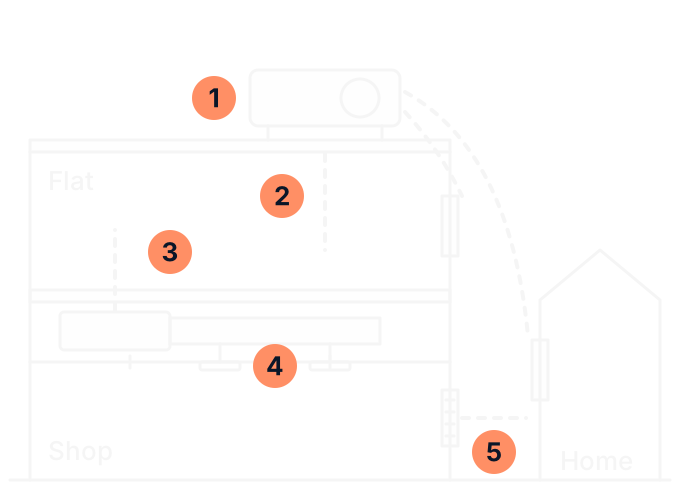
Noise from air conditioning reaches people through the air, through the structure, and through the ceiling space and ducts. Each path has a different fix. You can note all of them from the floor, the street or a window.
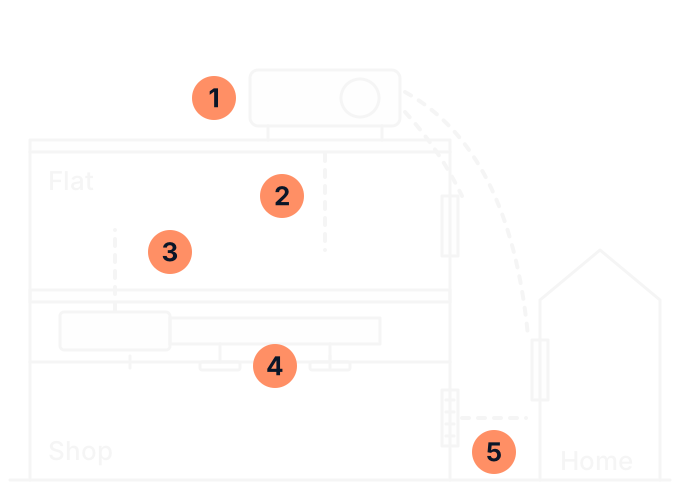
- Outdoor units, through the air: to the nearest windows, in the same building and next door. The sound on site can be higher than the catalogue figure, because of other noise and reflections. Note which way each unit faces and what it faces.
- Through the mounts and the roof: a unit's vibration can travel through its frame or bracket into the floors and walls. Note whether a unit sits on the roof over a flat or on a bracket fixed to a shared wall.
- Indoor units and ducts in the ceiling space: their noise and vibration can travel up through the floor to the rooms above. Note which tenancy the ducts run over.
- The ceiling itself: what blocks or absorbs sound in the ceiling can change in a fit-out. Note any ceiling work and when it was done.
- Openings: louvres, vents and open windows near plant let noise out. Note any that face homes.
What if the air conditioning sounds different from before?
A change in sound is often the first sign that something needs attention: parts work loose, airflow changes or components wear. Some sounds are normal: a soft hiss of refrigerant during cooling or defrost, a drain pump running, and a squeak as plastic parts expand and cool. The manual for the model lists them. A sound that is new, louder or harsher is the one to record.
| What you notice | What to do |
|---|---|
| Banging, grinding or screeching, or any new noise with a burning smell or a tripped breaker | Turn it off as the warning at the top of this guide says, and call. |
| A rattle, buzz or hum that is new or getting louder | Book a service visit, and record it in the meantime. A noise caught early can help prevent a bigger problem later. |
| A whistle at a grille, or a rush of air that was not there before | Record which grille and when. If ceiling or fit-out work has been done, see the next section. |
| A sound the manual lists as normal, unchanged since the system was new | Note it if a neighbour has raised it: it can still matter under the noise rules. |
Write down which unit it comes from, what it sounds like, whether it is steady or starts and stops, the time of day, and what happened just before, such as a service visit, a power cut or building work. Do not open panels or reach into a unit to find the source. The guide to rattling and vibration noise describes the common sounds.
Why is the air conditioning louder after ceiling work?
Ceiling work changes the things around the air conditioning even when nobody touched the unit, and removing a ceiling in an existing building can change its sound insulation. These are the changes that matter:
| What changed | Why the noise can change | What to note |
|---|---|---|
| The ceiling was removed, replaced or left open | Ceiling tiles absorb sound in the room and block sound passing over a wall through the ceiling space. A different tile, or no ceiling, can change both. | Which areas, what the ceiling is now, and the date of the work. |
| New walls or partitions | The supply and return air need a clear path. Where the ceiling space carries the air back to the unit, a new wall built up through it can narrow or block that path, and the air finds another way back, such as rushing through a doorway. Where air has to pass between rooms, a cross talk silencer lets it through while holding back sound. | Where the new walls are, whether they run up through the ceiling, and whether air now rushes through a doorway or a door no longer stays shut. |
| Grilles or ducts moved | Ducts that are poorly supported or bent sharply can vibrate as air moves through them, and a vent that is blocked or partly closed can whistle. The unit's airflow setting is redone when the ducts or outlets change. | Which grilles moved, and any that are now closed or covered. |
| Mounts and connections disturbed | Ducted units usually hang on rods with vibration isolators and join their ducts through a flexible connection. Work around them can undo that, and a new frame or service touching the unit or a duct can carry its vibration. | Whether the noise is a hum or rattle that you can also feel. |
Before the next fit-out, the guide to air conditioning checks before a commercial fitout covers planning the air conditioning into the work.
What can reduce the noise?
EPA Victoria prefers to eliminate the noise (opens in a new tab), and lists other approaches: replacing its cause with something that does not make it, engineering controls, and procedures. For air conditioning, the usual options are:
- Repair and maintenance, where a worn or loose part has made the system louder. EPA Victoria says the ongoing duty (opens in a new tab) includes regular inspections and maintenance, and replacing ageing equipment with quieter options over time.
- Where the plant sits and which way it faces, away from windows that open and bedrooms.
- Vibration isolation under outdoor units and on the rods of indoor units, and flexible connections to ducts.
- Barriers, enclosures and acoustic louvres around outdoor plant, designed with its airflow so the unit can still breathe, and duct silencers for noise in the ductwork.
- A low noise mode. Many outdoor units have a setting that limits their noise, switched on by the installer or by an external control. Cooling and heating performance may drop while it runs, and on some units the noise may not fall in every condition.
- Operating times. Timers or building controls, so plant does not run all night unless it has to.
Which of these suits a site, and whether it is enough, is a question for the assessment, not something anyone can promise in advance.
Planning new or replacement plant?
Settle these questions before the plant is ordered:
- Where will each outdoor unit sit, and which windows will it face? The guide to laying out outdoor units on a commercial roof covers where plant can go.
- Does the model have a low noise mode, and how much cooling and heating does it give up while that mode runs?
- How will it be mounted, and how will its vibration be kept out of the floors and walls?
- Does the planning permit for the premises set conditions about noise?
- Should an acoustic consultant review the plant selection before it is ordered? One Victorian council lists that review, and testing the installed plant (opens in a new tab) before it starts, among the controls for a food and drink business.
Who does what
| Who | What they deal with |
|---|---|
| The business running the plant | The general duty, and the noise from its equipment and contractors. EPA Victoria suggests keeping a log of complaints and what was done. |
| The landlord | Under a retail lease in Victoria (opens in a new tab), the landlord maintains the plant and equipment, such as the air conditioning, in the same condition as when the lease was entered into. That does not cover a repair needed because of the tenant's misuse, or an item the lease entitles or requires the tenant to remove at the end of the lease. |
| The owners corporation | Its common plant, its rules and its complaints process. A complaint starts with the owners corporation's internal process (opens in a new tab). An unresolved dispute can go to VCAT or to the Dispute Settlement Centre of Victoria (opens in a new tab), which offers free dispute resolution, including about noise. |
| An acoustic consultant | The assessment under the Noise Protocol, and advice on controls. |
| An air conditioning technician | Faults, mounts, ducts, settings and a model's low noise options. A technician can tell you whether a fault is making the equipment louder. A service visit does not decide whether the noise meets the rules. |
Noise observation and referral record
Who to call
If the noise is new or has changed, book a service visit first: a fault may be making the system louder. If the system is working as it should and still disturbs a neighbour, or a council, a permit or a complaint needs an answer on the limits, that is the acoustic consultant's job. Give each of them the record.
For how quiet the rooms inside the business should be, see the guide to air conditioning an open plan office.
ABL installs, replaces and maintains air conditioning for businesses in Bairnsdale and East Gippsland. When we look at a noisy system, we check the mounts, the fans, the ducts and the settings, and tell you whether a fault is making it louder than it should be. Our commercial air conditioning page explains how to book. Have the record in front of you when you call.
Sources (28)
- EPA Victoria: commercial, industrial and trade noise, updated 17 March 2026 (opens in a new tab) Checked on 20 November 2026.
- EPA Victoria: prescribed unreasonable noise from commercial, industrial and trade premises, updated 26 February 2026 (opens in a new tab) Checked on 20 November 2026.
- EPA Victoria: unreasonable noise guidelines, legislative noise framework, updated 26 May 2025 (opens in a new tab) Checked on 20 November 2026.
- EPA Victoria: control noise from your business, updated 24 October 2025 (opens in a new tab) Checked on 20 November 2026.
- EPA Victoria: Noise Protocol, publication 1826.5, September 2025 (opens in a new tab) Checked on 20 November 2026.
- EPA Victoria: residential noise, updated 4 November 2026 (opens in a new tab) Checked on 20 November 2026.
- Environment Protection Regulations 2021, authorised version 011, 20 October 2026 (opens in a new tab) Checked on 20 November 2026.
- Environment Protection Act 2017, authorised version 023, 30 June 2026 (opens in a new tab) Checked on 20 November 2026.
- Owners Corporations Regulations 2018, authorised version 002, model rules in Schedule 2 (opens in a new tab) Checked on 20 November 2026.
- Consumer Affairs Victoria: complaint handling and resolving disputes in an owners corporation (opens in a new tab) Checked on 20 November 2026.
- Consumer Affairs Victoria: who to go to for help, updated 22 June 2026 (opens in a new tab) Checked on 20 November 2026.
- Victorian Small Business Commission: repairs and maintenance under a retail lease (opens in a new tab) Checked on 20 November 2026.
- City of Stonnington: understand business noise requirements (opens in a new tab) Checked on 20 November 2026.
- Armstrong Ceilings: total acoustics, NRC and CAC (opens in a new tab) Checked on 20 November 2026.
- Holyoake: cross talk silencers catalogue (opens in a new tab) Checked on 20 November 2026.
- Building Design + Construction: airflow issues in open-plenum office spaces, McGuire Engineers (opens in a new tab) Checked on 20 November 2026.
- Daikin Middle East and Africa: noise levels in air conditioning systems (opens in a new tab) Checked on 20 November 2026.
- ActronAir: commercial split ducted indoor unit installation and commissioning guide, version 8 (opens in a new tab) Checked on 20 November 2026.
- Mitsubishi Electric Australia: PEA-M ducted indoor unit installation manual, September 2023 (opens in a new tab) Checked on 20 November 2026.
- Daikin Europe: FBA-A ducted unit installer reference guide, June 2025 (opens in a new tab) Checked on 20 November 2026.
- Daikin Europe: FCAG-B ceiling cassette installer and user reference guide, July 2025 (opens in a new tab) Checked on 20 November 2026.
- Daikin Europe: RZAG-N outdoor unit installer reference guide, March 2025 (opens in a new tab) Checked on 20 November 2026.
- Fujitsu General: ARTH24 to 36KHTA ducted unit installation manual (opens in a new tab) Checked on 20 November 2026.
- Fujitsu General: AOTH30 to 54KBTA outdoor unit installation manual (opens in a new tab) Checked on 20 November 2026.
- Mitsubishi Electric: City Multi PURY outdoor unit installation manual (opens in a new tab) Checked on 20 November 2026.
- Mitsubishi Electric: City Multi PUHY data book, with installation information (opens in a new tab) Checked on 20 November 2026.
- Australian Government: Triple Zero (opens in a new tab) Checked on 17 November 2026.
- ABL Refrigeration: air conditioning services (opens in a new tab) ABL's own page. Checked on 20 November 2026.
Related pages
- Commercial air conditioning in Bairnsdale and Gippsland
How to book a service or repair visit for a noisy system.
- Laying out commercial air conditioning outdoor units on a roof
Where outdoor plant can go on a commercial roof.
- Air conditioning checks before a commercial fitout or change of use
Planning the air conditioning into ceiling and fit-out work.
Noisy commercial air conditioning?
Call ABL with your noise record to book a service visit for the equipment.
Filled in the record? Copy or print it first: it is not sent with a call or an enquiry.