
Asbestos and air conditioning installation in an older home
Before an air conditioner goes into a home built or renovated before 1990: where the work meets asbestos, who checks it, and a checklist for the quote.
Last updated
If your home was built or renovated before 1990, treat the walls, eaves and ceilings an installer would drill as containing asbestos until a qualified person has checked them. Asbestos in Victoria (opens in a new tab) says a home of that age likely contains it, and that you cannot confirm it by looking. So tell the installer when the house was built before they quote, and show them where the units and pipes would go.
How to use this guide
Step 1: Find where the work goes
The wall, the eaves, the meter box and the ceiling.
Go to Where the work goesStep 2: Fill in the checklist
The age of the house, any report, and photos taken from a step back.
Go to the record
Where does an installation touch the building?
A split system needs a hole through an outside wall for its pipes, cable and drain, fixings for the indoor unit and its bracket, and a new circuit from the switchboard. A ducted system adds openings in the ceiling for each outlet and the return air grille. Taking out an old system can mean lifting a roof unit, removing a flue or patching where an old unit was. Each of these meets a building material.
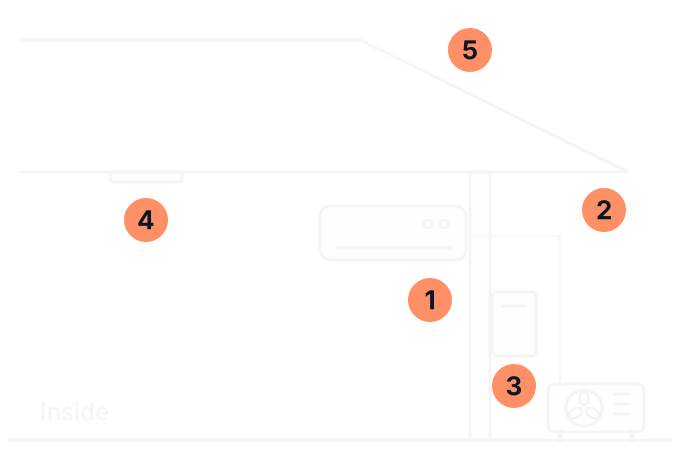
- The outside wall, where the pipes, cable and drain pass through: the cladding outside and the lining inside.
- The eaves, where pipes or a cable can run under the overhang.
- The meter box and switchboard, where the new circuit starts.
- The ceiling, where a ducted system needs openings and cables pass through.
- The roof, where an old roof-mounted unit comes out or a pipe passes through.
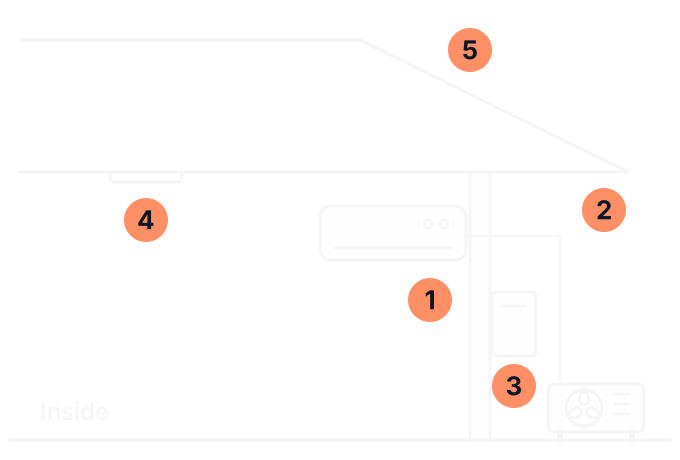
Asbestos in Victoria (opens in a new tab) lists where asbestos is commonly found in homes of that age. The table sets that list against the places an installation reaches. The material may be in any of them, and none can be ruled out by looking.
| Where the work goes | What may contain asbestos there | Tell the installer |
|---|---|---|
| Outside wall | External wall cladding, and the wall lining inside. | What the wall is made of on each side, as far as you know, and whether it has been reclad or relined. |
| Eaves | Eaves linings. Painted, well kept eaves can be asbestos cement and not look it. | Whether the pipes or a cable would run under the eaves. |
| Meter box and switchboard | Older meter and switchboard panels. Most of those that contain asbestos were installed before 1990. | When the switchboard was last replaced, if you know. Do not open the meter box to look. The guide to the electrical work in a quote covers what to note about the board. |
| Ceiling and roof space | Ceilings, and in an older ducted system its heating unit or the lining around it. | Whether a ducted system is planned, and what is in the roof space now. See ducted air conditioning. |
| Roof | Corrugated roof sheets and ridge capping. | Whether an old roof unit comes out, and what the roof is made of. See the guide to replacing evaporative cooling. |
| An old heater or its flue | Flues from older gas heaters. Larger round ones can look like plastic pipe. | Whether an old heater or flue is to be removed as part of the job. |
Bathrooms, kitchens and laundries are on the list too, because of the wall linings behind tiles. An indoor unit rarely goes there, but say so if it would. For taking out an old unit, see the guide to removing an old air conditioner.
Can you tell whether a wall contains asbestos by looking?
No. You cannot confirm asbestos just by looking at a material: only laboratory testing of a sample can tell you definitively. A sheet that is painted, intact and in good condition can still contain it, and a drill bit or a saw is how the fibres get into the air.
Who identifies asbestos before an installation?
Asbestos in Victoria (opens in a new tab) says it is safest to engage a qualified professional to inspect and sample a suspect material, and only a NATA-accredited laboratory can confirm whether it contains asbestos. The professionals it lists are asbestos surveyors, hazardous materials consultants, occupational hygienists and some building surveyors trained in asbestos identification. Its page links to directories of each.
For one pipe hole, a sample or two may be all you need. For a ducted system, or several units through several walls, ask for a survey of the areas the work affects. The professional tells you which. A survey report states:
- the materials found to contain asbestos
- where each one is, and its friability and condition
- what might disturb them
- what the surveyor recommends for managing or removing them
When you contact one, have ready the type of building, where it is, a description and photos of the material, and the work you are planning with its timing. Send them the same photos you send the installer, so both are talking about the same wall.
What does the installer have to do about asbestos?
A home is not a workplace under occupational health and safety law, so a homeowner has no asbestos register. Once you engage someone to work on it, it becomes their workplace, and their duties apply. WorkSafe Victoria (opens in a new tab) and Asbestos in Victoria (opens in a new tab) set those duties out. In short:
- The tradesperson must identify asbestos that is likely to be disturbed before the work starts.
- A power tool must not be used on a material containing asbestos unless the use is controlled, under regulation 216 of the Occupational Health and Safety Regulations 2017. WorkSafe Victoria (opens in a new tab) restated it on 1 September 2026.
- A builder, an electrician or a plumber generally holds no licence to remove asbestos, and the law heavily restricts (opens in a new tab) what they can do with it.
Ask the contractor how they will manage any asbestos they come across, before you accept the quote, and what happens to the day if a material turns out to need testing. When we quote in an older home, we ask when it was built and look at where the pipes, cable and drain would go.
What happens if asbestos is found where the work goes?
There are usually two ways forward, and the first is often simpler:
- Go around it. Another wall, a pipe route that does not pass under the eaves, or a different position for the indoor unit can keep the work away from the material. We look for that first.
- Have it removed first. If the material would be disturbed, Asbestos in Victoria (opens in a new tab) says to engage a licensed asbestos removalist. Friable asbestos needs a Class A licensed removalist. Non-friable asbestos can be removed by a Class A or a Class B licensed removalist.
After licensed removal, the area must be independently inspected and a clearance certificate issued (opens in a new tab) before it is reoccupied. The installation is booked after that, not alongside it. That is how Asbestos in Victoria sets it out, as at November 2026.
How should the quote and the timeline handle asbestos?
Keep the three jobs apart, each with its own price and its own paperwork. That way a delay or a finding in one does not blur what the others cover.
| Stage | Who does it | What you get |
|---|---|---|
| 1. Identify | An asbestos surveyor, a hazardous materials consultant or an occupational hygienist, with a NATA-accredited laboratory. | A laboratory result, or a survey report for the affected areas. |
| 2. Remove, if needed | A licensed asbestos removalist, then an inspector independent of the removalist. | A clearance certificate before the area is used again. |
| 3. Install | The air conditioning installer, and a licensed electrician for the circuit. | The installation paperwork. The guide to the electrical work in a quote covers the paperwork for the circuit. |
In the installation quote itself, look for two things in writing: what it assumes about the materials where the work goes, and what happens if a suspect material turns up once work has started. That second answer should say who stops the work, who arranges the testing and how the day is rebooked.
Check your home and contents policy too: many policies exclude asbestos (opens in a new tab).
What if you rent the home?
Asbestos in Victoria (opens in a new tab) says a rental provider must disclose asbestos that a qualified professional has identified, whether or not the renter asks, and must disclose known asbestos to a prospective renter who asks. A renter should not drill, sand or cut a material that may contain asbestos. If you rent and want an air conditioner, raise it with the rental provider first, and ask what is known about the walls where it would go.
Asbestos checklist before an air conditioning installation
Other questions about asbestos and installation
My house was built after 1990. Do I need to think about this?
The date does not rule it out. 1990 is the line Asbestos in Victoria (opens in a new tab) uses for homes that likely contain asbestos. Use of asbestos was phased out from the mid-1980s, and the final ban came into force on 31 December 2003, WorkSafe Victoria (opens in a new tab) says. If part of the house is older than the rest, or you do not know when a wall or ceiling was put in, tell the installer what you do know.
Can the installer drill one small hole carefully?
Not into a material that may contain asbestos, until it has been identified. The duty to identify comes before the drilling, and a drill is a power tool. If a different spot avoids the material, that is usually the quicker answer. If the result is that it contains asbestos, the hole waits for one of the two ways forward above: another route, or licensed removal first.
Who to call
We install split and ducted systems in Bairnsdale and East Gippsland, including in older homes. Our split system installation page explains how to ask for a quote. Send your checklist and photos with it, and tell us when the house was built. For the rest of the preparation, see the guides to getting your home ready for installation day and standard and non-standard installation.
Sources (15)
Checked on 20 November 2026
- Asbestos in Victoria: homeowner or renovator (opens in a new tab)
- Asbestos in Victoria: where is asbestos? (opens in a new tab)
- Asbestos in Victoria: how to identify asbestos safely (opens in a new tab)
- Asbestos in Victoria: builder and trades (opens in a new tab)
- Asbestos in Victoria: rental provider and renter (opens in a new tab)
- Asbestos in Victoria: permits, notifications and compliance, modified 30 September 2026 (opens in a new tab)
- Asbestos in Victoria: safe removal steps (opens in a new tab)
- WorkSafe Victoria: understand and manage asbestos in workplaces, reviewed 9 May 2024 (opens in a new tab)
- WorkSafe Victoria: safety alert, use of power tools on asbestos, 1 September 2026 (opens in a new tab)
- WorkSafe Victoria: injury hotspots, heating and air conditioning installation, reviewed 26 February 2026 (opens in a new tab)
- Asbestos and Silica Safety and Eradication Agency: asbestos product guide, asbestos cement eaves (opens in a new tab)
- Asbestos and Silica Safety and Eradication Agency: asbestos product guide, electrical fuse and meter board backing (opens in a new tab)
- Asbestos and Silica Safety and Eradication Agency: asbestos product guide, asbestos cement flue pipes (opens in a new tab)
- Asbestos and Silica Safety and Eradication Agency: asbestos product guide, insulated heater banks (opens in a new tab)
- ABL Refrigeration: air conditioning services (opens in a new tab) ABL's own page.
Related pages
- Split system installation in Bairnsdale and East Gippsland
How to ask for a quote, and what to send with it.
- How to prepare your home for air conditioning installation day
Access, power, pets and who makes good afterwards.
- Air conditioning older homes: fabric, routes and upgrades
Routes and choices in an older house.
Planning an installation in an older home?
Tell us when the house was built, and send photos of where the units and pipes would go.
Filled in the record? Copy or print it first: it is not sent with a call or an enquiry.