
Replacing evaporative cooling with refrigerated air conditioning
What changes when an evaporative cooler makes way for refrigerated air conditioning: closed rooms, return air, the old ducts, the roof unit and the trades.
Last updated
Replacing an evaporative cooler with refrigerated air conditioning changes how the house is cooled, not only the unit. An evaporative cooler blows outside air through wet pads into the house, and needs windows open to let it out. A refrigerated system cools the air already inside, with the windows and doors closed, and draws it back through a return air grille. So plan it as a new system: the roof unit, its water and its power are retired, the old ducts and outlets are usually replaced, and the new system is sized for the rooms you want cooled, and heated.
How to use this guide
Step 2: Sort out the old system
Water, power, the roof unit and the ducts each have a trade.
Go to Retiring the old unitStep 3: Fill in the checklist
What is there now, what you want, and who does each part.
Go to the record
What changes when you go from evaporative to refrigerated?
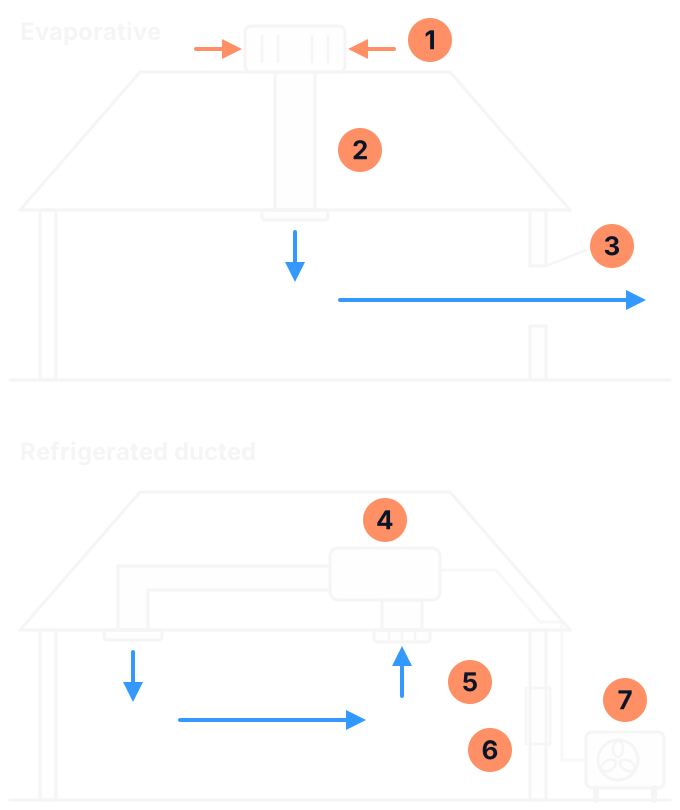
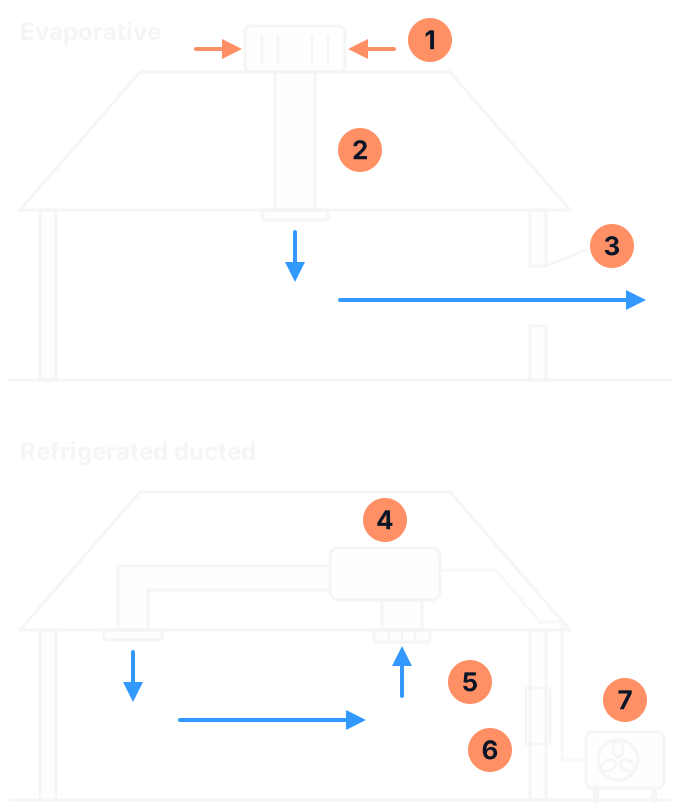
- Evaporative cooler: on the roof, joined to the water supply and the power. It draws outside air through wet pads.
- Duct and ceiling outlet: carry the cooled outside air into each room.
- Open window or door: the air has to leave the house somewhere, so some windows or doors stay open.
- Indoor unit and supply duct: in the roof space. The unit cools or heats the air and pushes it to the outlets.
- Return air grille: draws the room air back to the indoor unit, usually from a hallway ceiling.
- Closed windows and doors: the rooms being cooled are kept closed.
- Outdoor unit: on the ground outside, joined to the indoor unit by refrigerant pipes. It releases the heat taken out of the house.
| What changes | Evaporative cooling | Refrigerated air conditioning |
|---|---|---|
| How it cools | Water evaporating from wet pads cools the outside air drawn through them. | It takes heat out of the air inside and releases it outdoors. |
| The air | Fresh outside air, not recirculated. | The air already in the rooms, drawn back through a return air grille. |
| Windows and doors | Some left open, so the air can leave. | Closed in the rooms being cooled. |
| Humid days | It adds moisture to the air, and cools less when the air outside is already humid. | It usually takes moisture out as it cools, and keeps working on humid days. |
| Heating | None. | A reverse-cycle system heats as well, and Your Home (opens in a new tab), the Australian Government's guide, calls reverse-cycle systems the most energy-efficient you can buy. |
| Water | Connected to the water supply. A whole-house unit can use 25 litres or more an hour on hot, dry days. | None, apart from the water it takes out of the air, which drains away. |
| Winter | Warm air can escape up its ducts unless they are closed off or the roof unit is covered. | The ducts carry the heating, so they are insulated and sealed for it. |
Two habits change with it. Inside the house, air has to get back to the return air grille, through a gap under each door or a grille in or above it, and the designer allows for that. And an evaporative cooler brings in large volumes of outside air, so its use may need to be limited when the air outside is poor, such as during bushfires. A refrigerated system works on the air inside.
Can the evaporative ducts and outlets be reused?
Usually not. Most conversions get new ducts, new outlets and a return air grille, and the old ones come out. These are the reasons:
- Insulation. As at November 2026, the National Construction Code (opens in a new tab) sets a lower minimum insulation for the ductwork of an evaporative system (R1.0) than for one that heats and cools by refrigeration (R1.5), and refrigerated ducts should have a vapour barrier, because cold air in a warm roof space makes condensation.
- Return air. An evaporative system does not draw air back, so the house has no return air grille or duct. A refrigerated ducted system needs one, sized for the unit, usually in a central hallway.
- Relief vents. Some evaporative systems have ceiling vents that let the cooled air out into the roof space. A refrigerated system must not use the roof space as an air path, so those vents are taken out and the ceiling closed.
- Size and age. Ducts are sized for the airflow of the system they serve, and an evaporative cooler moves a lot of air.
Ask the designer which parts, if any, they would keep, and why, and have the answer in the quote. The guide to reusing old ducts with a new air conditioner lists the evidence to ask for on any duct that is kept.
Who retires the evaporative cooler?
Taking out an evaporative cooler touches water, power, the roof and the ceiling, and each has its own trade. Unused water and power connections should be made safe permanently by people licensed to do it, not left live in the roof.
| Part | What happens to it | Who does it |
|---|---|---|
| Water supply | Disconnected and capped, so no live water line is left in the roof. | A licensed plumber. |
| Drain | The cooler's drain usually runs to a waste pipe, a downpipe, a stormwater drain, an absorption pit or, on a tiled roof, a spreader. It comes out or is capped with the unit. | A licensed plumber. |
| Power | The cooler's circuit is disconnected and made safe at the switchboard end. | A licensed electrician. Energy Safe Victoria (opens in a new tab) says electrical installation work goes through a registered electrical contractor. |
| The roof unit | Lifted off the roof and taken away. | Whoever you contract for it. Work with a risk of a fall of more than 2 metres is high risk construction work, and WorkSafe Victoria (opens in a new tab) requires a safe work method statement for it. |
| The roof opening | Closed and made watertight. | As at November 2026, on a metal roof the sheeting and flashing are plumbing work under regulation 25 of Victoria's Plumbing Regulations (opens in a new tab). Re-laying tiles is not, though the flashings can be. |
| Ducts, outlets and relief vents | Taken out of the roof space, the ceiling holes sheeted and finished, and any ceiling insulation moved for them put back. | Agree it in the quote: the new system's installer, or a builder or plasterer. |
Ask whoever quotes the new system which of these lines they cover, and get a price for each of the rest. If the house was built or renovated before 1990, read the guide to installation and asbestos before anything on the roof or in the ceiling is cut.
What should you settle for the new system?
Start from the rooms, not the old layout. A new heat load for the rooms you want cooled and heated sets the size, and the old cooler's size tells you little. These are the decisions:
| Decision | What it depends on |
|---|---|
| Ducted or split systems | Whether you want the whole house heated and cooled, or the few rooms you use most. The guide to single, multi-split or ducted layouts compares them. |
| Zones | Which rooms you use together and at what times. Bedrooms and living areas are often separate zones. |
| Return air | Where the grille can go so air can get back to it from every room. See the guide to supply outlets and return grilles. |
| The outdoor unit | A firm, level spot with air around it, away from bedrooms, yours and your neighbours'. |
| Power | A new circuit from the switchboard. The guide to the electrical work in a quote covers what to have ready. |
| Existing heating | Whether a gas ducted heater or another heater stays, goes, or is replaced by the new system's heating. |
As at November 2026, ABL's published guide is $2,000 to $4,000 for a basic home split system, installed, and from $7,000 to $15,000 or more for a ducted system, depending on the size of the home and its zoning. Your quote is the price, and removing the old cooler is priced on top of it.
On running costs: a refrigerated system usually costs more to run for cooling than an evaporative cooler, which uses a fan, a small pump and water. It also replaces a heater. See ducted air conditioning for how running costs are worked out.
What about a rental property?
As at November 2026, Victoria's rental standards ask for an energy efficient fixed cooler in the main living area at a new agreement, or when one becomes periodic, from 1 March 2027, and in all rentals from 1 July 2030, with exemptions, including where installing one is unreasonable: the guide to rental heating and cooling standards in Victoria covers them. For an evaporative system, Consumer Affairs Victoria (opens in a new tab) says a ducted evaporative cooler in good working order, installed before 1 March 2027, counts as pre-existing fixed cooling, and that when it fails it can be replaced with an identical system. A room evaporative cooler that fails and cannot be repaired is upgraded (opens in a new tab) to an energy efficient fixed cooler.
So a rental provider is not forced to replace a working ducted evaporative system. Choosing refrigerated air conditioning instead is allowed, and the guide for rental providers (opens in a new tab) says an upgrade may receive a Victorian Energy Upgrades discount, subject to eligibility.
Is there a discount for the change?
The Victorian Energy Upgrades (opens in a new tab) program offers a discount on an approved reverse-cycle air conditioner, and the amount depends on what is replaced. An evaporative cooler is not one of the systems listed for decommissioning in the program's activity guide (opens in a new tab). The accredited provider confirms whether a discount applies and how much, before you buy. That is as at November 2026. The guide to rebates in an air conditioning quote has the questions to ask.
Evaporative to refrigerated conversion checklist
Other questions about replacing evaporative cooling
Can I keep the evaporative cooler and add refrigerated air conditioning?
It can stay, but run one or the other, not both. For winter, see the Winter row in the table above, and ask the designer to allow for it.
Does the new system need its own water supply?
No. It makes water as it cools, which runs to a drain. Where that drain goes is planned with the installation: see the guide to planning the condensate drain.
Who to call
We install ducted and split reverse-cycle systems for homes in Bairnsdale and East Gippsland. Our ducted air conditioning page lists what to send for a quote, and our split system installation page covers single rooms. Send your checklist with it, and tell us what is in the roof now.
Sources (23)
- Australian Government, Your Home: heating and cooling (opens in a new tab) Checked on 20 November 2026.
- AIRAH: residential air conditioning best practice guide (Victoria), second edition 2026 (opens in a new tab) Checked on 20 November 2026.
- Seeley International: how evaporative cooling works (opens in a new tab) Checked on 20 November 2026.
- Seeley International: Breezair ducted evaporative cooler owner manual (opens in a new tab) Checked on 20 November 2026.
- Seeley International: reverse cycle and evaporative cooling compared (opens in a new tab) Checked on 20 November 2026.
- Seeley International: Coolair evaporative cooler and relief vents (opens in a new tab) Checked on 20 November 2026.
- Government of South Australia: cooling your home, updated 15 December 2023 (opens in a new tab) Checked on 20 November 2026.
- Australian Building Codes Board: NCC 2025 Housing Provisions, part 13.7 services (opens in a new tab) Checked on 20 November 2026.
- Australian Building Codes Board: NCC 2025 state and territory adoption (opens in a new tab) Checked on 20 November 2026.
- Australian Building Codes Board: NCC 2025 Volume Three, VIC Part E2, heating, ventilation and air conditioning (opens in a new tab) Checked on 20 November 2026.
- Building and Plumbing Commission: practice note MS 05, evaporative coolers, drainage provisions, 14 December 2023 (opens in a new tab) Checked on 20 November 2026.
- Plumbing Regulations 2018 (Victoria), version 010 (opens in a new tab) Checked on 20 November 2026.
- Energy Safe Victoria: working with electrical workers, reviewed 24 January 2025 (opens in a new tab) Checked on 20 November 2026.
- WorkSafe Victoria: safe work method statements for high risk construction work, 6 July 2023 (opens in a new tab) Checked on 20 November 2026.
- Consumer Affairs Victoria: minimum energy efficiency standards, exemptions, updated 26 October 2026 (opens in a new tab) Checked on 20 November 2026.
- Consumer Affairs Victoria: minimum energy efficiency standards, cooling standard, updated 5 June 2026 (opens in a new tab) Checked on 20 November 2026.
- Residential Tenancies Amendment (Minimum Energy Efficiency Standards) Regulations 2025 (Victoria) (opens in a new tab) Checked on 20 November 2026.
- Consumer Affairs Victoria: rental minimum energy efficiency standards, a guide for rental providers, September 2026 (opens in a new tab) Checked on 20 November 2026.
- Victorian Government: Victorian Energy Upgrades heating and cooling discounts, updated 29 October 2026 (opens in a new tab) Checked on 17 November 2026.
- Essential Services Commission: Victorian Energy Upgrades space heating and cooling activity guide, version 3.19, 24 March 2026 (opens in a new tab) Checked on 20 November 2026.
- Daikin Australia: what is ducted zoning? (opens in a new tab) Checked on 20 November 2026.
- EPA Victoria: residential noise, updated 4 November 2026 (opens in a new tab) Checked on 20 November 2026.
- ABL Refrigeration: air conditioning services (opens in a new tab) ABL's own page. Checked on 20 November 2026.
Related pages
- Ducted heating and cooling in Bairnsdale and East Gippsland
What a ducted reverse-cycle system involves, and what to send for a quote.
- Replacing ducts when replacing a ducted unit
The evidence to ask for on any duct that is kept.
- Single, multi-split or ducted: choosing a room-control layout
Whole house or the rooms you use most.
Replacing an evaporative cooler?
Tell us what is in the roof now and which rooms you want cooled and heated, and we will quote the new system.
Filled in the record? Copy or print it first: it is not sent with a call or an enquiry.