
Remote or self-contained display fridges: where the heat goes and who services what
How remote and self-contained display fridges compare on heat in your shop, pipes, plant space, service and stock risk, with a responsibility record.
Last updated
A self-contained display fridge carries its whole refrigeration system inside the cabinet. It usually needs only a power supply, and it puts its heat, and the sound of its compressor, into the room it stands in. A remote display fridge has no compressor or condenser of its own. Refrigerant pipes join it to a condensing unit outside, on a roof or in a plant room, so that heat and noise go there instead. In return, a remote cabinet needs a pipe route, a drain, plant space and a refrigeration designer, and where several cabinets share one plant, a stoppage reaches all of them at once. Neither suits every shop. It comes down to where your heat can go, where pipes and plant can run, who services each part, and what happens to your stock if the plant stops.
How to use this guide
Step 1: Compare the two
Heat, pipes, plant space, service and a breakdown, side by side.
Go to ComparisonStep 2: Fill in the responsibility record
Who owns and services each part, where the heat goes, and the plan if plant stops.
Go to the record
What remote and self-contained mean
The difference is where the condensing unit sits: the compressor, and the condenser that gets rid of the heat. The GEMS determination (opens in a new tab) for refrigerated cabinets calls a cabinet integral if it is designed to have its condensing unit housed within, or directly attached to, the cabinet, and remote if it is not. A self-contained cabinet is what the determination calls integral.
- Self-contained. The compressor, the condenser and the cold coil are all in the cabinet.
- Remote, with its own condensing unit. The cabinet holds the cold coil and its fans. A pair of pipes runs to a condensing unit that serves that cabinet alone.
- Remote, on shared plant. One condensing unit or a central plant serves several cabinets, and often walk-in coolrooms and freezers as well.
The determination puts integral and remote display cabinets in separate product classes, so compare energy figures within one kind, not across the two. The guide to comparing energy ratings and running costs covers that.
How the two compare
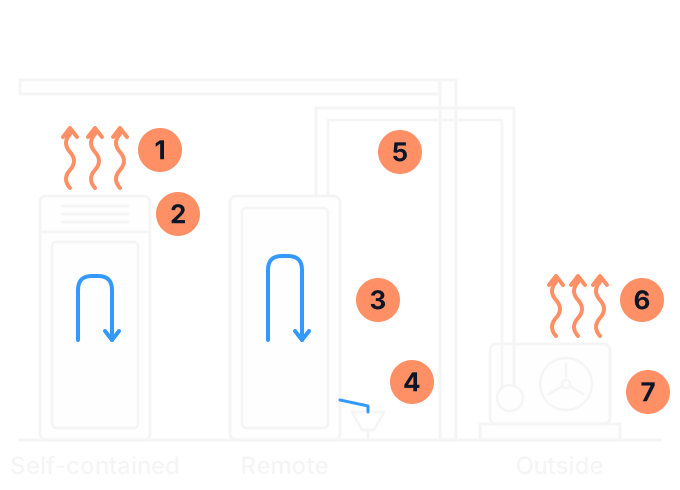
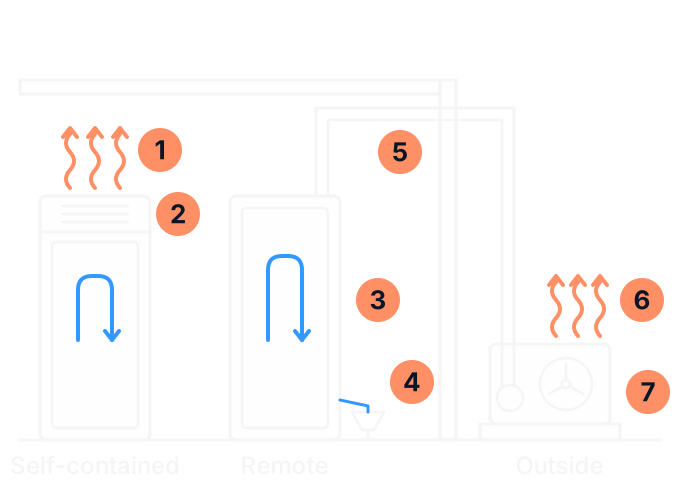
- Heat into the shop. A self-contained cabinet puts the heat it takes out of the cabinet into the room it stands in.
- The self-contained cabinet's refrigeration. It sits inside the cabinet, here at the top. On some cabinets it is at the base. A technician services it at the cabinet, and its grilles need clear air.
- The remote cabinet. It has no compressor or condenser. Its fans, lights and controls are still serviced in the shop.
- The drain. A remote cabinet needs a drain to a waste or a tundish.
- The pipe route. Insulated refrigerant pipes run from the cabinet, through the ceiling space or the floor and the wall, to the plant.
- The condensing unit outside. The remote cabinet's heat leaves here. The unit needs fresh air, away from exhaust outlets.
- Space around the plant. Clear space for air and for service, and a safe way for a technician to reach it.
| Point | Self-contained | Remote |
|---|---|---|
| Where the heat goes | Into the room the cabinet stands in. | To the condensing unit: outside, on a roof or in a plant room. |
| Noise | The compressor runs in the cabinet, in the room. | The compressor's noise goes with the plant, which may be near neighbours. |
| What it needs to run | A power supply. Some cabinets, such as fish cabinets, also need a drain. | Refrigerant pipes to the plant, a drain or tundish, power to the cabinet, a separate supply for the condensing unit, and control wiring. |
| Display space | Part of the cabinet holds the machinery. | No machinery inside, so more of the cabinet can hold stock. |
| Moving it later | Moves within the shop wherever there is power. | Harder to move: its pipes and drain are part of the building. |
| Installation | Placed to the clearances in the manual, usually by the buyer. | Designed and built on site: the plant sized and chosen by a qualified refrigeration designer, and the pipes joined by a licensed refrigeration technician. |
| Service access | Everything is at the cabinet, in the shop. | The cabinet in the shop, and the plant wherever it stands. |
| If the refrigeration stops | That cabinet stops. The others keep running. | With its own condensing unit, that cabinet. On shared plant, every cabinet on it at once. |
| Energy figures | Compared with other integral cabinets of the same kind. | Compared with other remote cabinets, which have product classes of their own. |
No column wins outright. Which suits you depends on the room, the building, the stock and who will look after it, and the manual for each model has the detail.
Where does the heat go?
A display cabinet moves heat out of the cabinet to wherever its condenser is. A self-contained cabinet gives that heat back to the shop, and the air conditioning has to work harder to carry it away. Refrigerated cabinets give off a lot of heat: in a small room without ventilation they make the room hot quickly, and a cabinet working in a hot room uses more electricity and can overheat its compressor motor.
A remote cabinet sends its compressor and condenser heat to the plant. The cabinet itself still runs fans, lights and, on some, heaters in the shop. Heat from the plant can sometimes be recovered, for example to pre-heat hot water, so ask the designer whether that suits your site.
Heat in a commercial kitchen
A kitchen already holds the heat of its cooking. Every self-contained cabinet adds its own, and the kitchen's ventilation or air conditioning has to carry all of it away. Keep cabinets away from ovens, cooktops and other cooking equipment, and from walls that take the sun, and keep their grilles clear. Remote plant takes the compressor and condenser heat out of the kitchen, at the cost of pipes, a drain and plant space.
Check each cabinet is rated for the hottest the room gets on a busy summer day: a class 5 or heavy duty cabinet is tested at 40°C. See the guide to climate classes for buyers. For cabinets that breathe from the front or the back, see the guide to choosing a commercial fridge format.
Does a kitchen exhaust hood affect a display cabinet?
It can, in three ways.
- Moving air upsets the cold air in the cabinet. Display cabinets are sensitive to air currents. Air conditioning outlets, fans, open doors and windows all disturb them, and so does the pull of an extraction hood close by. This holds for remote cabinets too: they still move cold air with their own fans.
- Grease reaches the condenser. A self-contained cabinet near the cooking line draws kitchen air through its condenser. A hood catches much of the grease from fryers and grills, but not all of it. Grease and dust coat the condenser and act like an insulator, so the cabinet works harder to hold its temperature, and the compressor can fail. A greasy kitchen may need its condensers cleaned more often: see refrigeration maintenance.
- Exhaust outlets and outside plant do not mix. A condensing unit needs fresh air and somewhere for its warm air to go. Keep it away from the kitchen exhaust outlet and any steam or hot air discharge.
For draughts on open-fronted cabinets, night covers and cabinets near an entrance, see the guide to open multideck or glass-door displays.
What does a remote cabinet need in pipework and plant space?
- A pipe route. A pair of insulated refrigerant pipes runs from each cabinet to the plant, through a ceiling, a floor or a wall. Shorter is better: a long run with many bends loses capacity and picks up heat on the way.
- A drain. Each remote cabinet needs a drain to a waste or a tundish, laid so it falls the whole way. A plumber connects it, and your council's environmental health team may have requirements for it.
- Power and controls. The condensing unit needs its own power supply, and remote cabinets may need control wiring back to the plant. In Victoria, all fixed electrical installation work needs a licensed electrician, as Energy Safe Victoria (opens in a new tab) sets out.
- Plant space. The condensing unit can stand on the ground, on a wall, on a roof, in a plant room or in a machine room. Wherever it goes, it needs a supply of fresh air, a way for its warm air to leave without coming back, the clear space its manual asks for around it, and above it on a unit that blows upwards, and no steam, hot air or fume exhaust nearby.
- A safe way to reach it. The refrigerant handling code of practice (opens in a new tab) asks designers to give safe access to the entire plant, including its pipework. A unit on a roof needs that as much as one on the ground.
- Quiet neighbours. Mount plant away from homes and other noise-sensitive spaces. EPA Victoria (opens in a new tab) says noise from commercial premises must not be unreasonable or exceed noise limits.
- The landlord. Holes through walls and roofs, and plant on the building, are changes to the premises. Business Victoria (opens in a new tab) says that in most cases you need your landlord's written approval before modifying leased premises.
Sizing and choosing the condensing unit, the pipes and the refrigerant is design work for a qualified refrigeration designer, and it starts from the cabinets, the room and the site. In Australia, work that involves handling a scheduled refrigerant, or a part of the equipment that could release one, needs a refrigerant handling licence, which the Australian Refrigeration Council (opens in a new tab) administers. A self-contained cabinet needs no refrigerant pipes connected, so placing it is normally the buyer's job, following the maker's instructions.
Who owns and services each part?
A self-contained cabinet is one product: one supplier, one warranty, and one place a technician works. A remote system splits into parts that different people supply, install, own and service. Write down who has each part before you sign, so nobody is guessing when something stops.
| Part | Self-contained | Remote |
|---|---|---|
| Cabinet | Supplied as one unit and serviced at the cabinet. | Supplied by the cabinet maker or its supplier. Its fans, lights and controls are serviced in the shop. |
| Condensing unit or plant | Inside the cabinet. | Supplied separately. A qualified refrigeration designer sizes and chooses it, and it is serviced where it stands. |
| Refrigerant pipework | None to connect. | Run and joined on site. Work on it needs a refrigerant handling licence. |
| Power | A power point for each cabinet. Some manuals ask for a circuit of its own. | Power to the cabinets, a separate supply for the plant, and control wiring. Fixed wiring needs a licensed electrician. |
| Drain | Only on some cabinets, such as fish cabinets. | A drain or tundish for each cabinet. |
| Holes, supports and plant space | None beyond a level floor and clear air. | Holes through walls or roofs, pipe supports and a place for the plant. In leased premises, these usually need the landlord's written approval. |
| Warranty | One warranty, from the cabinet maker or supplier. | Separate cover for the cabinet and for the installation. On one maker's terms, the cabinet warranty excludes problems that come from the remote installation, such as leaks or blockages in the pipework. |
In leased premises, settle early who owns the plant, the pipes and the holes when the lease ends. Under a retail lease, the Victorian Small Business Commission (opens in a new tab) says the landlord keeps the plant and equipment that was at the premises, such as the air conditioning system, in the condition it was in when the lease began. That does not cover a repair caused by the tenant's misuse, or items the tenant is entitled or required to remove at the end of the lease. Refrigeration plant you install is usually in that last group, but your lease and the landlord's written consent settle it, and a make good clause (opens in a new tab) can require you to remove the fit-out. See the guide to installing a coolroom in leased premises for the approvals.
What happens to your stock if shared plant stops?
When a self-contained cabinet stops, only its own stock is at risk, and a technician can work on it while the others keep running. A remote cabinet on its own condensing unit is the same. Shared plant is different: every cabinet and room on it depends on one system, so when it stops they all warm at once. On a central system a single leak can lose the refrigerant charge for every cabinet it serves. Separate systems give some redundancy, at the cost of more units to look after.
Potentially hazardous chilled food is kept at 5°C or below, unless the business can show another temperature is safe, and frozen food stays frozen. That is the rule in the food standards (opens in a new tab), and on shared plant it applies to every cabinet on it at the same moment. Before you choose shared plant, plan for that:
- Where the stock from every cabinet on the plant would go, and whether that space holds it all.
- How you would find out after hours: a temperature alarm on the cabinets or the plant that reaches a person. See temperature monitoring.
- Who to call for the plant and who to call for the cabinets, if they are different businesses.
- Whether to split the load across more than one system.
The guide to a commercial refrigeration contingency plan helps you set this up. If a cabinet or the plant has stopped now, go to refrigeration repairs.
Responsibility comparison
What to bring us
Have the record in front of you when you call, or send it with an enquiry, with a sketch or photos of where the cabinets and any outside plant could go. From it we can talk through where the heat, the pipes and the plant could go on your site. ABL supplies commercial refrigeration equipment: see equipment supply. For a cabinet that has stopped or is running warm, see refrigeration repairs.
Sources (24)
Checked on 19 November 2026
- Federal Register of Legislation: Greenhouse and Energy Minimum Standards (Refrigerated Cabinets) Determination 2024 (opens in a new tab)
- Federal Register of Legislation: explanatory statement to the GEMS (Refrigerated Cabinets) Determination 2024 (opens in a new tab)
- Australian Government, energy.gov.au: refrigeration guide for businesses (opens in a new tab)
- Food Standards Australia New Zealand: Safe Food Australia, chapter 3.2.2 (opens in a new tab)
- Australian Refrigeration Council: frequently asked questions (opens in a new tab)
- Australia and New Zealand refrigerant handling code of practice, part 2, 2025 edition (opens in a new tab)
- Energy Safe Victoria: Restricted Electrical Worker's licence, reviewed 1 July 2026 (opens in a new tab)
- EPA Victoria: commercial, industrial and trade noise, updated 17 March 2026 (opens in a new tab)
- Business Victoria: set up your premises, updated 15 September 2022 (opens in a new tab)
- Victorian Small Business Commission: repairs and maintenance (opens in a new tab)
- Victorian Small Business Commission: preparing for end of lease (opens in a new tab)
- ABL Refrigeration: commercial refrigeration services (opens in a new tab) ABL's own page.
- Hillphoenix: self-contained vs remote display case, 11 April 2023 (opens in a new tab)
- Hillphoenix: four reasons self-contained cases suit any store format, 18 January 2023 (opens in a new tab)
- Hillphoenix: distributed refrigeration, the next wave, June 2009 (opens in a new tab)
- Copeland: multiply the advantages of multiplex refrigeration systems, 6 July 2021 (opens in a new tab)
- Danfoss: cold room system design and component selection (opens in a new tab)
- Hussmann: Impact MT merchandiser installation manual, June 2010 (opens in a new tab)
- Williams Refrigeration Australia: operator and user manual, April 2020 (opens in a new tab)
- True Manufacturing: T-series reach-in installation manual, July 2021 (opens in a new tab)
- Heatcraft: condensing units installation and operations manual, September 2026 (opens in a new tab)
- Electrolux Professional: ECOguide to professional refrigeration, 2020 (opens in a new tab)
- Daikin: monoblock refrigeration unit explained (opens in a new tab)
- Foodservice Equipment Reports: clean that condenser, 25 October 2017 (opens in a new tab)
Related pages
- Open multideck or glass-door display refrigeration
How the display front changes draughts, access and energy.
- Commercial fridge climate classes: questions for the supplier
If self-contained cabinets will stand in a hot room.
- A commercial refrigeration contingency plan
Where stock goes if a cabinet or shared plant stops.
Choosing between remote and self-contained cabinets?
Send ABL your responsibility record with an enquiry, or call and talk through where the heat and the plant could go.
Filled in the record? Copy or print it first: it is not sent with a call or an enquiry.